
What Does Et Mean on Toyota Vehicles?

ET on Toyota vehicles stands for Electronic Throttle Control (ETC), a modern system that replaces mechanical throttle linkages with electronic signals. This technology enhances fuel efficiency, improves engine response, and supports advanced safety features like traction control and cruise control.
If you’ve ever glanced at your Toyota’s dashboard or owner’s manual and seen the letters “ET” pop up, you might have wondered what it means. Is it a warning? A feature? Something to worry about? Don’t stress—ET on Toyota vehicles isn’t a cause for alarm. In fact, it’s a sign that your car is equipped with advanced, modern engine technology designed to make your driving experience smoother, safer, and more efficient.
So, what does ET actually stand for? Simply put, **ET means Electronic Throttle Control**. This system has replaced the old-school mechanical throttle cables that once connected the gas pedal directly to the engine’s throttle body. Instead of a physical wire, ET uses electronic sensors, actuators, and a sophisticated network of computers to manage how much air enters the engine. This shift from mechanical to electronic control has revolutionized how vehicles respond to driver input, offering greater precision and integration with other vehicle systems.
You might also hear ET referred to as “drive-by-wire” or “throttle-by-wire.” These terms all describe the same concept: the gas pedal sends an electronic signal to the engine control unit (ECU), which then decides how much to open the throttle based on a variety of factors, including engine load, speed, and driving mode. This level of control allows Toyota to fine-tune performance, improve fuel economy, and support advanced safety and driver-assist technologies.
Key Takeaways
- ET means Electronic Throttle Control: It replaces the traditional cable-driven throttle with electronic sensors and actuators for precise engine management.
- Improved Fuel Efficiency: ET allows the engine control unit (ECU) to optimize throttle input, reducing fuel waste and improving mileage.
- Enhanced Driving Performance: The system delivers smoother acceleration and better throttle response across various driving conditions.
- Supports Advanced Safety Systems: ET integrates with traction control, stability control, and adaptive cruise control for safer driving.
- Common in Modern Toyotas: Most Toyota models from the early 2000s onward use ET, including popular vehicles like the Camry, Corolla, RAV4, and Prius.
- Requires Proper Maintenance: While reliable, the ET system can develop issues like throttle lag or warning lights if sensors or software aren’t maintained.
- Diagnostics via OBD-II: Problems with the ET system can be diagnosed using an OBD-II scanner, often showing codes like P2101 or P2119.
📑 Table of Contents
Understanding Electronic Throttle Control (ET) in Toyota Vehicles
Electronic Throttle Control, or ET, is one of the most important advancements in modern automotive engineering. While it might seem like a small change—replacing a cable with a wire—the impact is huge. In older vehicles, when you pressed the gas pedal, a physical cable pulled open the throttle plate in the engine, allowing more air in and increasing power. It was simple, direct, and reliable, but it lacked flexibility.
With ET, that direct mechanical link is gone. Instead, your gas pedal contains sensors that detect how far and how quickly you press it. This information is sent as an electronic signal to the engine control unit (ECU), the brain of your vehicle. The ECU then processes this input along with data from other sensors—like engine speed, air temperature, and load—and sends a command to an electric motor (called an actuator) to open or close the throttle plate.
This electronic handshake between pedal and engine allows for much more precise control. For example, if you’re driving in snowy conditions, the ECU can reduce throttle response to prevent wheel spin. If you’re cruising on the highway, it can optimize throttle input for maximum fuel efficiency. And if you suddenly need power—like when passing another vehicle—the system can respond instantly.
Toyota has been at the forefront of adopting ET technology. Most of their vehicles from the early 2000s onward use this system, including best-sellers like the Camry, Corolla, RAV4, Highlander, and even hybrid models like the Prius. The widespread use of ET reflects Toyota’s commitment to innovation, safety, and efficiency.
How ET Works: A Step-by-Step Breakdown
To truly appreciate what ET does, let’s walk through how it works in real time:
1. **You Press the Gas Pedal**: When you step on the accelerator, sensors in the pedal measure the position and rate of movement. This data is sent to the ECU.
2. **ECU Processes the Input**: The engine control unit analyzes the pedal input along with other data, such as engine RPM, vehicle speed, and current driving mode (Eco, Sport, etc.).
3. **Throttle Actuator Responds**: Based on the ECU’s calculations, an electric motor opens the throttle plate to the precise angle needed.
4. **Engine Adjusts Power Output**: With the correct amount of air entering the engine, fuel is injected in the right proportion, and combustion occurs efficiently.
5. **Feedback Loop Continues**: The system constantly monitors and adjusts, ensuring smooth, responsive performance.
This entire process happens in milliseconds, so you don’t notice any delay. In fact, many drivers find ET systems feel more responsive than older mechanical setups.
Benefits of ET Over Traditional Throttle Systems
So why did Toyota switch to ET? The answer lies in the many advantages it offers:
– **Better Fuel Economy**: Because the ECU can fine-tune throttle input, it reduces unnecessary fuel consumption. For example, it can prevent over-revving during light acceleration.
– **Smoother Acceleration**: ET eliminates the jerky feel that sometimes comes with mechanical throttles, especially in stop-and-go traffic.
– **Integration with Safety Systems**: ET works seamlessly with traction control, electronic stability control (ESC), and adaptive cruise control. If the system detects wheel slip, it can reduce throttle input instantly to regain traction.
– **Customizable Driving Modes**: Many Toyotas with ET offer driving modes like Eco, Normal, and Sport. In Eco mode, the throttle response is softened to save fuel. In Sport mode, it’s sharpened for quicker acceleration.
– **Reduced Maintenance**: With no throttle cable to stretch or wear out, ET systems require less mechanical maintenance over time.
Common Toyota Models That Use ET
Visual guide about What Does Et Mean on Toyota Vehicles?
Image source: vehiclesauthority.com
You’ll find Electronic Throttle Control in the vast majority of modern Toyota vehicles. This isn’t a luxury feature reserved for high-end models—it’s standard across the lineup. Here are some of the most popular Toyota models that use ET:
– **Toyota Camry**: One of America’s best-selling sedans, the Camry has used ET since the early 2000s. Whether you’re driving a base model or a sporty TRD version, ET ensures smooth and efficient performance.
– **Toyota Corolla**: As Toyota’s compact car icon, the Corolla benefits from ET’s fuel-saving capabilities and responsive handling.
– **Toyota RAV4**: The RAV4, a top choice for SUV buyers, uses ET to balance power and efficiency, especially in hybrid versions.
– **Toyota Highlander**: This midsize SUV uses ET to manage power delivery across three rows of seating and varying cargo loads.
– **Toyota Prius**: As a hybrid pioneer, the Prius relies heavily on ET to coordinate between the gasoline engine and electric motor for optimal efficiency.
– **Toyota Tacoma**: Even in rugged trucks like the Tacoma, ET helps deliver controlled power for towing and off-roading.
– **Toyota Sienna**: The minivan uses ET to provide smooth acceleration for families on the go.
In short, if your Toyota was built after 2000, there’s a very good chance it has ET. Even some late 1990s models began experimenting with early versions of the technology.
How to Identify if Your Toyota Has ET
You don’t need to be a mechanic to know if your Toyota uses Electronic Throttle Control. Here are a few ways to tell:
– **Check the Owner’s Manual**: Look for terms like “Electronic Throttle Control,” “Drive-by-Wire,” or “Throttle-by-Wire.”
– **Look Under the Hood**: If you don’t see a throttle cable connected to the gas pedal (it runs from the pedal to the engine), your car likely uses ET.
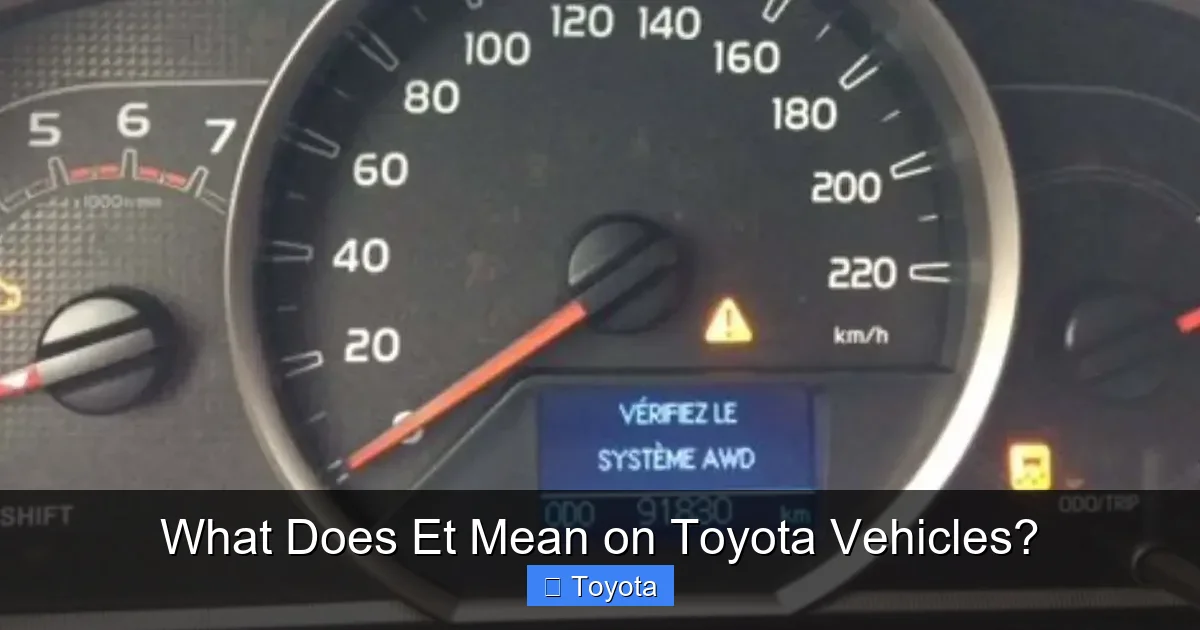
– **Dashboard Warnings**: If your car has a “Check Engine” or “Throttle” warning light, it’s often related to the ET system.
– **OBD-II Scan**: A mechanic or auto parts store can scan your vehicle’s computer for ET-related codes.
Most modern Toyotas will clearly indicate ET in their specifications, so a quick online search of your model and year can confirm it.
Advantages of ET in Everyday Driving
Visual guide about What Does Et Mean on Toyota Vehicles?
Image source: clazwork.com
Now that you know what ET is and where it’s used, let’s talk about how it actually improves your daily driving experience. While it might seem like a behind-the-scenes technology, ET has a real impact on how your Toyota feels and performs.
Improved Fuel Efficiency
One of the biggest benefits of ET is better gas mileage. Because the ECU can precisely control how much air enters the engine, it avoids the inefficiencies of a mechanical throttle. For example, when you gently press the gas pedal in stop-and-go traffic, the ECU can open the throttle just enough to maintain smooth movement without wasting fuel. This is especially helpful in hybrid models like the Prius, where every drop of fuel counts.
Studies have shown that vehicles with ET can achieve up to 5–10% better fuel economy compared to older cable-driven systems. That might not sound like much, but over thousands of miles, it adds up to real savings at the pump.
Smoother and More Responsive Acceleration
Have you ever driven an older car and noticed a slight delay or jerk when you press the gas? That’s often due to the mechanical nature of the throttle cable. With ET, that’s a thing of the past. The system responds instantly to your input, delivering power smoothly and predictably.
This is especially noticeable in city driving, where frequent stops and starts are common. ET ensures that your Toyota accelerates smoothly from a red light or stop sign, without lurching or hesitation. It also helps during highway merging, where quick, confident acceleration is key.
Enhanced Safety Through System Integration
ET isn’t just about performance—it’s also a critical part of your vehicle’s safety systems. Because the ECU controls the throttle electronically, it can work hand-in-hand with other safety technologies.
For example:
– **Traction Control**: If the wheels start to slip on ice or wet pavement, the ECU can reduce throttle input to regain grip.
– **Electronic Stability Control (ESC)**: If the vehicle begins to skid or lose direction, ET can help correct the path by adjusting power to individual wheels.
– **Adaptive Cruise Control**: In Toyotas with this feature, ET helps maintain a safe distance from the car ahead by gently adjusting speed without driver input.
– **Brake Override Systems**: If both the brake and gas pedals are pressed, the ECU prioritizes braking by closing the throttle.
These integrations make ET a silent guardian, working behind the scenes to keep you safe.
Customizable Driving Modes
Many Toyota models with ET offer selectable driving modes that change how the throttle responds. For instance:
– **Eco Mode**: Softens throttle response to maximize fuel efficiency. Great for commuting or long highway drives.
– **Normal Mode**: Balanced performance for everyday driving.
– **Sport Mode**: Sharpens throttle response for quicker acceleration and a more engaging drive.
These modes are possible because ET allows the ECU to interpret your pedal input differently based on your preference. It’s like having multiple cars in one.
Potential Issues and Maintenance Tips for ET Systems
Visual guide about What Does Et Mean on Toyota Vehicles?
Image source: quickeduhelp.com
While ET is reliable and advanced, it’s not immune to problems. Like any electronic system, it can develop issues over time. The good news is that most ET-related problems are preventable with proper care and attention.
Common ET Problems
Here are some issues you might encounter with your Toyota’s ET system:
– **Throttle Lag or Hesitation**: You press the gas, but the car doesn’t respond immediately. This can be caused by dirty throttle bodies, faulty sensors, or software glitches.
– **Check Engine Light**: A common sign of ET trouble. Codes like P2101 (Throttle Actuator Control Motor Circuit Range/Performance) or P2119 (Throttle Closed Position Performance) often point to ET issues.
– **Reduced Power Mode (Limp Mode)**: If the ECU detects a serious problem, it may limit engine power to protect the vehicle. This usually means a warning light and reduced performance.
– **Unintended Acceleration (Rare)**: While extremely rare, software bugs or sensor failures could theoretically cause sudden acceleration. Toyota has implemented multiple safeguards to prevent this.
How to Maintain Your ET System
Keeping your ET system in top shape is easier than you think. Here are some practical tips:
– **Regular Maintenance**: Follow your Toyota’s recommended service schedule. This includes throttle body cleaning every 30,000–50,000 miles.
– **Use Quality Fuel**: Low-quality or contaminated fuel can cause carbon buildup in the throttle body, affecting performance.
– **Avoid Aftermarket Modifications**: Unauthorized throttle controllers or performance chips can interfere with ET operation.
– **Keep Software Updated**: Some ET issues can be resolved with ECU software updates from a Toyota dealership.
– **Watch for Warning Signs**: If you notice hesitation, rough idling, or warning lights, get your car checked promptly.
DIY vs. Professional Help
Some ET maintenance tasks, like cleaning the throttle body, can be done at home with the right tools. However, diagnosing sensor issues or resetting the ECU often requires professional equipment. If your “Check Engine” light comes on, it’s best to visit a certified Toyota technician who can read the codes and perform accurate repairs.
ET and Toyota’s Commitment to Innovation
Toyota’s adoption of Electronic Throttle Control reflects its broader philosophy of continuous improvement and innovation. The company has long been a leader in automotive technology, from hybrid powertrains to advanced safety systems. ET is just one example of how Toyota uses electronics to enhance performance, efficiency, and safety.
In fact, Toyota was one of the first major automakers to widely implement drive-by-wire systems. This early adoption gave them a head start in refining the technology and integrating it with other vehicle systems. Today, ET is so seamless and reliable that most drivers don’t even think about it—until something goes wrong.
But Toyota’s innovation doesn’t stop at ET. The company continues to develop smarter, more responsive systems. For example, newer models feature predictive ET, which uses navigation and traffic data to anticipate driving conditions and adjust throttle response accordingly. This kind of forward-thinking engineering ensures that Toyota remains at the forefront of automotive technology.
The Future of ET in Toyota Vehicles
As vehicles become more connected and autonomous, ET will play an even bigger role. Future Toyotas may use ET to communicate with traffic signals, adjust speed based on road conditions, or even allow remote control via smartphone apps. The electronic nature of ET makes it ideal for integration with next-generation technologies.
Moreover, as Toyota expands its hybrid and electric vehicle lineup, ET will be essential for managing power delivery between electric motors and gasoline engines. In fully electric vehicles, the concept is similar—throttle input controls motor output—but the principles remain the same.
Conclusion: ET Makes Your Toyota Smarter and Safer
So, what does ET mean on Toyota vehicles? It stands for Electronic Throttle Control—a sophisticated system that has transformed how your car responds to your input. By replacing mechanical cables with electronic signals, ET delivers better fuel economy, smoother acceleration, and enhanced safety.
From the Camry to the RAV4, ET is a standard feature in modern Toyotas, quietly working behind the scenes to improve every drive. While it requires some maintenance and can develop issues over time, the benefits far outweigh the risks.
Understanding ET helps you appreciate the engineering that goes into your vehicle. It’s not just a convenience—it’s a key part of what makes Toyota vehicles reliable, efficient, and enjoyable to drive. So the next time you press the gas pedal, remember: that smooth, responsive feel is thanks to ET.
Frequently Asked Questions
What does ET stand for on a Toyota?
ET stands for Electronic Throttle Control, a system that uses electronic signals instead of a mechanical cable to control the engine’s throttle. It improves performance, fuel efficiency, and safety.
Is ET the same as drive-by-wire?
Yes, ET is often referred to as drive-by-wire or throttle-by-wire. These terms all describe the electronic control of the throttle system.
Can I drive my Toyota if the ET system fails?
In most cases, your car will go into “limp mode” with reduced power, allowing you to drive slowly to a repair shop. However, it’s best to avoid driving until the issue is fixed.
How do I know if my Toyota has ET?
Most Toyotas built after 2000 have ET. Check your owner’s manual or look for the absence of a throttle cable under the hood.
What causes ET problems in Toyota vehicles?
Common causes include dirty throttle bodies, faulty sensors, software glitches, or electrical issues. Regular maintenance can prevent many of these problems.
Can I clean the throttle body myself?
Yes, with the right tools and precautions, you can clean the throttle body at home. However, if you’re unsure, it’s safer to have a professional do it.
