Is Toyota Dynamic Navigation Worth It

Contents
- 1 Key Takeaways
- 2 📑 Table of Contents
- 3 What Is Toyota Dynamic Navigation?
- 4 How Does Toyota Dynamic Navigation Work?
- 5 Benefits of Toyota Dynamic Navigation
- 6 Limitations and Drawbacks
- 7 Who Should Consider Toyota Dynamic Navigation?
- 8 Alternatives to Toyota Dynamic Navigation
- 9 Is Toyota Dynamic Navigation Worth It? Final Verdict
- 10 Frequently Asked Questions
Deciding whether Toyota Dynamic Navigation is worth it depends on your driving habits and tech expectations. While it offers real-time traffic, automatic updates, and seamless integration with Toyota vehicles, some users may find smartphone alternatives more flexible and cost-effective.
Key Takeaways
- Real-Time Traffic Updates: Toyota Dynamic Navigation provides live traffic data to help you avoid congestion and save time on your daily commute.
- Automatic Map Updates: Unlike traditional systems, it downloads the latest maps over-the-air, ensuring you always have current road information.
- Integration with Toyota Services: Works seamlessly with Toyota apps like Remote Connect, allowing for remote destination input and vehicle status checks.
- Subscription Required: Full functionality requires a paid subscription after the initial trial period, which can add to long-term ownership costs.
- Better for Long-Distance and Frequent Drivers: Ideal for road trips and regular commuters who benefit from predictive routing and fuel-efficient directions.
- Smartphone Alternatives May Be Simpler: Free apps like Google Maps or Waze offer similar features without subscription fees, making them appealing to budget-conscious drivers.
- Enhanced Safety Features: Voice-guided navigation and hands-free operation help keep your focus on the road, improving driving safety.
📑 Table of Contents
If you’ve ever driven a newer Toyota—like a Camry, RAV4, or Highlander—you’ve probably noticed a sleek infotainment screen with built-in navigation. That’s Toyota Dynamic Navigation, a next-generation system designed to make getting from point A to point B smoother, smarter, and more connected. But what exactly sets it apart from the old-school GPS units or even your phone’s mapping app?
At its core, Toyota Dynamic Navigation is an embedded navigation system that uses cloud-based data to deliver real-time traffic conditions, automatic map updates, and intelligent route suggestions. Unlike older systems that required manual SD card updates or dealership visits, this one connects to the internet (via your phone or built-in cellular modem) to stay current. It’s part of Toyota’s broader Connected Services suite, which also includes remote start, emergency assistance, and vehicle diagnostics.
Think of it as your car’s personal co-pilot—one that doesn’t just tell you where to turn, but also warns you about accidents ahead, suggests faster routes during rush hour, and even lets you send destinations from your phone directly to the car. It’s especially useful if you’re driving in unfamiliar cities, planning long road trips, or simply want a more integrated driving experience.
But here’s the catch: while the hardware is built into many newer Toyotas, full access to Dynamic Navigation features usually requires a subscription after the first few years. That’s where the big question comes in—is it really worth the extra cost? Let’s break it down.
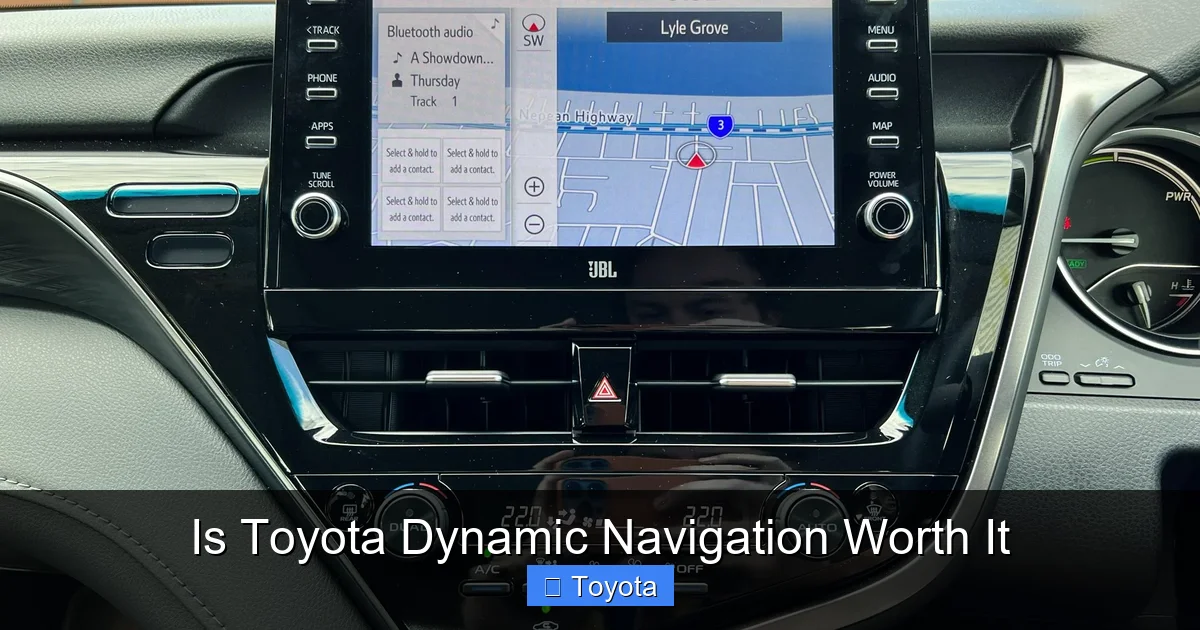
Visual guide about Is Toyota Dynamic Navigation Worth It
Image source: images.carexpert.com.au
To understand whether Toyota Dynamic Navigation is worth it, you first need to know how it actually functions. Unlike standalone GPS devices that rely solely on preloaded maps, this system is deeply connected to the cloud. Here’s how it works in practice.
Cloud-Based Mapping and Real-Time Data
The system pulls map data and traffic information from Toyota’s servers in real time. This means it can detect accidents, road closures, construction zones, and even sudden slowdowns caused by weather or events. When you start your trip, the system analyzes current conditions and suggests the fastest route—not just the shortest one.
For example, imagine you’re driving from downtown Los Angeles to Santa Monica during evening rush hour. A traditional GPS might route you down the 10 Freeway, but if there’s a major accident, Toyota Dynamic Navigation will instantly reroute you through side streets or alternate highways to save time. This kind of responsiveness is a game-changer for daily commuters.
Over-the-Air Map Updates
One of the biggest headaches with older navigation systems was outdated maps. You’d drive into a new neighborhood only to find the roads had changed, or worse—your GPS led you into a dead end. With Dynamic Navigation, map updates happen automatically over the internet. No more visiting the dealership or buying new SD cards.
These updates happen quietly in the background, usually when your car is parked and connected to Wi-Fi or cellular data. You’ll wake up to a system that already knows about new highways, changed speed limits, or updated points of interest like gas stations and restaurants.
Integration with Toyota Apps
Another major advantage is how well it plays with other Toyota services. If you have the Toyota app installed on your phone, you can search for a destination on your smartphone and send it directly to your car’s navigation system. This is especially handy when you’re walking to your vehicle and want to start planning your route early.
You can also use voice commands through Apple CarPlay or Android Auto (if equipped) to interact with the system hands-free. Say, “Hey Siri, navigate to the nearest Starbucks,” and the system will find one and start guiding you—no need to touch the screen while driving.
Predictive Routing and Learning Your Habits
Over time, Toyota Dynamic Navigation learns your driving patterns. If you regularly drive to the gym at 6 a.m. on weekdays or head to your parents’ house every Sunday, the system may start suggesting those routes automatically. It’s not quite AI-level smart, but it does make routine trips more convenient.
For instance, if you always go to the same coffee shop on Monday mornings, the system might pop up a notification: “Head to Brew & Beans? Traffic is light—ETA 12 minutes.” It’s these small touches that make the experience feel personalized.
Now that we know how it works, let’s look at the real-world benefits. Why might someone choose this system over a free app on their phone? Here are the top advantages.
1. Real-Time Traffic Avoidance
This is probably the biggest selling point. Real-time traffic data means the system can reroute you around jams before you even hit them. It uses data from other Toyota vehicles, traffic cameras, and third-party sources like INRIX to give you the most accurate picture of road conditions.
Imagine you’re driving home from work and there’s a 20-minute delay on the highway. Instead of sitting in gridlock, the system suggests a detour through residential streets that shaves 15 minutes off your trip. Over time, those saved minutes add up—especially if you commute daily.
2. Hands-Free Operation and Safety
Using your phone for navigation while driving can be distracting. Even with voice commands, you might glance at the screen to confirm a turn. Toyota Dynamic Navigation is designed to minimize that risk. The voice guidance is clear and timely, and the screen is positioned high on the dashboard for easy viewing without taking your eyes off the road.
Plus, since it’s integrated into the car, you don’t need to worry about your phone dying mid-trip or losing signal in a tunnel. The system uses the car’s power and connectivity, so it’s more reliable in remote areas.
3. Seamless Trip Planning
Planning a road trip? You can use the Toyota app to map out multiple stops—gas stations, rest areas, scenic viewpoints—and send the entire itinerary to your car. The system will guide you from one stop to the next without requiring you to re-enter addresses.
For example, if you’re driving from San Francisco to Lake Tahoe, you can pre-load stops at a winery in Napa, a lunch spot in Sacramento, and a gas station near Truckee. The navigation system will optimize the order and give you turn-by-turn directions for the whole journey.
4. Enhanced Points of Interest (POI)
The system includes a rich database of points of interest, including gas stations, EV charging stations, restaurants, hotels, and even parking garages. You can filter results by rating, price, or distance, making it easy to find exactly what you need.
If you’re driving an electric Toyota like the bZ4X, the system can even show you compatible charging stations and estimate how long it will take to recharge. This level of detail is especially helpful on long trips where range anxiety might be a concern.
5. Remote Destination Input
One of the most convenient features is the ability to send destinations from your phone to your car. Let’s say you’re at work and realize you need to stop by the post office on the way home. Instead of typing the address into your phone while driving, you can do it from your desk using the Toyota app. The destination appears on your car’s screen the moment you get in.
This feature is a lifesaver for busy professionals, parents, or anyone who values efficiency. It also reduces the temptation to handle your phone while driving, which is a major safety win.
Limitations and Drawbacks
Of course, no system is perfect. While Toyota Dynamic Navigation has many strengths, it’s not without its downsides. Let’s be honest about where it falls short.
Subscription Costs Add Up
Here’s the elephant in the room: after the initial trial period (usually 3 years), you’ll need to pay for a subscription to keep full functionality. As of 2024, the cost is around $10–$15 per month, depending on the plan. Over five years, that’s $600–$900—money that could buy a high-end smartphone or a year of premium Spotify.
For some, this is a dealbreaker. Why pay for navigation when Google Maps and Waze are free? These apps offer real-time traffic, voice guidance, and even crowd-sourced incident reports—all without a monthly fee.
Smartphone Alternatives Are Often Better
Let’s face it: your phone is probably smarter than your car’s navigation system. Apps like Google Maps are updated daily, have better search functionality, and integrate with your calendar, email, and contacts. If you’ve ever used Google Maps to find a restaurant your friend mentioned in a text, you know how powerful that integration can be.
Plus, smartphone apps are constantly improving. Features like augmented reality navigation (where arrows appear over live camera footage) or lane guidance are often more advanced than what’s available in-car. And if your phone dies, you can always borrow a charger or use a power bank—options that aren’t as easy with a built-in system.
Connectivity Issues Can Be Frustrating
Since Dynamic Navigation relies on an internet connection, it can struggle in areas with poor cellular coverage. If you’re driving through rural Montana or a mountain pass with spotty service, the system might lose real-time data or fail to load new maps.
While it does cache some data for offline use, it’s not as robust as dedicated offline GPS units. If you frequently drive in remote areas, this could be a significant limitation.
User Interface Can Feel Dated
Even in newer models, the infotainment system can feel a bit clunky compared to modern smartphones. Menus may take a few taps to navigate, and the voice recognition isn’t always as accurate as Siri or Google Assistant. Some users report that entering addresses manually is slower than typing on a phone.
Additionally, not all Toyota models support the latest version of Dynamic Navigation. Older vehicles may have limited features or require hardware upgrades to access full functionality.
Over-Reliance on the System
There’s also a psychological downside: over-reliance on GPS can erode your sense of direction and spatial awareness. If the system fails or gives incorrect directions, you might feel lost or frustrated. It’s always good to have a backup plan—like a paper map or a basic understanding of major roads.
So, who actually benefits from this system? It’s not for everyone, but certain drivers will find it incredibly valuable.
Frequent Commuters
If you drive the same route to work every day, real-time traffic updates can save you significant time. The system learns your routine and can suggest departures earlier or later based on congestion patterns. For someone spending 1–2 hours in the car daily, those saved minutes add up to hours over a year.
Long-Distance Travelers
Road trippers will appreciate the ability to plan multi-stop journeys, find charging stations, and avoid construction zones. The integration with Toyota’s remote services also means you can check your vehicle’s status (like tire pressure or fuel level) from your phone before heading out.
Tech-Savvy Toyota Owners
If you already use Toyota’s app for remote start, lock/unlock, or vehicle health reports, adding Dynamic Navigation makes sense. It creates a unified ecosystem where your phone and car work together seamlessly.
Drivers in High-Traffic Areas
Cities like Los Angeles, New York, or Chicago have unpredictable traffic. A system that can reroute you in real time is a huge advantage. It reduces stress and helps you arrive on time—whether you’re heading to a meeting or picking up your kids from school.
Those Who Value Hands-Free Convenience
If you prefer not to handle your phone while driving, the built-in system offers a safer, more integrated alternative. Voice commands and remote input reduce distractions and keep your focus on the road.
Before you decide to pay for a subscription, consider the alternatives. You might not need it at all.
Google Maps and Waze
These free apps offer real-time traffic, voice navigation, and crowd-sourced updates. Waze, in particular, is great for reporting accidents, police traps, and road hazards. Both apps work offline to some extent and are updated frequently.
Apple CarPlay and Android Auto
If your Toyota supports these systems, you can mirror your phone’s navigation apps directly onto the car’s screen. This gives you the best of both worlds: the familiarity of your phone’s interface with the convenience of in-car display.
Standalone GPS Devices
Devices from Garmin or TomTom offer offline maps, long battery life, and rugged designs. They’re ideal for off-roading or traveling in areas with poor connectivity. While they lack real-time traffic, many models now include basic connectivity features.
Hybrid Approach
Many drivers use a combination: Dynamic Navigation for long trips and smartphone apps for daily driving. This way, you get the benefits of both without paying for features you don’t always need.
So, after weighing the pros and cons, is Toyota Dynamic Navigation worth it? The answer depends on your lifestyle, driving habits, and budget.
If you’re a frequent driver who values real-time traffic, seamless integration, and hands-free convenience, then yes—it’s likely worth the investment. The ability to avoid traffic jams, plan complex trips, and control navigation from your phone adds real value, especially if you spend a lot of time in the car.
However, if you mostly drive short distances, already use Google Maps or Waze, and don’t mind handling your phone occasionally, you might find the subscription cost hard to justify. Free alternatives are powerful, constantly improving, and don’t lock you into a monthly fee.
Ultimately, Toyota Dynamic Navigation shines brightest for long-distance travelers, daily commuters in high-traffic areas, and tech enthusiasts who want a fully connected driving experience. For others, it may be a nice-to-have feature—but not a must-have.
Before committing, take advantage of the free trial period. Test it on your daily routes, try sending destinations from your phone, and see how it handles real-world conditions. If you find yourself relying on it and saving time, it might just be worth the price.
And remember: no navigation system replaces good judgment. Always stay alert, keep your eyes on the road, and use technology as a helpful tool—not a crutch.
Frequently Asked Questions
How much does Toyota Dynamic Navigation cost after the trial?
After the initial 3-year trial, a subscription typically costs $10–$15 per month, depending on the plan and vehicle model. Some packages include additional services like remote start or safety alerts.
Can I use Toyota Dynamic Navigation without a subscription?
Basic navigation functions may still work, but real-time traffic, automatic updates, and remote destination input require an active subscription. Without it, the system functions like a standard GPS with outdated maps.
Does Toyota Dynamic Navigation work offline?
It can cache some map data for offline use, but real-time features like traffic rerouting and live updates require an internet connection. Performance may suffer in areas with poor cellular coverage.
Is Toyota Dynamic Navigation compatible with Apple CarPlay?
Yes, but they work separately. You can use Apple CarPlay for navigation while Dynamic Navigation runs in the background, or choose to use one system at a time.
How often are map updates provided?
Map updates are delivered automatically over-the-air, usually monthly or as needed when new roads or points of interest are added. No manual downloads are required.
Can I cancel my Toyota Dynamic Navigation subscription anytime?
Yes, subscriptions can typically be canceled at any time through the Toyota app or website. However, you’ll lose access to premium features immediately upon cancellation.