
How Much Does It Cost to Charge a Jeep 4xe?

Charging a Jeep 4xe is surprisingly affordable, with most owners spending just $3 to $7 per full charge at home. Depending on electricity rates and driving habits, you could save hundreds annually compared to traditional gas-powered SUVs—making the 4xe a smart, eco-friendly investment.
[FEATURED_IMAGE_PLACEOLDER]
So, you’ve got your eyes on the Jeep 4xe—or maybe you already own one. It’s stylish, rugged, and packed with off-road capability, but what really sets it apart is its plug-in hybrid powertrain. That means you can drive up to 25 miles on pure electric power before the gas engine kicks in. But here’s the big question on everyone’s mind: *How much does it actually cost to charge a Jeep 4xe?*
Let’s be real—nobody wants to buy a cool new vehicle only to get hit with surprise energy bills. The good news? Charging a Jeep 4xe is far cheaper than filling up a traditional gas tank. In fact, most owners report spending just a few dollars per full charge when plugging in at home. But the real cost depends on several factors: where you live, how you charge, and how much you drive.
In this guide, we’ll break down everything you need to know about the cost to charge a Jeep 4xe. We’ll look at real-world electricity rates, compare home vs. public charging, and show you how to maximize your savings. Whether you’re charging in your garage or on a road trip, we’ve got you covered. By the end, you’ll know exactly what to expect—and how to keep your charging costs low.
Key Takeaways
- Home charging is the most cost-effective option: Most Jeep 4xe owners charge at home using a standard 120V outlet or a 240V Level 2 charger, costing between $3 and $7 per full charge.
- Electricity rates vary by location: Charging costs depend heavily on your local utility rates—ranging from under $0.10/kWh in some states to over $0.30/kWh in others.
- Public charging can be pricier: While convenient, public fast chargers often cost more per kWh than home electricity, especially during peak hours.
- You’ll still use some gas: The Jeep 4xe is a plug-in hybrid, so it switches to gasoline after the 25-mile electric range is used, affecting overall fuel economy.
- Time-of-use plans can save money: Switching to a time-of-use (TOU) electricity plan allows you to charge during off-peak hours for lower rates.
- Annual savings add up: Compared to a gas-only SUV, the 4xe can save $500–$1,000 per year in fuel costs, depending on mileage and electricity prices.
- Charging equipment matters: Investing in a Level 2 home charger reduces charging time and improves convenience, though it requires an upfront cost.
📑 Table of Contents
Understanding the Jeep 4xe’s Electric Capabilities
Before we dive into costs, let’s get familiar with what the Jeep 4xe can do. The 4xe is a plug-in hybrid electric vehicle (PHEV), which means it has both an electric motor and a gasoline engine. It’s not a full EV like a Tesla, but it’s more efficient than a standard gas-powered SUV.
The 4xe comes with an 11.4 kWh lithium-ion battery pack. This battery powers the electric motor and gives you an EPA-estimated electric range of about 25 miles. That’s enough for most daily commutes, school runs, or quick errands—all without using a drop of gas.
Once the battery is depleted, the 2.0-liter turbocharged four-cylinder gasoline engine takes over. It works alongside the electric motor to deliver a combined 375 horsepower and 470 lb-ft of torque. That’s serious power for towing, off-roading, or just accelerating onto the highway.
One of the best things about the 4xe is its regenerative braking system. Every time you slow down or brake, the electric motor acts as a generator, capturing energy and sending it back to the battery. This helps extend your electric range and reduces wear on the brake pads.
Now, here’s the key point: because the 4xe can run on electricity for short trips, you’ll rely less on gasoline. That means lower fuel costs and fewer trips to the pump. But to take full advantage of that electric range, you need to charge regularly. And that’s where the cost question comes in.
How Much Does It Cost to Charge a Jeep 4xe at Home?
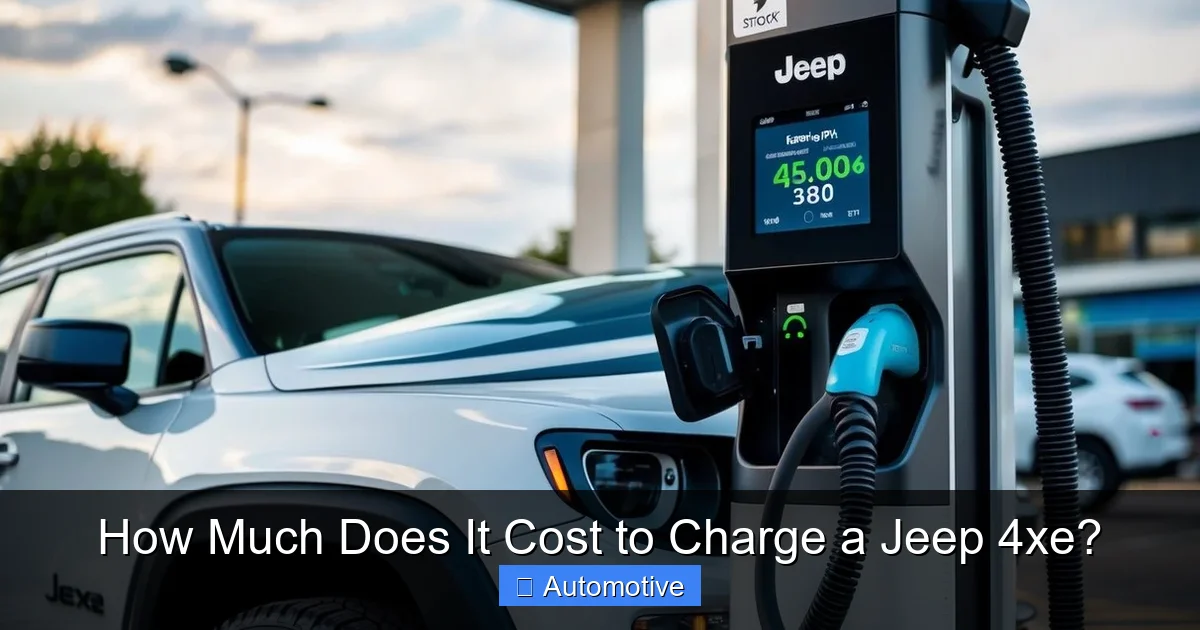
Visual guide about How Much Does It Cost to Charge a Jeep 4xe?
Image source: koala.sh
Let’s get to the heart of the matter: how much does it cost to charge a Jeep 4xe at home? The short answer? Usually between $3 and $7 per full charge. But let’s break that down so you understand where the number comes from.
Your charging cost depends on two main things: the size of the battery and your local electricity rate. The Jeep 4xe has an 11.4 kWh battery. To calculate the cost, you multiply the battery capacity by your electricity rate (measured in cents per kilowatt-hour, or kWh).
For example, if your electricity costs $0.15 per kWh, a full charge would cost:
11.4 kWh × $0.15 = $1.71
Wait—that’s less than $2! So why do we say $3 to $7? Because most people don’t charge from 0% to 100% every time. Also, charging isn’t 100% efficient. Some energy is lost as heat during the charging process. Experts estimate that charging efficiency is around 85–90%, so you might need to pull slightly more than 11.4 kWh from the grid to fully charge the battery.
Let’s adjust for that. If we assume 88% efficiency, you’d need about 12.95 kWh to charge the battery fully:
11.4 kWh ÷ 0.88 = 12.95 kWh
Now, using the $0.15/kWh rate:
12.95 kWh × $0.15 = $1.94
Still under $2. But electricity rates vary widely across the U.S. In states like Louisiana or Washington, rates can be as low as $0.09/kWh. In California or Hawaii, they can exceed $0.30/kWh.
So, let’s look at a few real-world examples:
– **Low-cost area (e.g., Washington State, $0.09/kWh):** 12.95 × $0.09 = $1.17 per charge
– **Average area (e.g., Texas, $0.13/kWh):** 12.95 × $0.13 = $1.68 per charge
– **High-cost area (e.g., California, $0.28/kWh):** 12.95 × $0.28 = $3.63 per charge
Even in expensive areas, a full charge rarely costs more than $4. And if you charge during off-peak hours (more on that later), you could pay even less.
Now, let’s talk about how often you’ll charge. If you drive 25 miles or less per day, you might only need to charge once every 1–2 days. That’s $1.50 to $3.50 every other day—or about $22 to $52 per month. Compare that to a gas-only SUV that gets 20 mpg and drives 1,000 miles per month. At $3.50 per gallon, that’s $175 in gas. The savings are clear.
Charging with a Standard 120V Outlet (Level 1)
Many Jeep 4xe owners start by charging with a standard 120V household outlet—also known as Level 1 charging. It’s convenient because you can plug in almost anywhere. But it’s also the slowest method.
A Level 1 charger typically delivers about 1.4 kW of power. To fully charge the 11.4 kWh battery, it would take roughly 8–10 hours. That’s fine if you’re charging overnight, but not ideal if you need a quick top-up.
The cost is the same as any other method—based on kWh used—but the slow speed means you might not always get a full charge. For example, if you plug in at 8 PM and unplug at 6 AM, you’ll get about 10–12 hours of charging. That’s enough for a full charge, but if you forget to plug in or have a shorter overnight window, you might only gain 10–15 miles of range.
Still, for many drivers, Level 1 is sufficient. If your daily commute is under 20 miles, you can easily recharge overnight and start each day with a full battery.
Upgrading to a 240V Level 2 Charger
If you want faster, more reliable charging, a Level 2 charger is the way to go. These use a 240V circuit (like an electric dryer or oven) and can deliver 6.6 to 7.2 kW of power.
With a Level 2 charger, the Jeep 4xe can go from 0% to 100% in about 2.5 hours. That’s a huge improvement over Level 1. It also means you can top up quickly during the day or after a short trip.
The cost per charge is the same—still based on kWh—but the convenience is worth it for many owners. A Level 2 charger typically costs $500 to $800 for the unit, plus installation. If you hire an electrician, installation can add $300 to $1,000, depending on your home’s electrical setup.
But here’s the good news: many utility companies and states offer rebates or tax credits for installing a Level 2 charger. For example, some programs cover up to 50% of the cost. And since you’ll charge more efficiently and consistently, you’ll get more value from your 4xe’s electric range.
Public Charging: Convenience vs. Cost

Visual guide about How Much Does It Cost to Charge a Jeep 4xe?
Image source: adventurejeep.com
While home charging is the most affordable option, public charging can be useful—especially on road trips or when you’re away from home. But it’s important to know that public charging often costs more than home electricity.
Public charging stations fall into two main categories: Level 2 and DC fast charging. The Jeep 4xe can use both, but it doesn’t support ultra-fast DC charging like some full EVs. Its onboard charger limits DC fast charging to about 50 kW, and even then, it’s not designed for frequent use.
Level 2 Public Charging
Most public charging stations are Level 2, delivering 6.6 to 7.2 kW—similar to a home Level 2 charger. These are commonly found at shopping centers, parking garages, and workplaces.
The cost varies by network and location. Some stations charge by the hour, others by the kWh. On average, public Level 2 charging costs between $0.20 and $0.40 per kWh.
Using our earlier example (12.95 kWh per full charge), that’s:
– At $0.20/kWh: $2.59
– At $0.30/kWh: $3.89
– At $0.40/kWh: $5.18
So, public charging can cost 2–3 times more than home charging. But it’s still cheaper than gas. And if you’re only using it occasionally—like while shopping or at work—it’s a reasonable expense.
Some networks, like ChargePoint or EVgo, offer membership plans that reduce the per-kWh rate. Others let you pay as you go with a credit card or app. Always check the pricing before you plug in.
DC Fast Charging
DC fast charging is faster but less common for PHEVs like the 4xe. It can charge the battery to 80% in about 30–40 minutes. However, frequent fast charging can degrade the battery over time, so it’s best used sparingly.
Public DC fast charging rates are typically higher—often $0.35 to $0.50 per kWh or more. Some networks charge by the minute, which can be expensive if you’re not careful.
For example, a 30-minute fast charge at $0.15 per minute would cost $4.50—even if you only use 8 kWh of energy. That’s inefficient and costly compared to Level 2.
The bottom line? Use public charging when it’s convenient, but don’t rely on it as your primary method. Home charging is almost always cheaper and more reliable.
Factors That Affect Charging Costs

Visual guide about How Much Does It Cost to Charge a Jeep 4xe?
Image source: cdn.myjeepcar.com
Now that we’ve covered the basics, let’s look at the factors that can influence how much it costs to charge a Jeep 4xe. Understanding these will help you save money and get the most out of your vehicle.
Electricity Rates and Time-of-Use Plans
Electricity isn’t priced the same 24/7. Most utilities offer time-of-use (TOU) plans, where rates are lower during off-peak hours (usually overnight) and higher during peak demand (typically 4 PM to 9 PM).
If you charge your 4xe overnight—say, between 10 PM and 6 AM—you could pay 30–50% less per kWh. For example, instead of $0.15/kWh during the day, you might pay $0.10/kWh at night.
To take advantage of this, check with your utility company about TOU plans. Many offer them at no extra cost. Just make sure your charging schedule aligns with the low-rate window.
Some smart chargers or the Jeep app can automatically start charging when rates are lowest. That way, you don’t have to remember to plug in at a certain time.
Driving Habits and Electric Range Usage
How much you drive—and how often you charge—directly affects your costs. If you only drive 10 miles a day, you might only need to charge every other day. But if you drive 50 miles daily, you’ll rely more on gasoline and charge more frequently.
The key is to maximize your electric range. Plan short trips—grocery runs, school drop-offs, coffee stops—on electric power. Save the gas engine for longer drives or highway speeds.
Also, consider your climate. Cold weather reduces battery efficiency and range. In winter, you might get only 15–18 miles of electric range instead of 25. That means more charging and slightly higher costs.
Charging Efficiency and Battery Health
No charging system is 100% efficient. As mentioned earlier, about 10–15% of energy is lost during charging. That’s why we use 12.95 kWh instead of 11.4 kWh in our calculations.
Also, avoid letting the battery sit at 0% or 100% for long periods. Keeping it between 20% and 80% helps prolong battery life. Most drivers charge to 80–90%, which is fine for daily use.
State and Local Incentives
Some states offer incentives for EV and PHEV owners, including reduced electricity rates for charging or rebates on home chargers. For example, California’s Clean Fuel Reward gives up to $1,500 for eligible drivers. Check with your state’s energy office or the Department of Energy’s Alternative Fuels Data Center for current programs.
Real-World Cost Examples
Let’s put it all together with a few real-world scenarios.
Example 1: Daily Commuter in Texas
– Daily drive: 20 miles
– Electricity rate: $0.13/kWh (average for Texas)
– Charging method: Home Level 2 charger
– Charges every night
Cost per charge: 12.95 kWh × $0.13 = $1.68
Monthly cost: $1.68 × 30 = $50.40
Annual cost: $604.80
Compare to a gas SUV (20 mpg, 600 miles/month, $3.50/gallon):
600 ÷ 20 = 30 gallons × $3.50 = $105/month = $1,260/year
Savings: $655 per year
Example 2: Weekend Warrior in California
– Daily drive: 10 miles (electric)
– Weekend trips: 100 miles (gas)
– Electricity rate: $0.28/kWh (peak), $0.18/kWh (off-peak)
– Charges 5 nights/week during off-peak
Cost per charge: 12.95 × $0.18 = $2.33
Weekly cost: $2.33 × 5 = $11.65
Monthly cost: $46.60
Annual cost: $559.20
Gas cost: 100 miles/week × 4 = 400 miles/month
Assuming 25 mpg combined: 16 gallons × $5.00 = $80/month = $960/year
Total annual energy cost: $559 + $960 = $1,519
Compare to gas-only SUV (20 mpg, 800 miles/month):
40 gallons × $5.00 = $200/month = $2,400/year
Savings: $881 per year
Example 3: Road Tripper Using Public Charging
– Charges at home 4 nights/week: $1.68 × 4 = $6.72/week
– Uses public Level 2 twice/week: $3.50 × 2 = $7.00/week
– Monthly cost: ($6.72 + $7.00) × 4 = $54.88
Slightly higher than home-only charging, but still far cheaper than gas.
Tips to Reduce Charging Costs
Want to save even more? Here are some practical tips:
– **Charge during off-peak hours.** Sign up for a TOU plan and charge overnight.
– **Use a Level 2 home charger.** It’s faster and encourages regular charging.
– **Avoid public fast charging unless necessary.** It’s convenient but costly.
– **Precondition the cabin while plugged in.** Use the Jeep app to heat or cool the interior using grid power, not battery.
– **Keep tires properly inflated.** This improves efficiency and range.
– **Drive smoothly.** Aggressive acceleration and braking reduce electric range.
Conclusion
So, how much does it cost to charge a Jeep 4xe? For most owners, the answer is: not much. At home, a full charge typically costs between $1.50 and $4.00, depending on your electricity rate. Over a month, that’s $45 to $120—far less than what you’d spend on gas for a comparable SUV.
While public charging is more expensive, it’s still a viable option for occasional use. And with smart habits—like charging overnight and maximizing your electric range—you can keep costs low and enjoy the benefits of plug-in hybrid driving.
The Jeep 4xe isn’t just about saving money, though. It’s about reducing emissions, enjoying quiet electric driving, and still having the power and capability to go anywhere. Whether you’re commuting to work or exploring the backcountry, the 4xe gives you the best of both worlds.
So plug in, charge up, and hit the road—without worrying about the cost.
Frequently Asked Questions
How much does it cost to charge a Jeep 4xe at home?
Charging a Jeep 4xe at home typically costs between $1.50 and $4.00 per full charge, depending on your local electricity rate. Most owners spend around $3 to $7 per week if charging daily.
Can I charge a Jeep 4xe with a regular outlet?
Yes, you can charge a Jeep 4xe using a standard 120V household outlet (Level 1 charging). It takes about 8–10 hours for a full charge, making it ideal for overnight charging.
Is it cheaper to charge at home or at a public station?
Charging at home is almost always cheaper than public charging. Home electricity rates are typically $0.10–$0.20/kWh, while public stations often charge $0.20–$0.40/kWh or more.
How often do I need to charge my Jeep 4xe?
If you drive under 25 miles per day, you may only need to charge every 1–2 days. Longer commutes will require more frequent charging or reliance on gasoline.
Does cold weather affect charging costs?
Yes, cold weather reduces battery efficiency and electric range, meaning you may need to charge more often. This can slightly increase your overall charging costs in winter months.
Are there rebates for installing a home charger?
Many states and utility companies offer rebates or tax credits for installing a Level 2 home charger. Check with your local energy provider or the Department of Energy for current programs.
