
Did Toyota Buy the 5.7 Engine from Gm

No, Toyota did not buy the 5.7 engine from GM. The Toyota 5.7L V8 (1UR-FE) was developed in-house and shares no design lineage with GM’s engines. Despite rumors, the two engines are entirely independent in origin and engineering.
Key Takeaways
- Toyota’s 5.7L V8 is an in-house design: The 1UR-FE engine was developed entirely by Toyota for use in its trucks and SUVs, with no involvement from General Motors.
- GM’s 5.7L engine is a small-block V8: General Motors’ 5.7L engine, commonly known as the LS1 or later variants, is part of their iconic small-block family and used in performance and truck applications.
- No evidence of licensing or acquisition: There are no official records, patents, or statements confirming that Toyota purchased or licensed the 5.7L engine from GM.
- Design and architecture differ significantly: Toyota’s 1UR-FE uses aluminum construction, DOHC, and variable valve timing, while GM’s 5.7L is typically iron-block, pushrod, and OHV.
- Rumors stem from performance similarities: The confusion likely arises because both engines produce similar horsepower and torque, leading to mistaken assumptions about shared origins.
- Toyota prioritizes reliability and refinement: The 1UR-FE was engineered for durability and smooth operation, aligning with Toyota’s brand reputation, unlike GM’s performance-focused approach.
- Both engines serve different markets: While GM’s 5.7L powers muscle cars and trucks, Toyota’s version is found in luxury SUVs and full-size trucks like the Tundra and Land Cruiser.
📑 Table of Contents
Introduction: The Engine That Sparked a Rumor
Have you ever heard someone say, “Toyota just bought the 5.7 engine from GM”? It’s a claim that pops up in online forums, car meetups, and even casual conversations among gearheads. At first glance, it might seem plausible—after all, both Toyota and General Motors produce powerful 5.7-liter V8 engines. They’re used in trucks, SUVs, and even performance vehicles. But is there any truth to this rumor?
The short answer is no. Toyota did not buy the 5.7 engine from GM. In fact, the two engines are fundamentally different in design, engineering philosophy, and origin. Yet, the myth persists, fueled by confusion over engine displacement, performance numbers, and a lack of public understanding about how automakers develop their powertrains. This article will dive deep into the origins of both engines, clarify the facts, and explain why this rumor gained traction in the first place.
Understanding Toyota’s 5.7L V8: The 1UR-FE Engine
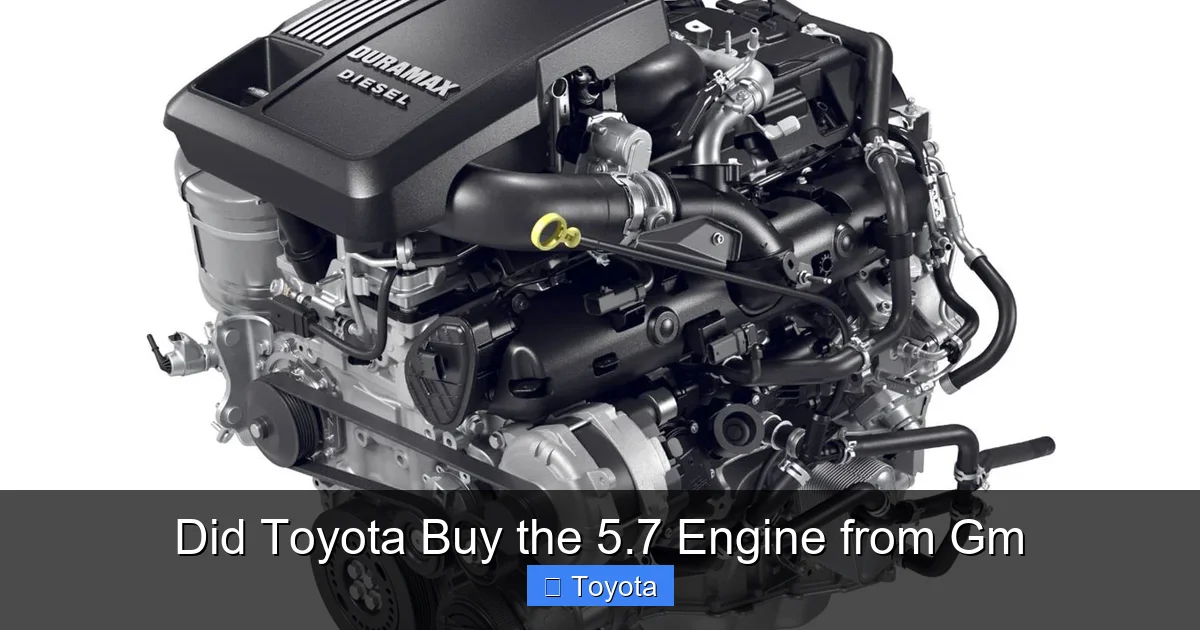
Toyota’s 5.7-liter V8 engine, officially known as the 1UR-FE, made its debut in 2007. It was introduced as part of Toyota’s effort to compete in the full-size truck and SUV market, particularly in North America, where V8 power is highly valued. The engine was designed from the ground up by Toyota’s internal engineering teams, with a focus on reliability, smooth operation, and long-term durability.
Visual guide about Did Toyota Buy the 5.7 Engine from Gm
Image source: gmauthority.com
Design and Engineering Philosophy
The 1UR-FE is a modern overhead cam (OHC) V8 engine with dual overhead camshafts (DOHC) per cylinder bank. It features an all-aluminum construction, which reduces weight compared to traditional iron-block engines. This design choice improves fuel efficiency and helps with weight distribution in vehicles like the Toyota Tundra and Sequoia.
One of the standout features of the 1UR-FE is its use of Variable Valve Timing with intelligence (VVT-i). This technology adjusts the timing of the intake and exhaust valves to optimize performance, fuel economy, and emissions across different driving conditions. It’s a hallmark of Toyota’s engineering approach—prioritizing refinement and efficiency without sacrificing power.
Performance and Applications
The 1UR-FE produces around 381 horsepower and 401 lb-ft of torque in its most common configuration. These numbers are competitive with other V8 engines in its class, but what sets it apart is how that power is delivered. The engine is known for its smooth, linear power band and quiet operation—qualities that align with Toyota’s reputation for building dependable, comfortable vehicles.
This engine powers several of Toyota’s flagship models, including:
- Toyota Tundra (2007–2021)
- Toyota Sequoia (2008–2022)
- Lexus LX 570 (2008–2021)
- Toyota Land Cruiser (2008–2021)
These vehicles are often used for towing, off-roading, and long-distance travel—applications where reliability and low-end torque are critical. The 1UR-FE was engineered to meet these demands, with a robust internal structure, forged connecting rods, and a durable crankshaft.
Why Toyota Developed Its Own 5.7L Engine
Toyota has a long history of developing its own engines in-house. From the legendary 2JZ in the Supra to the efficient 2AR-FE in the Camry, Toyota prefers to control its powertrain technology rather than rely on outside suppliers. This allows the company to tailor engines to its specific vehicle platforms and brand values.
When Toyota decided to enter the full-size truck market in the U.S., it needed a powerful, reliable V8 to compete with Ford’s 5.4L Triton, Chevrolet’s 6.0L Vortec, and Dodge’s 5.7L HEMI. Rather than license an existing engine or partner with another manufacturer, Toyota invested in developing the 1UR-FE from scratch. This decision reflects Toyota’s engineering independence and long-term strategy.
GM’s 5.7L Engine: The Small-Block Legacy
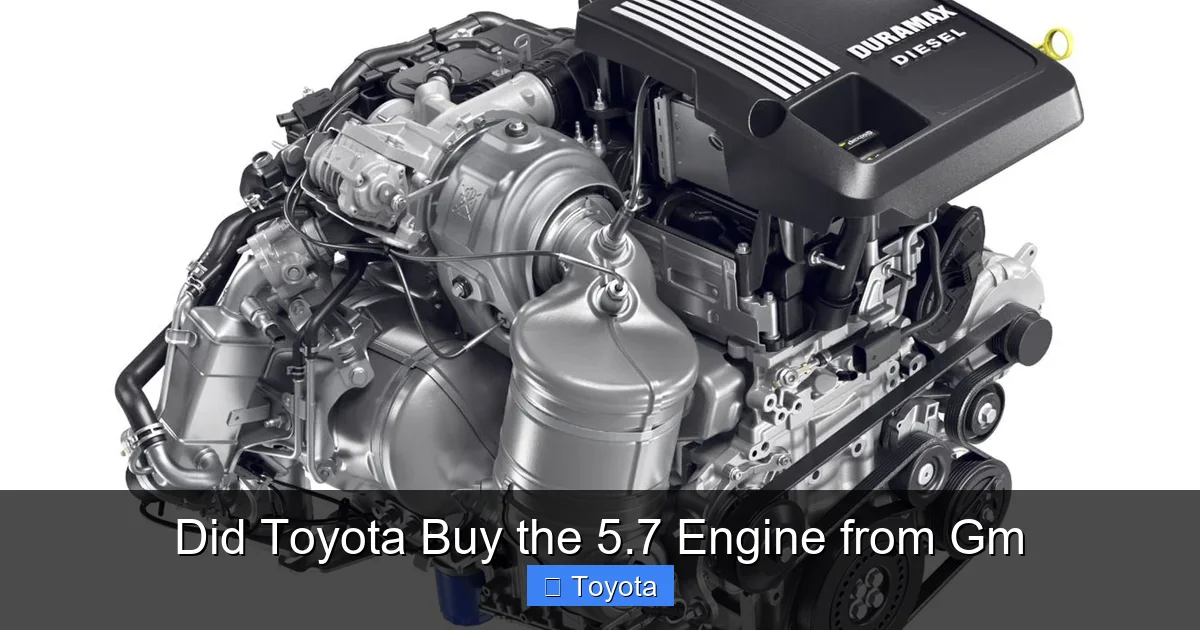
On the other side of the rumor is General Motors’ 5.7-liter V8 engine. Unlike Toyota’s modern DOHC design, GM’s 5.7L is part of the iconic small-block engine family, which has been in production since the 1950s. The most famous variant is the LS1, introduced in 1997 for the Chevrolet Corvette and later used in a wide range of GM vehicles.
Visual guide about Did Toyota Buy the 5.7 Engine from Gm
Image source: gmauthority.com
The LS Engine Family
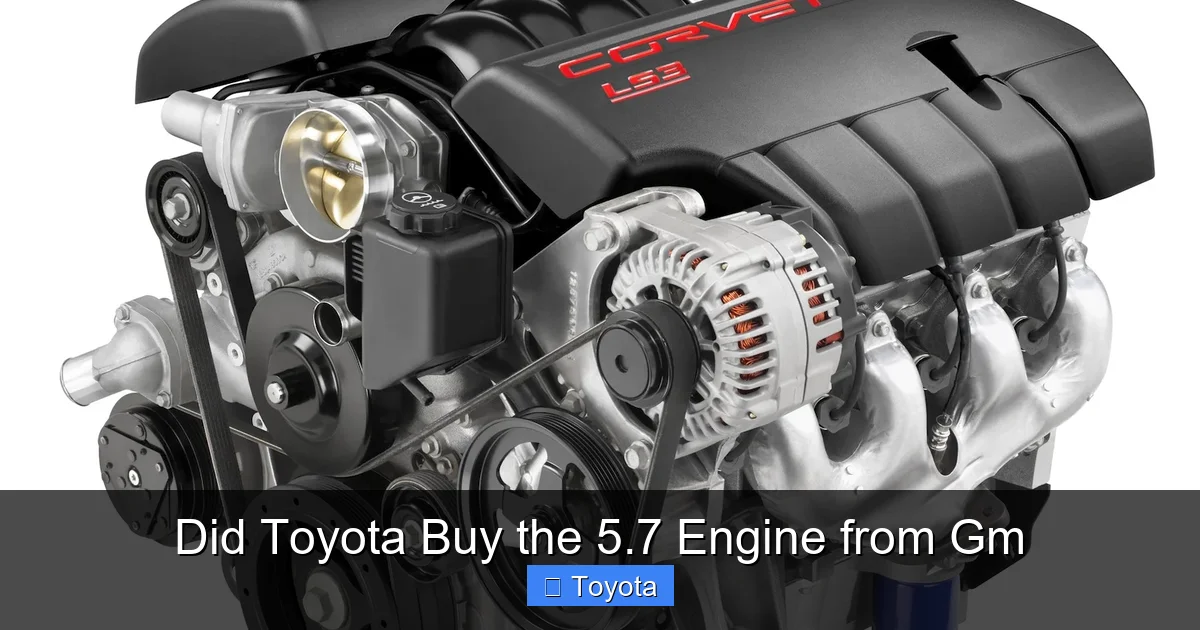
The LS1 and its successors (like the LS2, LS3, and L96) are based on GM’s Gen III and Gen IV small-block architecture. These engines are known for their compact size, lightweight design, and exceptional performance potential. Most LS engines use an overhead valve (OHV) configuration with a single camshaft in the engine block and pushrods to actuate the valves.
Despite their simpler design compared to DOHC engines, LS engines are incredibly popular in the performance and racing communities. They’re easy to modify, widely available, and capable of producing massive power with aftermarket support. The 5.7L LS1, for example, originally produced around 345 horsepower in the Corvette, but can easily exceed 500 horsepower with minor upgrades.
Applications and Cultural Impact
GM’s 5.7L engine has powered some of the most iconic American performance cars, including:
- Chevrolet Corvette (C5, 1997–2004)
- Chevrolet Camaro (1998–2002)
- GMC Sierra and Chevrolet Silverado (various model years)
- Holden Commodore (Australia)
The engine’s versatility and performance have made it a favorite among car enthusiasts. Swapping an LS engine into non-GM vehicles—a practice known as an “LS swap”—is a common modification in the custom car world. This popularity has helped spread awareness of the 5.7L engine, sometimes leading to confusion with other manufacturers’ engines.
Engineering Differences from Toyota’s 5.7L
While both engines displace 5.7 liters, their internal designs are nearly opposite. GM’s 5.7L uses a pushrod OHV layout, which is simpler and more compact but limits high-RPM performance compared to DOHC designs. Toyota’s 1UR-FE, with its dual overhead cams and variable valve timing, is better suited for high-revving applications and emissions compliance.
Additionally, GM’s small-block engines often use iron blocks in truck applications (like the Vortec 5700), while Toyota’s 1UR-FE is always aluminum. This difference affects weight, cooling, and manufacturing cost. Toyota’s choice of aluminum reflects its focus on fuel efficiency and modern engineering, while GM’s iron-block approach prioritizes strength and cost-effectiveness for heavy-duty use.
Debunking the Myth: Why the Rumor Exists
So why do people believe Toyota bought the 5.7 engine from GM? The rumor likely stems from a combination of factors, including similar engine sizes, overlapping performance figures, and a general lack of public knowledge about engine development.
Visual guide about Did Toyota Buy the 5.7 Engine from Gm
Image source: gmauthority.com
Similar Displacement and Power Output
Both engines are 5.7 liters and produce roughly 350–400 horsepower in stock form. This similarity can lead to assumptions that they’re related or even the same engine. However, displacement alone doesn’t indicate shared design or origin. Many automakers produce engines of similar size for competitive reasons.
Misinformation in Online Communities
Car forums and social media platforms are rife with speculation and half-truths. A comment like “I heard Toyota uses GM engines” can spread quickly, especially if it’s repeated without verification. Over time, these claims become accepted as fact, even when there’s no evidence to support them.
Lack of Transparency in Engine Sourcing
Some automakers do share engines or collaborate on powertrains. For example, Toyota and Subaru jointly developed the 86/BRZ sports car, and Ford and Mazda have shared engine technology in the past. This history of collaboration may lead people to assume that Toyota and GM have a similar arrangement—even though there’s no record of such a partnership.
Confusion with Other Toyota Engines
Toyota has used engines from other manufacturers in the past, particularly in smaller vehicles. For instance, some early Toyota models in Europe used diesel engines from BMW. However, these were exceptions, not the rule. Toyota’s core lineup—especially its trucks and SUVs—relies on in-house engines.
No Official Evidence of Acquisition
Despite extensive research, there are no patents, press releases, or financial records indicating that Toyota purchased or licensed the 5.7L engine from GM. Both companies have well-documented engine development histories, and neither has ever claimed ownership of the other’s technology.
Toyota’s Engine Development Strategy
To fully understand why Toyota didn’t buy the 5.7 engine from GM, it’s important to look at Toyota’s broader approach to engine development. The company is known for its vertical integration—designing and manufacturing most of its components in-house. This strategy gives Toyota greater control over quality, cost, and innovation.
In-House Engineering Excellence
Toyota’s powertrain division, part of its broader R&D efforts, employs thousands of engineers dedicated to engine design, testing, and refinement. The company invests heavily in research, including advanced materials, combustion efficiency, and hybrid technology. The 1UR-FE is a product of this investment, reflecting decades of internal expertise.
Focus on Reliability and Longevity
One of Toyota’s core brand values is reliability. The 1UR-FE was engineered to last hundreds of thousands of miles with minimal maintenance. Features like forged internals, advanced cooling systems, and conservative tuning all contribute to this goal. In contrast, GM’s 5.7L engines, while durable, are often tuned for higher performance and may require more maintenance under heavy use.
Global Platform Strategy
Toyota designs its engines to work across multiple vehicle platforms and markets. The 1UR-FE, for example, is used in both the U.S.-market Tundra and the global Land Cruiser. This global approach requires engines that can meet diverse regulatory standards and driving conditions—something that would be difficult to achieve with a licensed engine from another manufacturer.
The Future of Toyota’s V8 Engines
As the automotive industry shifts toward electrification, the future of large-displacement V8 engines is uncertain. Toyota has already begun phasing out the 1UR-FE in favor of newer powertrains, including turbocharged V6 engines and hybrid systems.
Transition to Newer Powertrains
In 2022, Toyota introduced a new 3.4-liter twin-turbo V6 engine (V35A-FTS) to replace the 5.7L V8 in the Tundra and Sequoia. This engine produces similar power and torque while offering better fuel economy and lower emissions. It’s part of Toyota’s broader strategy to reduce carbon emissions without sacrificing performance.
Hybrid and Electric Options
Toyota is also investing heavily in hybrid and electric technology. The Tundra i-FORCE MAX combines the new V6 engine with an electric motor to deliver over 437 horsepower and improved towing capacity. This hybrid system represents the next evolution of Toyota’s powertrain philosophy—blending internal combustion with electric efficiency.
Legacy of the 1UR-FE
Even as Toyota moves away from the 5.7L V8, the 1UR-FE will be remembered as a reliable, smooth, and capable engine. It helped establish the Tundra as a serious competitor in the full-size truck market and reinforced Toyota’s reputation for building durable vehicles. Its legacy lives on in the vehicles it powered and the owners who continue to drive them.
Conclusion: Setting the Record Straight
The rumor that Toyota bought the 5.7 engine from GM is just that—a rumor. There is no factual basis for the claim, and the evidence clearly shows that Toyota developed its 5.7L V8 engine independently. The 1UR-FE is a product of Toyota’s in-house engineering, designed to meet the specific needs of its trucks and SUVs.
While both Toyota and GM produce 5.7-liter V8 engines, they are fundamentally different in design, purpose, and philosophy. Toyota’s engine prioritizes reliability and refinement, while GM’s focuses on performance and versatility. Understanding these differences helps clarify why the two companies took separate paths in engine development.
As the automotive world evolves, it’s important to rely on accurate information and avoid spreading myths. The next time someone asks, “Did Toyota buy the 5.7 engine from GM?” you can confidently say no—and explain why.
Frequently Asked Questions
Did Toyota ever use GM engines in any of its vehicles?
No, Toyota has not used GM engines in its mainstream vehicles. While Toyota has occasionally partnered with other manufacturers for specific models (like the Toyota 86 with Subaru), there is no record of Toyota using GM engines in its trucks or SUVs.
Are Toyota’s 5.7L and GM’s 5.7L engines interchangeable?
No, the engines are not interchangeable. They have different mounting points, transmissions, electronics, and physical dimensions. Swapping one for the other would require extensive modifications and is not practical for most owners.
Which engine is more reliable: Toyota’s 5.7L or GM’s 5.7L?
Toyota’s 1UR-FE is generally considered more reliable for long-term, low-maintenance use, especially in heavy-duty applications. GM’s 5.7L engines are durable but often tuned for higher performance, which can increase wear over time.
Why do both engines have the same displacement?
Engine displacement is often chosen to meet market demands and compete with rivals. Both Toyota and GM developed 5.7L engines to compete in the full-size truck and performance car segments, where this size offers a good balance of power and efficiency.
Will Toyota bring back the 5.7L V8 engine?
It’s unlikely. Toyota has shifted focus to turbocharged V6 and hybrid powertrains, which offer similar performance with better fuel economy and lower emissions. The 5.7L V8 is being phased out in favor of these newer technologies.
Can you increase the power of Toyota’s 5.7L engine?
Yes, the 1UR-FE can be modified for more power, though it’s less popular in the performance community than GM’s LS engines. Upgrades like cold air intakes, exhaust systems, and engine tuning can yield modest gains, but major power increases require internal modifications.
