
How Much Hp Does a Honda Civic Type R Have?

The Honda Civic Type R is a high-performance hot hatch renowned for its impressive horsepower output. Depending on the model year and generation, it delivers between 306 and 329 horsepower, making it one of the most powerful front-wheel-drive production cars ever built.
Key Takeaways
- Horsepower varies by generation: The latest FL5 Civic Type R (2023–present) produces 315 hp, while earlier models like the FK8 (2017–2021) made 306 hp.
- Turbocharged 2.0L engine: All modern Type Rs use a high-revving, turbocharged 2.0-liter inline-four engine designed for track and street performance.
- Front-wheel-drive dominance: Despite being FWD, the Type R’s advanced aerodynamics and limited-slip differential allow it to handle high power without excessive torque steer.
- Real-world performance: With 0–60 mph times under 5 seconds, the Type R rivals many rear-wheel-drive sports cars in acceleration.
- Aftermarket tuning potential: Enthusiasts often upgrade the turbo, intake, and ECU to push horsepower beyond 400 hp reliably.
- Track-focused engineering: Honda tunes the Type R for circuit use, with features like Brembo brakes, adaptive suspension, and a lightweight chassis.
- Global availability: While horsepower ratings are consistent worldwide, emissions regulations may slightly affect torque delivery in certain markets.
📑 Table of Contents
- How Much HP Does a Honda Civic Type R Have?
- The Evolution of the Honda Civic Type R’s Horsepower
- Under the Hood: The Engine That Powers the Type R
- Real-World Performance: What Does 300+ HP Feel Like?
- Aftermarket Tuning: Can You Get More Than 315 HP?
- Comparing the Type R to the Competition
- Is the Honda Civic Type R Worth the Hype?
How Much HP Does a Honda Civic Type R Have?
If you’re into performance cars, you’ve probably heard the name *Honda Civic Type R* whispered with reverence at car meets, track days, or even just scrolling through social media. This isn’t just another compact car with a loud exhaust—it’s a full-blown performance machine that punches far above its weight class. But the big question on everyone’s mind is: *How much HP does a Honda Civic Type R have?*
The short answer? It depends on the generation. But across all modern iterations, the Civic Type R consistently delivers over 300 horsepower from a compact, front-wheel-drive hatchback—something that was once considered nearly impossible. From the FK8 generation (2017–2021) to the latest FL5 (2023–present), Honda has refined the formula, squeezing more power, better handling, and sharper responsiveness out of every update.
What makes the Type R special isn’t just the horsepower number—it’s how that power is delivered. Unlike many turbocharged cars that feel sluggish off the line, the Type R’s engine revs eagerly, responds instantly to throttle input, and keeps pulling hard all the way to the redline. It’s a car that rewards skilled drivers, whether you’re carving up mountain roads or setting lap times at your local track.
In this article, we’ll break down the horsepower output across every major Civic Type R generation, explore the engineering behind that power, and show you what it really means when you press the accelerator. Whether you’re a longtime Honda fan or just curious about what makes this hot hatch so legendary, you’re in the right place.
The Evolution of the Honda Civic Type R’s Horsepower
Visual guide about How Much Hp Does a Honda Civic Type R Have?
Image source: cdn.autopapo.com.br
To truly understand how much HP the Honda Civic Type R has, we need to take a quick trip through its recent history. The Type R badge has been around since the late 1990s, but the modern era really began with the FK2 generation in 2015. That model introduced the now-iconic 2.0-liter turbocharged engine, marking a shift from naturally aspirated power to forced induction—and a huge jump in performance.
FK2 Generation (2015–2017): The Turbocharged Revolution
The FK2 Civic Type R was a game-changer. It was the first Type R to use a turbocharged engine, ditching the high-revving VTEC engines of the past for a modern, efficient, and powerful 2.0-liter inline-four. This engine produced **306 horsepower** and **295 lb-ft of torque**, which was a massive leap from its predecessor.
What made the FK2 special wasn’t just the power—it was how Honda packaged it. The engine was mounted transversely (like most front-wheel-drive cars), but Honda used a clever dual-axis strut front suspension to reduce torque steer, a common issue in high-power FWD vehicles. The result? A car that could put down over 300 hp without tearing itself apart under hard acceleration.
The FK2 also introduced a six-speed manual transmission—no automatics, no CVTs. Honda believed that driving enthusiasts wanted full control, and they delivered with a gearbox that had short, precise shifts and a clutch that felt connected and communicative.
FK8 Generation (2017–2021): Refinement and Record-Breaking Performance
The FK8 Civic Type R took everything the FK2 did and made it better. Horsepower remained at **306 hp**, but torque increased slightly to **295 lb-ft**, and Honda made significant improvements to aerodynamics, cooling, and chassis rigidity.
This generation became famous for setting a front-wheel-drive lap record at the Nürburgring Nordschleife in 2017, completing the 12.9-mile circuit in just 7 minutes and 43.8 seconds. That record stood for years and proved that the Type R wasn’t just a street car—it was a legitimate track weapon.
One of the key upgrades in the FK8 was the addition of a more aggressive front splitter, a larger rear wing, and underbody diffusers. These aerodynamic enhancements increased downforce, allowing the car to corner at higher speeds without losing grip. The suspension was also retuned for better compliance over rough surfaces, making it more usable on public roads.
Horsepower stayed the same, but drivability improved dramatically. The engine had a broader power band, meaning you didn’t have to rev it as high to access peak torque. This made daily driving more relaxed, while still offering explosive performance when needed.
FL5 Generation (2023–Present): The Most Powerful Type R Yet
The latest Civic Type R, known as the FL5, arrived in 2023 with a refreshed design, improved technology, and—most importantly—a bump in power. The FL5 produces **315 horsepower** and **310 lb-ft of torque**, making it the most powerful production Civic Type R ever built.
This increase comes from a combination of engine tuning, improved turbo efficiency, and better cooling. Honda also refined the intake and exhaust systems to reduce backpressure and improve airflow. The result is an engine that feels even more responsive and eager to rev.
The FL5 also benefits from a lighter chassis, thanks to increased use of high-strength steel and aluminum components. This reduces overall weight, improving both acceleration and handling. The suspension has been retuned again, with new dampers and bushings that offer a better balance between comfort and track capability.
One of the most exciting changes in the FL5 is the updated infotainment system and driver-assistance features. While purists might grumble about added tech, features like adaptive cruise control and lane-keeping assist make the Type R more practical for daily use—without sacrificing its performance soul.
Under the Hood: The Engine That Powers the Type R

Visual guide about How Much Hp Does a Honda Civic Type R Have?
Image source: motortrend.com
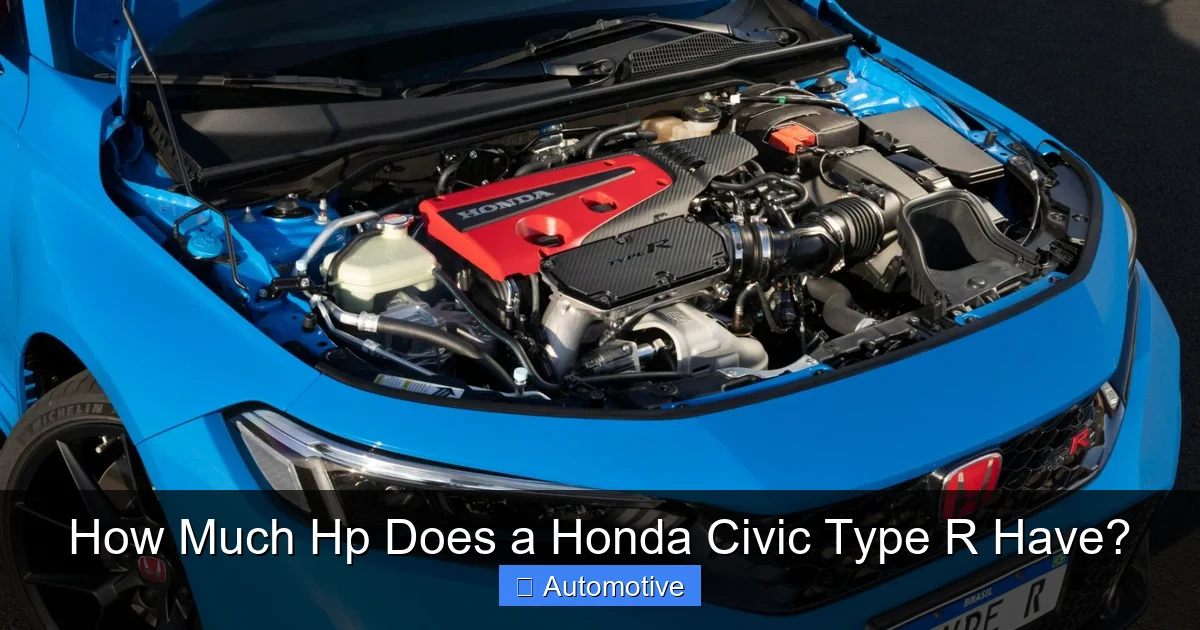
So, what’s under the hood that allows the Civic Type R to deliver such impressive horsepower? The answer lies in its turbocharged 2.0-liter inline-four engine, known internally as the **K20C1**.
The K20C1 Engine: A High-Performance Marvel
The K20C1 is a derivative of Honda’s K-series engines, which have a long history in performance applications. But this isn’t your average K20 from a regular Civic. The Type R version is heavily modified for high output and durability.
Key features of the K20C1 include:
– **Direct fuel injection:** Delivers precise fuel metering for better combustion efficiency and power.
– **Turbocharger with electronic wastegate:** Provides consistent boost pressure and reduces turbo lag.
– **High-compression ratio (9.8:1):** Balances performance with fuel efficiency and emissions.
– **Forged connecting rods and pistons:** Built to handle high cylinder pressures and sustained high-RPM operation.
– **Variable Valve Timing and Lift Electronic Control (VTEC):** Optimizes valve timing for both low-end torque and high-RPM power.
The turbocharger is a key component. It’s a twin-scroll design, which separates exhaust pulses to improve exhaust gas flow and reduce turbo lag. This means the engine builds boost quickly, even at low RPMs, giving the Type R that instant throttle response that drivers love.
Horsepower is generated at **6,500 RPM**, and the engine redlines at **7,000 RPM**—remarkable for a turbocharged engine. The broad power band means you don’t have to constantly shift gears to stay in the sweet spot. You can cruise in sixth gear at highway speeds and still have plenty of pull when you need it.
Cooling and Reliability: Built for the Track
One of the biggest challenges with high-performance turbo engines is heat management. The Type R addresses this with an advanced cooling system that includes:
– A larger radiator
– An oil cooler
– A transmission cooler (for the manual gearbox)
– Ducting to direct airflow to critical components
These features allow the Type R to sustain high performance during repeated track sessions without overheating. Many owners report being able to complete multiple hot laps without any drop in power or reliability.
Honda also uses a reinforced engine block and a high-flow oil pump to ensure proper lubrication under extreme conditions. This attention to detail is what allows the Type R to deliver consistent performance, lap after lap.
Real-World Performance: What Does 300+ HP Feel Like?
Visual guide about How Much Hp Does a Honda Civic Type R Have?
Image source: jdmenginezone.com
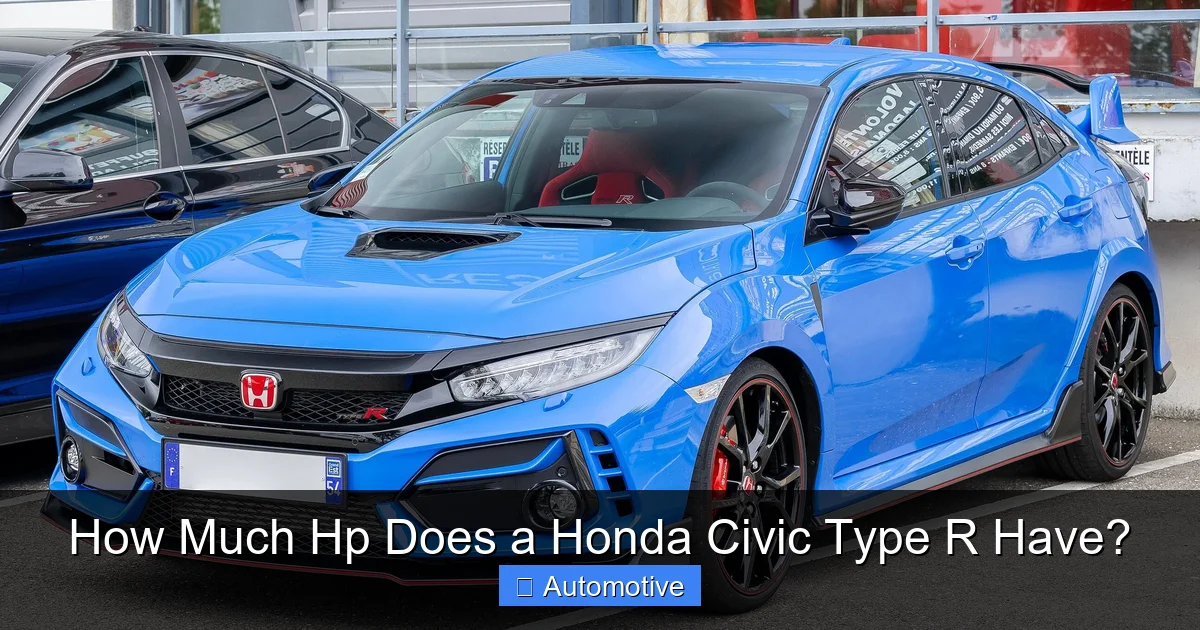
Numbers on a spec sheet are one thing—but what does it actually feel like to drive a car with over 300 horsepower? If you’ve never driven a high-performance car, the Civic Type R will surprise you.
Acceleration: 0–60 mph in Under 5 Seconds
The latest FL5 Civic Type R can accelerate from 0 to 60 mph in just **4.9 seconds**, according to independent tests. That’s faster than many sports cars that cost twice as much. The FK8 was slightly slower, at around **5.1 seconds**, but still incredibly quick for a front-wheel-drive hatchback.
What makes the acceleration so impressive is the lack of turbo lag. The engine responds immediately to throttle input, and the turbo spools up quickly. There’s no waiting for boost—just instant, linear power delivery.
The six-speed manual transmission plays a big role here. The short throws and precise engagement make shifting quick and satisfying. You’ll find yourself rowing through the gears just for the fun of it, even on a casual drive.
Handling: A Front-Wheel-Drive Supercar?
One of the biggest myths about front-wheel-drive cars is that they can’t handle high horsepower. The Civic Type R proves that wrong.
Thanks to its **helical limited-slip differential (LSD)**, the Type R can transfer power to the outside wheel during cornering, reducing understeer and improving traction. The LSD works by automatically sending more torque to the wheel with more grip, which is especially helpful when exiting corners.
The suspension is another key factor. The Type R uses a **dual-axis strut front suspension** and a **multi-link rear setup**, both tuned for sharp response and high cornering loads. The adaptive dampers (on higher trims) adjust in real time based on driving conditions, offering a comfortable ride on the highway and firm control on the track.
Honda also uses lightweight 19-inch wheels and high-performance tires (like the Michelin Pilot Sport 4S or Cup 2), which provide excellent grip and feedback. The result is a car that feels planted and predictable, even when pushed to the limit.
Braking: Stopping Power to Match the Go
With great power comes the need for great stopping power—and the Type R delivers. It comes equipped with **Brembo brakes** featuring four-piston front calipers and large ventilated rotors. These brakes offer excellent pedal feel and consistent performance, even after repeated hard stops.
On the track, the Type R can handle multiple laps without brake fade, thanks to the cooling ducts and high-temperature brake fluid. For daily driving, the brakes are smooth and progressive, making city driving easy and comfortable.
Aftermarket Tuning: Can You Get More Than 315 HP?
For many enthusiasts, 315 horsepower isn’t enough. The good news? The Civic Type R is one of the most tuner-friendly cars on the market.
Common Upgrades for More Horsepower
With relatively simple modifications, it’s possible to push the Type R well beyond its factory horsepower rating. Here are some popular upgrades:
– **ECU Tune:** A custom engine tune can increase boost pressure and optimize fuel and ignition timing. This alone can add 30–50 hp, bringing total output to around 350–365 hp.
– **Cold Air Intake:** Improves airflow into the engine, reducing intake temperatures and increasing efficiency.
– **Cat-Back Exhaust:** Reduces backpressure and improves exhaust flow, adding a few horsepower and a more aggressive sound.
– **Upgraded Turbocharger:** For serious power gains, enthusiasts often swap in a larger turbo (like a Garrett or BorgWarner unit). With supporting mods, this can push output to **400+ hp**.
– **Intercooler Upgrade:** A larger or more efficient intercooler reduces intake air temperatures, preventing power loss under sustained load.
Many tuning shops offer “stage” packages that bundle these upgrades. A Stage 1 tune (ECU only) is safe for daily driving and doesn’t require hardware changes. Stage 2 and beyond involve more extensive modifications and are best suited for track use.
Reliability and Longevity
One of the biggest concerns with tuning is reliability. Can the Type R handle 400+ hp without blowing up?
The answer is: **yes, with proper supporting mods**. The K20C1 engine is built strong, but pushing it beyond 400 hp requires upgraded fuel injectors, a high-flow fuel pump, and possibly forged internals. Many owners run 400+ hp setups on the street and track without issues, as long as the car is properly maintained and tuned by a reputable shop.
Regular oil changes, quality fuel, and monitoring engine parameters (via an OBD2 scanner or dash display) are essential for longevity.
Comparing the Type R to the Competition
So how does the Civic Type R stack up against other hot hatches and sports cars? Let’s look at a few key rivals.
Ford Focus RS (Discontinued)
The Focus RS made **350 hp** and **350 lb-ft of torque**, but it was all-wheel-drive. While it had more power, the Type R’s lighter weight and superior aerodynamics gave it an edge on the track. The Focus RS also suffered from reliability issues with its clutch and drivetrain under hard use.
Volkswagen Golf R
The latest Golf R produces **315 hp**—the same as the FL5 Type R—but it’s all-wheel-drive and slightly heavier. It’s a great car, but many drivers prefer the Type R’s sharper handling and more engaging manual transmission.
Subaru WRX STI
The STI makes **310 hp** and has a legendary rally pedigree. But it’s heavier, less refined, and uses an older turbocharged boxer engine. The Type R offers better fuel economy, more modern tech, and superior aerodynamics.
Hyundai Elantra N
The Elantra N is a newer competitor, making **276 hp** (or 286 hp with the optional Performance Package). It’s more affordable and offers a dual-clutch automatic, but it doesn’t match the Type R’s track-focused engineering or lap times.
In short, the Civic Type R stands out for its combination of power, handling, and driver engagement—all in a practical, four-door package.
Is the Honda Civic Type R Worth the Hype?
After years of development and refinement, the Honda Civic Type R has earned its place among the greats. With **315 horsepower** in its latest form, it delivers supercar-rivaling performance in a usable, reliable package.
Whether you’re a track day enthusiast, a weekend canyon carver, or just someone who loves driving, the Type R offers an experience that’s hard to match. It’s not the fastest car in a straight line, nor the most luxurious—but it’s one of the most *fun*.
The answer to “How much HP does a Honda Civic Type R have?” is simple: enough to put a smile on your face every time you drive it.
Frequently Asked Questions
How much horsepower does the 2023 Honda Civic Type R have?
The 2023 Honda Civic Type R (FL5 generation) produces 315 horsepower and 310 lb-ft of torque, making it the most powerful production Type R ever built.
Is the Civic Type R faster than a Mustang?
The Civic Type R has a similar 0–60 mph time (around 4.9 seconds) to the base Ford Mustang EcoBoost, but the Mustang GT with 450+ hp is significantly faster in a straight line. However, the Type R often outperforms the Mustang on twisty roads and tracks due to its superior handling.
Can you daily drive a Honda Civic Type R?
Yes, many owners use the Type R as a daily driver. It has four doors, decent cargo space, and modern comfort features. The ride can be firm, but adaptive suspension (on higher trims) helps balance comfort and performance.
Does the Type R have a manual transmission?
Yes, all modern Civic Type Rs come exclusively with a six-speed manual transmission. Honda believes in preserving the driving experience for enthusiasts.
How reliable is the Honda Civic Type R?
The Type R is generally reliable when properly maintained. The K20C1 engine is robust, and Honda’s track-focused cooling systems help prevent overheating. Regular oil changes and quality fuel are key to longevity.
Can the Civic Type R handle track use?
Absolutely. The Type R is designed for the track, with features like Brembo brakes, a limited-slip differential, and aerodynamic enhancements. Many owners take it to track days without issues.
