
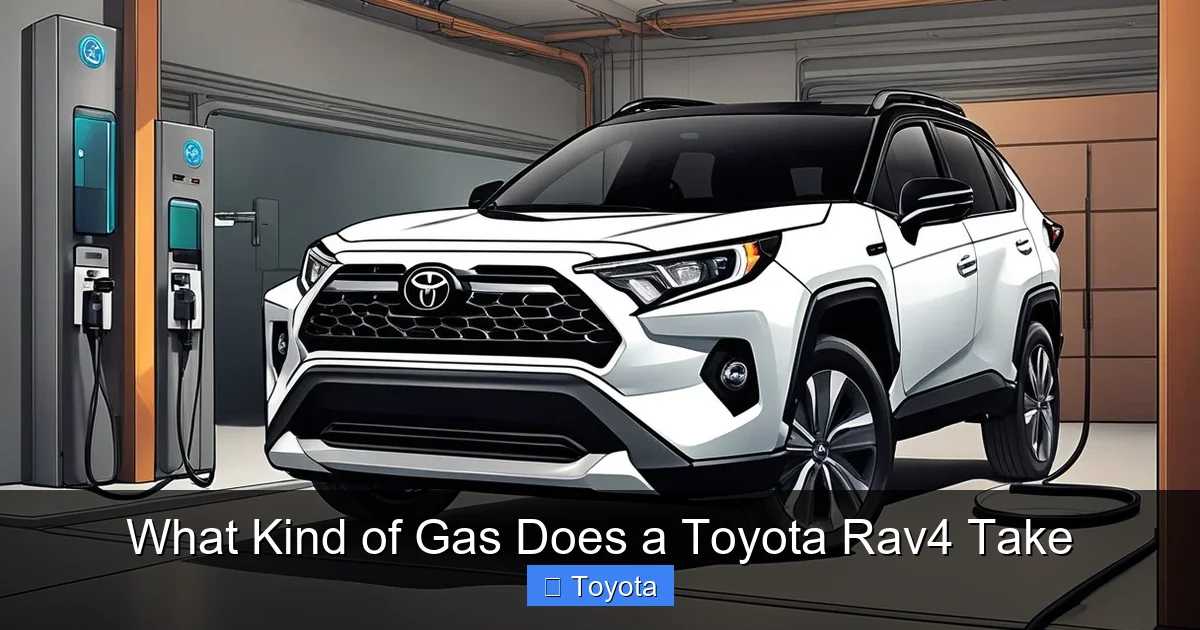
What Kind of Gas Does a Toyota Rav4 Take

Your Toyota RAV4 is designed to run efficiently on regular unleaded gasoline with an octane rating of 87 or higher. While premium fuel isn’t required, using it occasionally may offer slight performance benefits under heavy loads or high temperatures.
Key Takeaways
- Regular unleaded gasoline (87 octane) is recommended: The Toyota RAV4 is engineered to operate optimally on standard fuel, making it cost-effective and widely accessible.
- Premium fuel is optional, not required: Higher octane fuels (91–93) may improve performance in turbocharged or high-performance trims but offer minimal gains for most drivers.
- Flex-fuel compatibility in select models: Some RAV4 Hybrid and gasoline-only models support E85 ethanol blends, but check your owner’s manual to confirm eligibility.
- Avoid diesel and leaded fuels: These can severely damage the engine and emissions system, leading to costly repairs and voided warranties.
- Fuel quality matters: Choose reputable gas stations with Top Tier detergent additives to keep your engine clean and running smoothly.
- Hybrid models have similar fuel needs: The RAV4 Hybrid uses the same regular unleaded gasoline as the gas-only version, with added efficiency from its electric motor system.
- Seasonal and regional considerations: Cold weather may affect fuel performance, so using winter-blend gasoline in colder climates can help with cold starts.
📑 Table of Contents
- What Kind of Gas Does a Toyota RAV4 Take?
- Understanding Octane Ratings and Why They Matter
- Gasoline vs. Flex-Fuel: Is E85 an Option?
- Hybrid and Plug-In Hybrid Models: Do They Need Special Fuel?
- What Happens If You Use the Wrong Fuel?
- Tips for Maximizing Fuel Efficiency in Your RAV4
- Seasonal and Regional Fuel Considerations
- Conclusion: Stick with Regular, Drive Smart
What Kind of Gas Does a Toyota RAV4 Take?
If you’re a proud owner of a Toyota RAV4—or considering buying one—you’ve probably asked yourself: *What kind of gas does a Toyota RAV4 take?* It’s a smart question, because fuel choice directly impacts your vehicle’s performance, fuel economy, and long-term reliability. The good news? Toyota has designed the RAV4 to be both efficient and flexible when it comes to fuel. But there’s more to the story than just picking up the nearest pump.
The Toyota RAV4 is one of the most popular compact SUVs on the market, known for its reliability, fuel efficiency, and versatility. Whether you’re driving the standard gasoline model, the RAV4 Hybrid, or even the plug-in RAV4 Prime, understanding your fuel options helps you get the most out of your vehicle. While the answer might seem simple—just use regular gas—there are nuances depending on your model year, engine type, and driving habits.
In this guide, we’ll break down everything you need to know about fueling your RAV4. From octane ratings and fuel types to tips for maximizing efficiency and avoiding common mistakes, we’ve got you covered. Whether you’re filling up for the first time or just want to double-check your habits, this article will help you make informed decisions at the pump.
Understanding Octane Ratings and Why They Matter

Visual guide about What Kind of Gas Does a Toyota Rav4 Take
Image source: fabulousautoclub.com
Before diving into what fuel your RAV4 needs, it helps to understand what “octane” actually means. Octane rating measures a fuel’s ability to resist “knocking” or “pinging” during combustion—essentially, premature ignition of the air-fuel mixture in the engine. Higher octane fuels are more resistant to this knocking, which is why high-performance or turbocharged engines often require them.
Most gas stations offer three main octane levels: regular (87), mid-grade (89), and premium (91–93). The numbers refer to the fuel’s anti-knock index (AKI), which is the average of the Research Octane Number (RON) and Motor Octane Number (MON). In the U.S., the octane rating you see on the pump is the AKI.
Now, here’s the key point: **your Toyota RAV4 does not require premium fuel.** Toyota engineers have designed the engine to run efficiently on regular unleaded gasoline with an octane rating of 87. Using higher-octane fuel won’t harm your engine, but it also won’t provide significant benefits unless you’re driving under extreme conditions—like towing, hauling heavy loads, or driving in very hot weather.
For example, if you live in a mountainous region and frequently drive uphill with a full load of passengers and gear, you might notice a slight improvement in engine responsiveness with premium fuel. But for everyday commuting, city driving, or light highway travel, regular gas is perfectly sufficient.
Can You Use Premium Gas in a RAV4?
Yes, you can use premium gasoline in your RAV4—but it’s not necessary. Some drivers believe that higher-octane fuel automatically means better performance or cleaner engines, but that’s a common misconception. Unless your owner’s manual specifically recommends or requires premium fuel (which it doesn’t for most RAV4 models), you’re just spending extra money for no real gain.
Toyota states that using fuel with an octane rating higher than 87 will not improve fuel economy or performance in standard RAV4 models. The engine’s computer is calibrated to optimize combustion for 87-octane fuel, so it won’t “take advantage” of the higher octane. You might see a tiny bump in power under heavy load, but it’s usually negligible.
That said, if you want to treat your RAV4 to premium fuel once in a while—say, before a long road trip—it won’t hurt. Just don’t expect miracles. And if you’re on a budget, sticking with regular unleaded is the smarter financial move.
Gasoline vs. Flex-Fuel: Is E85 an Option?
Visual guide about What Kind of Gas Does a Toyota Rav4 Take
Image source: koala.sh
Another question that comes up is whether the RAV4 can run on flex-fuel, such as E85—a blend of 85% ethanol and 15% gasoline. The answer depends on your specific model and year.
Most standard Toyota RAV4 models are **not** flex-fuel compatible. They are designed to run on gasoline with up to 10% ethanol (E10), which is the standard ethanol blend found at most U.S. gas stations. However, some newer RAV4 Hybrid models, particularly those sold in certain regions, may be certified to use E85. This is more common in states with strong ethanol production, like Iowa or Minnesota.
If your RAV4 is flex-fuel capable, it will be clearly indicated on the fuel door, in the owner’s manual, or on a label inside the fuel filler cap. Look for the yellow gas cap or a “Flex-Fuel” badge on the vehicle. If you don’t see these, your RAV4 is not designed for E85.
Using E85 in a non-flex-fuel vehicle can cause serious damage. Ethanol is more corrosive than gasoline and can degrade rubber seals, fuel lines, and injectors not designed to handle it. It can also reduce fuel economy by up to 25%, since ethanol contains less energy per gallon than gasoline.
Benefits and Drawbacks of E85
If your RAV4 *is* flex-fuel compatible, E85 can offer some advantages. Ethanol burns cleaner than gasoline, producing fewer greenhouse gas emissions. It’s also domestically produced, reducing dependence on foreign oil. And in some areas, E85 is cheaper per gallon than regular gas—though the lower energy content means you’ll burn more of it.
However, E85 has downsides. It can be harder to find, especially outside the Midwest. Cold starts can be more difficult in winter, as ethanol doesn’t vaporize as easily in low temperatures. And again, fuel economy takes a hit. So while E85 is an option for some RAV4 owners, it’s not always the best choice.
Always consult your owner’s manual or a Toyota dealer before using E85. If your vehicle isn’t designed for it, stick with regular unleaded gasoline.
Hybrid and Plug-In Hybrid Models: Do They Need Special Fuel?

Visual guide about What Kind of Gas Does a Toyota Rav4 Take
Image source: motortrend.com
The Toyota RAV4 Hybrid and RAV4 Prime (plug-in hybrid) are increasingly popular due to their excellent fuel economy and reduced emissions. But do these models require different fuel than the standard gasoline version?
The short answer is **no**. Both the RAV4 Hybrid and RAV4 Prime use the same regular unleaded gasoline (87 octane) as the gas-only models. The difference lies in how the engine and electric motor work together to maximize efficiency.
In the RAV4 Hybrid, the gasoline engine and electric motor operate in tandem. The electric motor assists during acceleration and handles low-speed driving, reducing the load on the engine. This means the engine doesn’t have to work as hard, which improves fuel economy and reduces wear and tear.
The RAV4 Prime takes this a step further. With a larger battery and more powerful electric motor, it can travel up to 42 miles on electric power alone. When the battery is depleted, it operates like a standard hybrid. But again, when running on gasoline, it uses the same regular unleaded fuel.
Fueling Tips for Hybrid RAV4 Owners
Even though the fuel type is the same, hybrid drivers can take extra steps to maximize efficiency:
– **Keep the battery charged:** For the RAV4 Prime, plugging in regularly allows you to drive more miles on electricity, reducing gasoline use.
– **Use eco-driving modes:** The RAV4 Hybrid and Prime come with driving modes like “Eco” and “EV” that optimize fuel and energy use.
– **Avoid aggressive acceleration:** Hybrids recover energy during braking, so smooth, gradual driving helps recharge the battery and save fuel.
In short, hybrid RAV4 models don’t need special fuel—but they do benefit from smart driving habits.
What Happens If You Use the Wrong Fuel?
Using the wrong type of fuel in your RAV4 can lead to a range of problems, from reduced performance to serious engine damage. Let’s look at the most common mistakes and their consequences.
Using Diesel in a Gasoline Engine
This is a rare but serious error. Diesel fuel is thicker and has a higher flash point than gasoline. If you accidentally put diesel in a gasoline-powered RAV4, the engine won’t start or will run very poorly. Diesel can clog fuel injectors, damage the fuel pump, and contaminate the entire fuel system.
If this happens, **do not start the engine**. Have the vehicle towed to a service center for fuel system flushing. Continuing to drive can cause irreversible damage.
Using Leaded or Non-Standard Fuels
Leaded gasoline has been banned in the U.S. for decades, but it’s still used in some racing or vintage vehicles. Never use leaded fuel in a modern RAV4. It can destroy the catalytic converter and oxygen sensors, leading to expensive repairs.
Similarly, avoid fuels with high methanol or other additives not approved by Toyota. Stick to Top Tier gasoline, which contains high levels of detergent additives that keep your engine clean.
Using Low-Quality or Contaminated Gas
Not all gas stations are created equal. Some may sell fuel with water contamination, excessive ethanol, or low detergent content. Over time, this can lead to carbon buildup, rough idling, and reduced fuel economy.
To avoid this, choose reputable gas stations—especially those certified by the Top Tier program. Brands like Shell, Chevron, Exxon, and Costco typically meet these standards.
Tips for Maximizing Fuel Efficiency in Your RAV4
Now that you know what kind of gas your RAV4 takes, let’s talk about how to get the most miles per gallon. Fuel efficiency isn’t just about the fuel—it’s also about how you drive and maintain your vehicle.
Drive Smoothly
Aggressive driving—rapid acceleration, hard braking, and high speeds—can reduce fuel economy by up to 30%. Instead, accelerate gradually, maintain a steady speed, and anticipate traffic to avoid unnecessary braking.
Use cruise control on the highway to maintain a consistent speed, which helps improve fuel efficiency.
Keep Your RAV4 Well-Maintained
A well-maintained vehicle runs more efficiently. Follow Toyota’s recommended maintenance schedule, including:
– Regular oil changes (use the correct viscosity, such as 0W-20)
– Air filter replacements
– Tire rotations and proper inflation
– Spark plug inspections
Underinflated tires increase rolling resistance, which reduces fuel economy. Check your tire pressure monthly and keep it at the recommended level (usually found on a sticker inside the driver’s door).
Reduce Weight and Drag
Extra weight and aerodynamic drag hurt fuel economy. Remove roof racks when not in use, and avoid carrying unnecessary items in the cargo area. Even a few hundred pounds can make a noticeable difference over time.
Use the Right Fuel Additives (If Needed)
While Top Tier gasoline already contains detergents, you can use fuel system cleaners occasionally to remove carbon buildup. Products like Techron or Sea Foam can help restore performance if you notice rough idling or reduced power.
However, don’t overuse additives. Most drivers don’t need them regularly—once or twice a year is sufficient.
Seasonal and Regional Fuel Considerations
Fuel formulations can vary by season and region. In colder climates, gasoline is blended to vaporize more easily in low temperatures, helping with cold starts. This “winter blend” is used from roughly October to April.
In warmer months, refineries switch to “summer blend” gasoline, which reduces evaporative emissions and helps prevent smog formation.
These seasonal changes are automatic and don’t require any action from you. Just know that fuel economy may vary slightly depending on the time of year—your RAV4 might get a few extra miles per gallon in winter due to the fuel blend, even though cold weather itself can reduce efficiency.
In high-altitude areas, the air is thinner, which can affect engine performance. However, modern engines like those in the RAV4 have sensors that adjust fuel delivery automatically. You don’t need to change your fuel type—just be aware that fuel economy might be slightly lower at elevation.
Conclusion: Stick with Regular, Drive Smart
So, what kind of gas does a Toyota RAV4 take? The answer is simple: **regular unleaded gasoline with an octane rating of 87 or higher**. This applies to all gasoline, hybrid, and plug-in hybrid models. Premium fuel is optional and offers minimal benefits for most drivers. Flex-fuel (E85) is only safe if your vehicle is specifically designed for it.
By using the right fuel and following good driving and maintenance habits, you’ll keep your RAV4 running smoothly for years to come. Avoid the temptation to “upgrade” to premium gas unless you’re under extreme driving conditions. And always choose high-quality fuel from reputable stations.
Your RAV4 is built to be efficient, reliable, and easy to own. With the right fuel and a little care, it will take you wherever you need to go—without breaking the bank at the pump.
Frequently Asked Questions
Can I use premium gas in my Toyota RAV4?
Yes, you can use premium gasoline in your RAV4, but it’s not required. The engine is designed to run efficiently on regular unleaded (87 octane), and using higher-octane fuel won’t significantly improve performance or fuel economy for most drivers.
Is the Toyota RAV4 Hybrid compatible with E85?
Some RAV4 Hybrid models are flex-fuel capable and can use E85, but most are not. Check your fuel door, owner’s manual, or look for a yellow gas cap to confirm. Using E85 in a non-flex-fuel vehicle can cause engine damage.
What happens if I put diesel in my RAV4?
Putting diesel in a gasoline-powered RAV4 can cause serious damage. The engine may not start or run properly, and diesel can clog fuel injectors and damage the fuel system. Do not start the engine—have it towed for professional cleaning.
Does the RAV4 Prime need special fuel?
No, the RAV4 Prime uses the same regular unleaded gasoline (87 octane) as other RAV4 models. The difference is its plug-in hybrid system, which allows for electric-only driving before switching to gasoline.
Can low-quality gas damage my RAV4?
Yes, low-quality or contaminated gasoline can lead to carbon buildup, rough idling, and reduced fuel economy. Always choose Top Tier certified gas stations for cleaner, more reliable fuel.
Will using premium gas clean my engine?
Not necessarily. While some premium fuels have extra detergents, regular Top Tier gasoline already contains sufficient cleaning agents. Using premium gas won’t harm your engine, but it won’t provide significant cleaning benefits over quality regular fuel.
