
How Much Is a Mazda Catalytic Converter Worth in Scrap

The value of a Mazda catalytic converter in scrap depends on its model, engine size, and precious metal content. Prices typically range from $50 to over $500, with high-end models like the CX-9 or turbocharged engines fetching top dollar. Knowing what affects pricing helps you get the most cash when recycling.
If you’ve ever owned a Mazda—whether it’s a sporty MX-5 Miata, a family-friendly CX-5, or a powerful CX-9—you know these vehicles are built for performance, reliability, and style. But like all cars, they eventually age, and parts wear out. One component that often becomes a point of interest, especially when a car reaches the end of its life, is the catalytic converter. It’s not just a pollution control device; it’s also a source of valuable metals. So, how much is a Mazda catalytic converter worth in scrap?
The short answer? It depends. But the good news is that Mazda catalytic converters can be quite valuable—sometimes hundreds of dollars—depending on several key factors. Unlike older economy cars with minimal precious metal content, many modern Mazdas, especially those with larger engines or turbocharged systems, come equipped with converters packed with platinum, palladium, and rhodium. These metals are in high demand globally, and their market prices fluctuate daily. That means the scrap value of your Mazda’s catalytic converter isn’t fixed—it changes based on supply, demand, and even geopolitical events.
In this guide, we’ll walk you through everything you need to know about the scrap value of a Mazda catalytic converter. We’ll break down what determines pricing, which models are most valuable, how to find a reputable recycler, and tips to maximize your payout. Whether you’re scrapping an old Mazda, replacing a stolen converter, or just curious about the worth of this often-overlooked part, this article will give you the insights you need to make informed decisions.
Key Takeaways
- Scrap value varies by model and engine: Larger engines and luxury Mazda models usually have more valuable catalytic converters due to higher platinum, palladium, and rhodium content.
- Precious metals drive pricing: The market price of platinum, palladium, and rhodium directly impacts how much recyclers will pay for your converter.
- OEM vs. aftermarket matters: Original equipment manufacturer (OEM) converters from Mazda are typically worth more than aftermarket replacements.
- Location and recycler choice affect payout: Scrap yards and recycling centers in urban areas or near refineries may offer better rates.
- Condition and removal method count: A clean, intact converter with minimal damage will fetch a higher price than one that’s crushed or contaminated.
- Documentation helps: Having the vehicle identification number (VIN) and proof of ownership can prevent issues and increase trust with recyclers.
- Stay legal and ethical: Only sell converters from vehicles you own, and avoid buying or selling stolen parts to stay compliant with state and federal laws.
📑 Table of Contents
- What Is a Catalytic Converter and Why Is It Valuable?
- Factors That Affect the Scrap Value of a Mazda Catalytic Converter
- How to Determine the Value of Your Mazda Catalytic Converter
- Top Mazda Models with High-Value Catalytic Converters
- How to Sell Your Mazda Catalytic Converter for Scrap
- Legal and Ethical Considerations
- Tips to Maximize Your Scrap Value
- Conclusion
What Is a Catalytic Converter and Why Is It Valuable?
Before diving into pricing, it helps to understand what a catalytic converter actually does—and why it’s worth anything in scrap.
A catalytic converter is an emissions control device located in your vehicle’s exhaust system. Its job is to convert harmful pollutants like carbon monoxide, nitrogen oxides, and unburned hydrocarbons into less harmful substances like carbon dioxide, nitrogen, and water vapor. It does this using a honeycomb structure coated with precious metals that act as catalysts.
These metals—primarily platinum, palladium, and rhodium—are extremely rare and expensive. They don’t get consumed in the chemical reactions; instead, they speed up the conversion process. Because of their scarcity and high demand in industries like jewelry, electronics, and automotive manufacturing, these metals are highly sought after in recycling.
Now, here’s where Mazda comes into play. Mazda has long been known for engineering efficient, high-performance engines—especially their Skyactiv technology, which emphasizes fuel efficiency and reduced emissions. To meet strict environmental standards, Mazda uses high-quality catalytic converters with significant amounts of precious metals. This makes their converters more valuable than those in many other mainstream vehicles.
For example, a Mazda CX-9 with a 2.5L turbocharged engine typically has a larger, more complex catalytic converter than a base-model Mazda3. The CX-9’s converter often contains more palladium and rhodium, which can push its scrap value well above $300. In contrast, a standard Mazda3 with a 2.0L engine might only fetch $80–$120 in scrap.
But it’s not just about size. The design and placement of the converter also matter. Some Mazda models have multiple catalytic converters—one close to the engine (pre-cat) and another further down the exhaust line (main cat). The pre-cat, being closer to the engine and exposed to higher temperatures, often has a denser coating of precious metals and is more valuable.
Factors That Affect the Scrap Value of a Mazda Catalytic Converter
Visual guide about How Much Is a Mazda Catalytic Converter Worth in Scrap
Image source: i.ytimg.com
So, what exactly determines how much your Mazda catalytic converter is worth in scrap? Let’s break it down.
1. Vehicle Model and Engine Type
Not all Mazdas are created equal when it comes to catalytic converter value. The make, model, and engine size play a huge role.
For instance:
– Mazda CX-9 (2.5L Turbo): Often valued between $300 and $500+ in scrap due to high rhodium content.
– Mazda CX-5 (2.5L or 2.5T): Typically ranges from $150 to $300.
– Mazda3 (2.0L or 2.5L): Usually between $80 and $150.
– Mazda6 (2.5L): Around $100–$180.
– Mazda MX-5 Miata (2.0L): Smaller converter, often $70–$120.
Turbocharged engines generally require more robust emissions systems, which means more precious metals. That’s why the CX-9 and turbocharged CX-5 models tend to be the most valuable.
2. Precious Metal Content
The real money in catalytic converters comes from the metals inside. Let’s look at each:
– Platinum: Used in both gasoline and diesel engines. It’s valuable but less so than palladium or rhodium.
– Palladium: Heavily used in gasoline engines (like Mazda’s). Prices have soared in recent years due to supply shortages.
– Rhodium: The most expensive of the three. It’s used in small amounts but can dramatically increase value. Rhodium prices have exceeded $10,000 per ounce at times.
Mazda converters, especially from 2010–2023 models, often contain significant palladium and rhodium. The exact amount depends on the year and emissions regulations at the time of manufacturing.
3. OEM vs. Aftermarket
Original Equipment Manufacturer (OEM) converters—those installed by Mazda at the factory—are almost always worth more than aftermarket replacements. Why? Because OEM parts are built to stricter standards and often use higher-grade materials.
An aftermarket converter might use cheaper metals or thinner coatings to cut costs. While it may still function properly, it won’t yield as much in scrap. If you’re selling a converter, be sure to mention whether it’s OEM or aftermarket—it can make a $50–$100 difference.
4. Condition and Cleanliness
A clean, intact catalytic converter will always fetch a higher price. Recyclers prefer converters that haven’t been crushed, cut, or contaminated with oil, coolant, or road debris.
If the honeycomb inside is melted or broken, the metal recovery becomes more difficult and less efficient. Similarly, if the converter has been sitting in a damp garage or exposed to salt (common in snowy regions), corrosion can reduce its value.
Tip: When removing the converter, avoid damaging the shell. Use proper tools and keep it upright to prevent internal damage.
5. Location and Recycler
Where you live and who you sell to can impact your payout. Scrap yards in major cities or near refining hubs (like Texas, California, or the Midwest) often offer better rates because they have direct access to refineries.
Some recyclers specialize in catalytic converters and use XRF (X-ray fluorescence) analyzers to test metal content on the spot. These shops may pay more because they can verify value quickly.
Always get quotes from at least two or three recyclers. Prices can vary by $50 or more for the same part.
6. Market Fluctuations
The scrap value of a catalytic converter isn’t static. It changes daily based on global metal markets. For example, if rhodium prices spike due to mining disruptions in South Africa (a major supplier), your converter could be worth significantly more one week than the next.
Websites like Kitco or Metalary track precious metal prices in real time. While you don’t need to become a commodities trader, checking current prices before selling can help you time your sale for maximum profit.
How to Determine the Value of Your Mazda Catalytic Converter
Visual guide about How Much Is a Mazda Catalytic Converter Worth in Scrap
Image source: engineeringlearn.com
Now that you know the factors that affect value, how do you figure out what your specific converter is worth?
Step 1: Identify Your Vehicle and Converter
Start by noting your Mazda’s year, make, model, and engine size. This information is usually found on your registration, insurance card, or by looking up your VIN.
Next, locate the catalytic converter. It’s typically a rounded or oval metal canister in the exhaust system, usually between the engine and the muffler. Some vehicles have more than one.
Look for a stamp or code on the converter itself. Many OEM converters have a serial number or manufacturer code (e.g., “Denso,” “Bosal,” or “Mazda OEM”). This can help recyclers identify the part and estimate value.
Step 2: Use Online Pricing Tools
Several websites and apps can give you a rough estimate of your converter’s scrap value. Some popular options include:
– Catalytic Converter Recycling Calculator (CatalyticConverterPrice.com)
– Converter King
– Scrap Catalytic Converter Value Checker
These tools ask for your vehicle details and sometimes the converter code. They then provide a price range based on current metal values and historical data.
Keep in mind: these are estimates. The final price depends on the recycler’s testing and market conditions.
Step 3: Get Quotes from Local Recyclers
Once you have an idea of the value, contact local scrap yards or catalytic converter buyers. Many now offer online quote forms where you can upload photos and details.
When requesting a quote, include:
– Vehicle year, make, model, and engine
– Converter location (front, rear, dual)
– Photos of the converter (both sides, close-up of stamp if possible)
– Whether it’s OEM or aftermarket
Some recyclers will even come to your location to pick up the converter, especially if it’s valuable.
Step 4: Test the Metal Content (Optional)
If you’re serious about maximizing value, consider getting your converter tested. Some recyclers use handheld XRF devices to measure metal content instantly. This gives you hard data to negotiate with.
Alternatively, you can send a small sample to a refining lab, though this is usually only worth it for high-value converters.
Top Mazda Models with High-Value Catalytic Converters
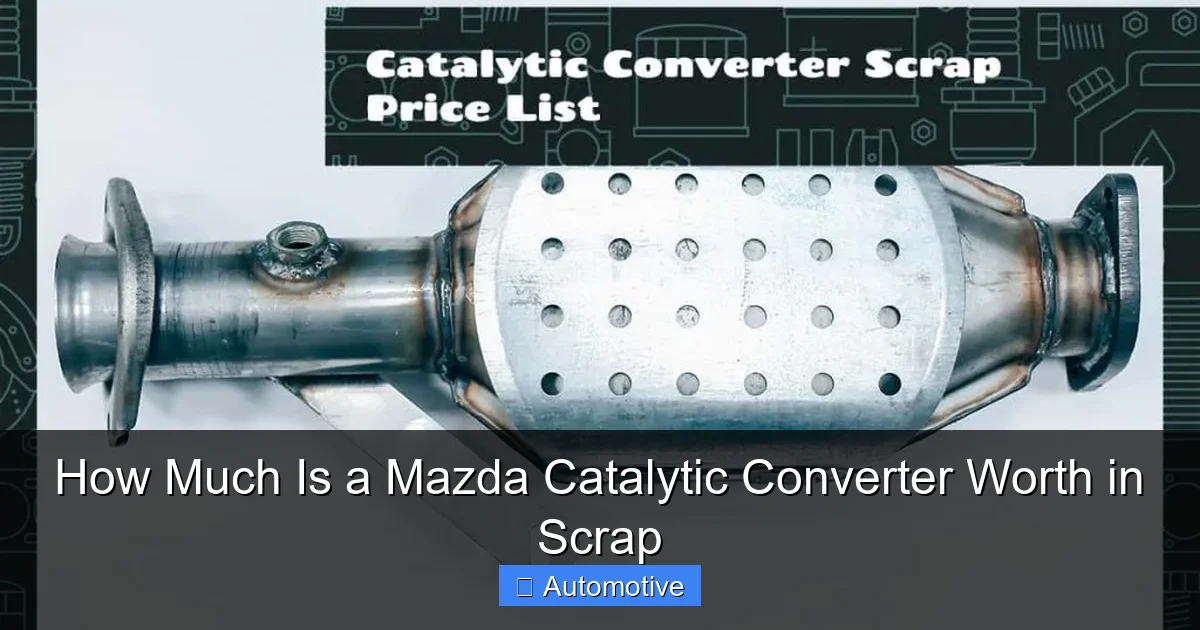
Visual guide about How Much Is a Mazda Catalytic Converter Worth in Scrap
Image source: upgradedvehicle.com
Not all Mazda catalytic converters are equal. Here are some of the most valuable models based on scrap pricing trends:
Mazda CX-9 (2016–2023)
With its 2.5L turbocharged engine, the CX-9 has one of the most valuable converters in Mazda’s lineup. The close-coupled pre-cat is especially rich in rhodium and palladium. Scrap values often range from $350 to $500+, depending on condition and market prices.
Mazda CX-5 (2017–2023, 2.5T Turbo)
The turbocharged version of the CX-5 has a high-value converter, typically fetching $200–$350. The non-turbo 2.5L model is still valuable, usually $120–$200.
Mazda6 (2014–2021, 2.5L)
This midsize sedan has a well-designed emissions system. Its converter is often worth $100–$180 in scrap.
Mazda3 (2014–2023, 2.5L)
While not the highest-value model, the 2.5L engine in the Mazda3 still produces a decent converter, typically valued at $90–$150.
Mazda MX-5 Miata (2016–2023, 2.0L)
The Miata’s converter is smaller, but due to its performance-oriented design and OEM quality, it still holds value—usually $80–$130.
Older Models (2000s)
Some older Mazdas, like the 2006–2010 Mazda6 with a V6 engine, can also be valuable. These models often used higher metal loads before regulations tightened. A 2008 Mazda6 V6 converter might fetch $100–$160.
How to Sell Your Mazda Catalytic Converter for Scrap
Selling a catalytic converter isn’t as simple as dropping it off at a scrap yard. Here’s how to do it the right way.
1. Ensure You Own the Vehicle
Most states require proof that you legally own the car the converter came from. This prevents the sale of stolen parts. Have your title, registration, or VIN ready.
Some recyclers may ask for a signed affidavit stating the converter was removed from a vehicle you own.
2. Remove the Converter Safely
If you’re doing the removal yourself, take precautions:
– Let the engine cool completely.
– Use jack stands and wheel chocks—never rely on a jack alone.
– Wear gloves and eye protection.
– Use a reciprocating saw or torch carefully to avoid damaging surrounding parts.
If you’re not comfortable, hire a mechanic. Many shops will remove the converter for $50–$150 and may even buy it from you.
3. Clean the Converter
Wipe off dirt, oil, and rust. Don’t pressure wash it—water can damage the internal honeycomb. A clean converter looks better and is easier to test.
4. Choose a Reputable Buyer
Avoid fly-by-night operations. Look for recyclers with:
– A physical address and phone number
– Positive online reviews
– Transparent pricing
– Experience with catalytic converters
Ask if they test on-site and how they determine value.
5. Get Paid
Payment methods vary. Some pay cash, others by check or bank transfer. Be wary of buyers who offer unusually high prices—this could be a scam.
Always get a receipt that includes the converter details, price, and date.
Legal and Ethical Considerations
Catalytic converter theft has surged in recent years, making regulations stricter. Selling a converter isn’t illegal—but it must be done ethically.
Know Your State Laws
Many states require:
– Proof of vehicle ownership
– Documentation of removal
– Registration with the recycler
For example, California requires sellers to provide ID, vehicle info, and a signed statement. Failure to comply can result in fines.
Avoid Stolen Parts
Never buy a converter from someone who can’t prove ownership. If a deal seems too good to be true, it probably is.
Similarly, don’t sell converters from vehicles you don’t own. This includes parts from scrapped cars you’ve purchased—make sure the title is clear.
Environmental Responsibility
Catalytic converters contain hazardous materials. Never crush or burn them. Always recycle through a licensed facility.
Proper recycling ensures metals are recovered safely and reduces the need for new mining.
Tips to Maximize Your Scrap Value
Want to get the most cash for your Mazda catalytic converter? Follow these tips:
– Sell when metal prices are high: Check rhodium and palladium prices before selling.
– Keep the converter intact: Don’t cut it open or crush it.
– Remove it cleanly: Avoid damaging the shell or internal structure.
– Shop around: Get multiple quotes to find the best offer.
– Bundle with other scrap: Some yards offer better rates if you bring multiple parts.
– Time your sale: Avoid selling during market downturns if possible.
Conclusion
So, how much is a Mazda catalytic converter worth in scrap? The answer isn’t one-size-fits-all, but with the right knowledge, you can get a fair price. Values typically range from $50 for smaller models to over $500 for high-performance or luxury Mazdas. The key factors are engine size, precious metal content, OEM status, condition, and market timing.
By understanding what drives value and following best practices for removal and sale, you can turn an old part into real cash. Just remember to stay legal, choose reputable buyers, and keep safety in mind.
Whether you’re scrapping an old Mazda or replacing a stolen converter, knowing the worth of this small but valuable component puts you in control. And in today’s market, that knowledge is more valuable than ever.
Frequently Asked Questions
How much is a Mazda CX-5 catalytic converter worth in scrap?
The scrap value of a Mazda CX-5 catalytic converter typically ranges from $150 to $350, depending on the engine type. The 2.5L turbocharged model is usually worth more due to higher precious metal content.
Can I sell a catalytic converter without the car?
Yes, but you must prove legal ownership of the vehicle it came from. Most recyclers require a title, registration, or VIN to prevent the sale of stolen parts.
Why are Mazda catalytic converters so valuable?
Mazda uses high-quality OEM converters with significant amounts of platinum, palladium, and rhodium—especially in turbocharged or larger engines. These metals are rare and in high demand.
How do I find the value of my specific Mazda converter?
Use online pricing tools, check your vehicle’s make/model/engine, and get quotes from local recyclers. Some shops test metal content on-site for accurate pricing.
Is it legal to sell a catalytic converter?
Yes, as long as you legally own the vehicle and follow state regulations. Many states require documentation to prevent theft and ensure ethical sales.
What should I do if my Mazda catalytic converter was stolen?
Report the theft to police, file an insurance claim if covered, and consider installing anti-theft devices. When replacing it, keep the old converter (if recovered) for potential scrap value.