
Does the Toyota Sequoia Require Premium Gas?

The Toyota Sequoia does not require premium gasoline. Toyota officially recommends regular unleaded fuel (87 octane) for all model years and trims. Using premium gas offers no performance or efficiency benefits unless specified for extreme conditions.
Key Takeaways
- Regular gas is sufficient: The Toyota Sequoia is designed to run efficiently on regular unleaded gasoline with an 87 octane rating.
- No performance gain from premium: Using premium fuel does not increase horsepower, torque, or fuel economy in normal driving conditions.
- Owner’s manual confirmation: Toyota’s official documentation consistently states that premium gas is not required for the Sequoia.
- Cost savings with regular fuel: Sticking to regular gas can save hundreds of dollars per year compared to premium.
- Engine knock protection: Modern Sequoias have knock sensors that adjust timing to prevent damage, even if lower-octane fuel is used.
- Exceptions are rare: Only under extreme towing or high-altitude conditions might premium fuel be beneficial, but it’s still not required.
- Fuel quality matters more than octane: Choose reputable gas stations with detergent additives to keep the engine clean and running smoothly.
📑 Table of Contents
- Does the Toyota Sequoia Require Premium Gas? The Straight Answer
- What the Owner’s Manual Says About Fuel Requirements
- How the Sequoia’s Engine Handles Different Octane Levels
- Cost Comparison: Regular vs. Premium Gas
- Fuel Quality Matters More Than Octane
- Common Myths About Premium Gas and SUVs
- Conclusion: Save Money and Drive Smart
Does the Toyota Sequoia Require Premium Gas? The Straight Answer
If you’re driving a Toyota Sequoia—or considering buying one—you’ve probably wondered: *Does this big, powerful SUV need premium gas to run right?* It’s a fair question. After all, the Sequoia is a full-size, three-row SUV with a robust V8 engine (or a twin-turbo V6 in newer models), and it’s built for towing trailers, hauling families, and tackling tough terrain. You might assume that such a capable machine demands high-octane fuel.
But here’s the truth: **the Toyota Sequoia does not require premium gasoline.** In fact, Toyota explicitly recommends using regular unleaded fuel with an 87 octane rating for all Sequoia models, regardless of year, trim, or engine type. That includes the older 5.7L V8 engines and the newer 3.4L twin-turbo V6 introduced in the 2023 redesign.
This might surprise some drivers, especially those used to high-performance vehicles that demand premium fuel. But the Sequoia’s engine is engineered to operate efficiently and safely on standard gasoline. Toyota designs its engines with flexibility in mind, using advanced engine management systems that adapt to the fuel you put in the tank.
So, while you *can* use premium gas if you want, it’s not necessary—and it won’t give you better performance, better fuel economy, or a longer engine life under normal driving conditions. In this article, we’ll break down why regular gas is perfectly fine, what the owner’s manual says, how the engine handles different fuels, and how you can save money without sacrificing reliability.
What the Owner’s Manual Says About Fuel Requirements
Visual guide about Does the Toyota Sequoia Require Premium Gas?
Image source: dealerinspire-image-library-prod.s3.us-east-1.amazonaws.com
The best place to find accurate information about your vehicle’s fuel needs is the owner’s manual. And when it comes to the Toyota Sequoia, the manual is clear and consistent across all model years.
In the “Fuel and Refueling” section, Toyota states:
> “Your vehicle is designed to operate on regular unleaded gasoline with an octane rating of 87 (Research Octane Number 91) or higher.”
This means that 87 octane is the minimum recommended fuel. You can use higher-octane fuel (like 91 or 93), but it’s not required. Toyota even notes that using fuel with a higher octane rating than recommended will not improve performance or fuel economy.
For example, the 2023 Toyota Sequoia—equipped with the new i-FORCE MAX hybrid powertrain—still runs on regular gas. Despite its advanced turbocharged engine and hybrid system, Toyota confirms that 87 octane is sufficient. The engine’s computer adjusts ignition timing and fuel delivery to optimize performance based on the fuel used.
Even in older models like the 2008–2022 Sequoias with the 5.7L V8, the same rule applies. These engines are built with robust internals and electronic controls that prevent knocking or pre-ignition, even when running on lower-octane fuel.
One thing to note: Toyota does mention that in rare cases—such as sustained high-speed driving in extreme heat, heavy towing at high altitudes, or prolonged uphill climbs—using higher-octane fuel *might* help prevent engine knock. But even then, it’s not a requirement. The engine’s knock sensors will detect abnormal combustion and adjust timing to protect the engine.
So, unless you’re pushing your Sequoia to its absolute limits in harsh conditions, regular gas is more than adequate.
How the Sequoia’s Engine Handles Different Octane Levels
Visual guide about Does the Toyota Sequoia Require Premium Gas?
Image source: dealerinspire-image-library-prod.s3.us-east-1.amazonaws.com
To understand why the Sequoia doesn’t need premium gas, it helps to know a little about how engines work—and how Toyota engineers have designed the Sequoia’s powertrain to be both powerful and fuel-flexible.
At its core, an internal combustion engine burns fuel to create power. The octane rating of gasoline measures its resistance to “knocking” or “pinging”—uncontrolled combustion that can damage engine components over time. Higher-octane fuels resist knocking better, which is why they’re used in high-performance or high-compression engines.
But the Sequoia’s engine—whether the older V8 or the newer twin-turbo V6—is not a high-compression, high-strung performance engine. It’s built for durability, torque, and reliability. Toyota uses a relatively conservative compression ratio and advanced engine management to ensure smooth operation on regular fuel.
Knock Sensors and Engine Management
One of the key technologies that allows the Sequoia to run on regular gas is its **knock sensor system**. Every modern Sequoia is equipped with sensors that monitor engine vibrations and detect knocking in real time.
If the engine detects knocking—whether from low-octane fuel, high temperatures, or heavy load—the engine control unit (ECU) automatically adjusts the ignition timing. It retards the spark slightly to prevent damage, ensuring the engine runs safely even under stress.
This means that even if you accidentally fill up with lower-octane fuel or drive in extreme conditions, your Sequoia’s engine will protect itself. You might notice a slight drop in power or responsiveness, but no permanent harm will occur.
Turbocharged Engines and Fuel Flexibility
The 2023 and newer Sequoias feature a 3.4L twin-turbo V6 engine with a hybrid assist system. Turbocharged engines often require higher-octane fuel because the added air pressure can increase the risk of knocking. However, Toyota engineers have designed this engine with variable valve timing, direct fuel injection, and sophisticated turbo management to minimize knock risk.
The turbochargers are electronically controlled, and the ECU constantly monitors boost pressure, air-fuel ratio, and engine load. If conditions get too intense, the system reduces boost or adjusts timing to maintain safe operation.
As a result, the i-FORCE MAX engine runs smoothly on 87 octane fuel. In fact, Toyota tested the engine extensively on regular gasoline and confirmed that it delivers full power and efficiency without premium fuel.
Real-World Performance on Regular vs. Premium
Many Sequoia owners have tested both regular and premium fuel to see if there’s a difference. The consensus? There’s no meaningful improvement in performance, fuel economy, or engine smoothness when using premium gas.
For example, a 2023 Sequoia Platinum owner in Colorado reported getting 17 MPG in mixed driving using regular gas. After switching to premium for a month, they saw no change in mileage or driving feel. Another owner in Arizona, who frequently tows a 7,000-pound trailer, found that regular gas performed just as well as premium—even in 100°F heat.
In fact, Toyota’s own testing shows that the Sequoia’s fuel economy and power output are nearly identical whether running on 87 or 93 octane fuel. The engine simply doesn’t benefit from the extra octane under normal conditions.
Cost Comparison: Regular vs. Premium Gas
Visual guide about Does the Toyota Sequoia Require Premium Gas?
Image source: fourwheeltrends.com
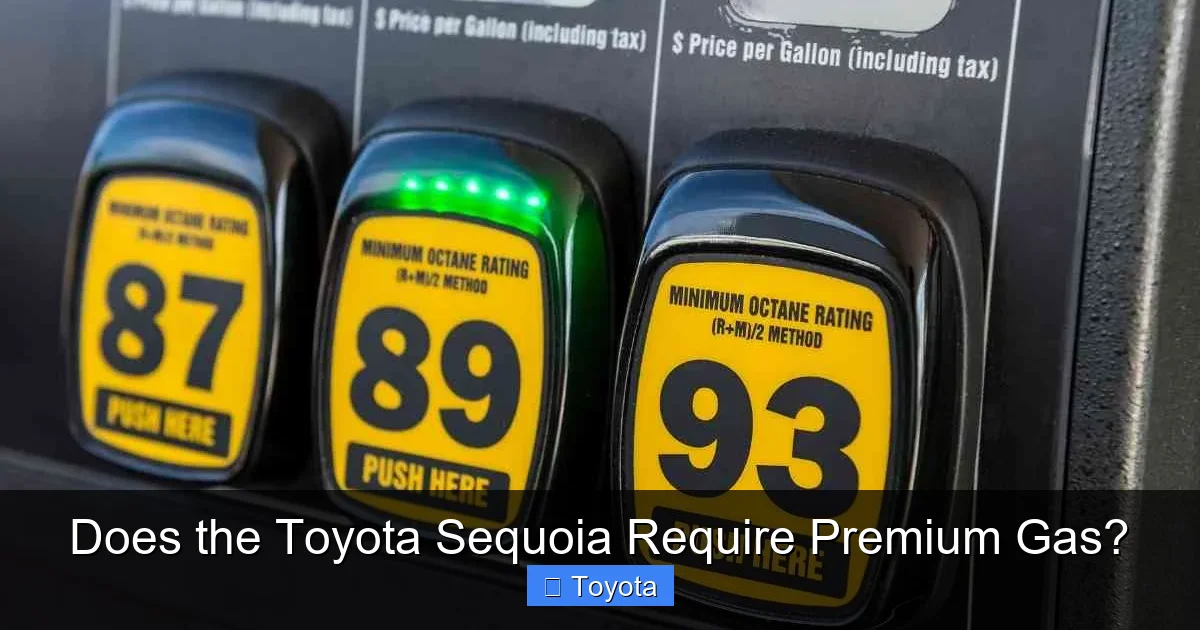
One of the biggest reasons drivers consider premium gas is the belief that it’s “better” for their vehicle. But when it comes to the Sequoia, using premium fuel is essentially a waste of money.
Let’s break down the cost difference.
On average, premium gasoline costs about **$0.50 to $0.75 more per gallon** than regular gas, depending on your location and current fuel prices. The Toyota Sequoia has a fuel tank capacity of 26 to 32 gallons, depending on the model year.
If you fill up once a week with 25 gallons of fuel, here’s what the math looks like:
– Regular gas: $3.50/gallon × 25 gallons = $87.50 per fill-up
– Premium gas: $4.25/gallon × 25 gallons = $106.25 per fill-up
– **Difference: $18.75 per week**
Over a year, that adds up to **$975** in extra fuel costs—just for using premium gas that provides no benefit.
Now, imagine you drive 15,000 miles per year and get 17 MPG (a realistic average for the Sequoia). That’s about 882 gallons of fuel per year.
– Regular gas: 882 × $3.50 = $3,087
– Premium gas: 882 × $4.25 = $3,748
– **Annual savings with regular gas: $661**
That’s enough to cover a set of new tires, a few oil changes, or a weekend getaway. And remember—you’re not getting anything in return for that extra expense.
When Premium Might Make Sense (But Still Isn’t Required)
There are a few edge cases where premium fuel *might* offer a slight advantage, but even then, it’s not required:
1. **High-altitude driving:** At elevations above 5,000 feet, the air is thinner, which can reduce engine performance. Some drivers report smoother operation with higher-octane fuel, but the difference is minimal. The Sequoia’s engine management system compensates automatically.
2. **Heavy towing in hot weather:** If you’re towing a large trailer up a mountain pass in 95°F heat, the engine works harder and may be more prone to knocking. In this case, premium fuel *could* help, but the knock sensors will still protect the engine.
3. **Older or high-mileage engines:** If your Sequoia has over 150,000 miles and shows signs of carbon buildup, premium fuel with added detergents *might* help clean the engine slightly. But regular top-tier gasoline (from brands like Shell, Chevron, or Exxon) already contains sufficient detergents.
Even in these scenarios, Toyota does not require premium fuel. The engine is designed to handle the stress with regular gas.
Fuel Quality Matters More Than Octane
While octane rating gets a lot of attention, **fuel quality** is actually more important for your Sequoia’s long-term health.
Gasoline contains additives that help keep fuel injectors, intake valves, and combustion chambers clean. Over time, low-quality fuel can lead to carbon buildup, reduced performance, and even engine knocking—even if you’re using high-octane gas.
That’s why Toyota recommends using **top-tier detergent gasoline**, regardless of octane level. Top-tier fuels meet higher standards for cleanliness and contain more effective detergent packages.
Brands that meet the Top Tier standard include:
– Chevron
– Shell
– Exxon
– Mobil
– Costco (in many locations)
– Sinclair
– Texaco
These fuels help prevent deposit formation and keep your engine running smoothly. In fact, using top-tier regular gas is better for your Sequoia than using low-quality premium gas from a discount station.
Tips for Choosing the Right Fuel
Here are some practical tips to keep your Sequoia running well without overspending:
– **Stick with regular unleaded (87 octane)** unless you’re in an extreme situation.
– **Choose top-tier gas stations** for better fuel quality and engine protection.
– **Avoid off-brand or discount stations** that may sell lower-quality fuel.
– **Don’t mix fuels unnecessarily**—consistency helps the engine management system work optimally.
– **Use fuel additives sparingly**—most modern engines don’t need them if you’re using quality gas.
Common Myths About Premium Gas and SUVs
There are several myths about premium gasoline that persist, especially among SUV and truck owners. Let’s clear them up:
Myth 1: “Bigger engines need premium gas.”
Not true. Engine size doesn’t determine fuel requirements. What matters is compression ratio, turbocharging, and engine design. The Sequoia’s engine is built to run on regular gas, regardless of its size.
Myth 2: “Premium gas cleans your engine better.”
Only if it’s a top-tier brand. The octane rating doesn’t affect cleaning ability. Detergent additives do—and many regular fuels have them too.
Myth 3: “Using premium gas will improve fuel economy.”
Studies by the Department of Energy and AAA have shown no consistent improvement in MPG when using premium gas in vehicles designed for regular fuel.
Myth 4: “I should use premium gas to protect my investment.”
Your Sequoia is already protected by its engine design and sensors. Regular gas won’t harm it—especially if you follow the maintenance schedule and use quality fuel.
Conclusion: Save Money and Drive Smart
The Toyota Sequoia is a rugged, reliable, and powerful SUV that doesn’t need premium gasoline to perform at its best. Toyota designed it to run efficiently on regular unleaded fuel, and the owner’s manual, engine technology, and real-world testing all confirm this.
Using premium gas won’t make your Sequoia faster, more efficient, or longer-lasting. In fact, it could cost you nearly $1,000 per year for no benefit. Instead, focus on using high-quality regular fuel from reputable stations, maintaining your vehicle properly, and driving smart.
Your Sequoia will thank you with years of dependable service—whether you’re cruising the highway, towing a boat, or exploring the backcountry. And your wallet will thank you too.
Frequently Asked Questions
Can I use premium gas in my Toyota Sequoia?
Yes, you can use premium gas, but it’s not required. The Sequoia runs perfectly fine on regular unleaded fuel, and using premium won’t improve performance or fuel economy.
Will using regular gas damage my Sequoia’s engine?
No, regular gas will not damage your Sequoia. The engine is designed to run on 87 octane fuel, and knock sensors protect it from damage even under stress.
Should I use premium gas when towing?
Not necessarily. While premium fuel might offer a slight edge in extreme towing conditions, the Sequoia’s engine management system compensates automatically. Regular gas is still safe and effective.
Does the 2023 Sequoia need premium gas?
No, the 2023 Toyota Sequoia with the i-FORCE MAX hybrid engine runs on regular unleaded gasoline. Premium fuel is optional and provides no significant benefit.
What happens if I accidentally use regular gas in my Sequoia?
Nothing bad will happen. The Sequoia is designed to run on regular gas, so using it—even by accident—is perfectly safe and expected.
Is top-tier gas better than regular gas?
Top-tier gas has better detergent additives, which help keep your engine clean. It’s a good choice for any vehicle, but it’s not the same as premium gas. You can use top-tier regular fuel in your Sequoia.
