
Does Toyota 4runner Qualify for Section 179?

The Toyota 4Runner can qualify for Section 179 tax deductions if used primarily for business purposes and meets specific weight and usage criteria. Understanding the rules around vehicle classification, gross vehicle weight rating (GVWR), and business use percentage is essential to claiming this valuable tax benefit.
Key Takeaways
- Section 179 allows businesses to deduct the full purchase price of qualifying vehicles: This tax incentive is designed to encourage business investment in equipment and vehicles.
- The Toyota 4Runner may qualify if it has a GVWR over 6,000 pounds: Most 4Runner models meet this threshold, making them eligible for the deduction.
- Business use must be 50% or more to claim the deduction: Personal use reduces the allowable deduction proportionally.
- Bonus depreciation may also apply in addition to Section 179: This can significantly increase first-year tax savings for qualifying vehicles.
- Leased 4Runners may not qualify for Section 179: The deduction typically applies only to purchased vehicles used by the business.
- Documentation and proper recordkeeping are critical: Keep mileage logs, purchase receipts, and usage records to support your claim.
- Consult a tax professional for personalized advice: Tax laws change frequently, and professional guidance ensures compliance and maximum benefit.
📑 Table of Contents
- Does the Toyota 4Runner Qualify for Section 179?
- What Is Section 179 and How Does It Work?
- Does the Toyota 4Runner Meet the GVWR Requirement?
- Business Use Requirements for Section 179
- Leasing vs. Buying: Which Is Better for Section 179?
- Real-World Example: How a Business Owner Used Section 179 on a 4Runner
- Common Mistakes to Avoid
- Conclusion: Is the Toyota 4Runner a Smart Business Investment?
Does the Toyota 4Runner Qualify for Section 179?
If you’re a business owner eyeing a rugged, reliable SUV like the Toyota 4Runner, you might be wondering: can I write off this vehicle on my taxes? The short answer is—yes, possibly. But it’s not as simple as just buying the truck and claiming the deduction. The Toyota 4Runner may qualify for Section 179 of the IRS tax code, but only under certain conditions.
Section 179 is a powerful tax incentive that allows businesses to deduct the full purchase price of qualifying equipment—including vehicles—in the year they are placed into service, rather than depreciating the cost over several years. This can result in significant upfront tax savings, especially for small to medium-sized businesses looking to reduce taxable income.
But not all vehicles qualify. The IRS has specific rules about which vehicles are eligible, and the Toyota 4Runner sits in a gray area that requires careful evaluation. Factors like gross vehicle weight rating (GVWR), business use percentage, and how the vehicle is used all play a role in determining eligibility.
In this guide, we’ll walk you through everything you need to know about whether the Toyota 4Runner qualifies for Section 179, how to maximize your tax savings, and what pitfalls to avoid. Whether you’re using your 4Runner for client meetings, site visits, or transporting equipment, understanding these rules can put real money back in your pocket.
What Is Section 179 and How Does It Work?
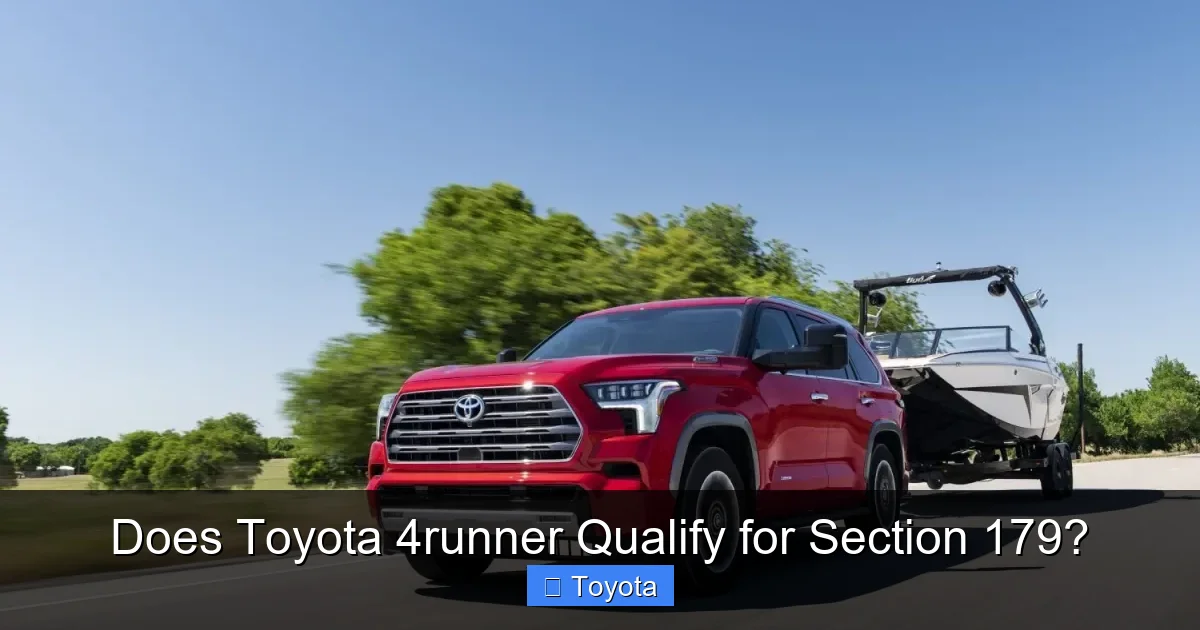
Visual guide about Does Toyota 4runner Qualify for Section 179?
Image source: motorbiscuit.com
Section 179 is a tax deduction provision in the U.S. tax code that allows businesses to deduct the full purchase price of qualifying equipment and vehicles in the year they are purchased and put into service. Instead of spreading the cost over the asset’s useful life through depreciation, Section 179 lets you take the entire expense upfront—up to certain limits.
For 2024, the maximum Section 179 deduction is $1,220,000, with a phase-out threshold of $3,050,000 in total equipment purchases. This means that if your business buys more than $3.05 million in qualifying assets, your deduction begins to decrease dollar for dollar.
The goal of Section 179 is to encourage businesses to invest in themselves by making it more financially attractive to buy equipment, vehicles, and technology. It’s especially beneficial for small businesses that want to upgrade their fleet without waiting years to recoup the cost through depreciation.
But here’s the catch: not all vehicles qualify. The IRS distinguishes between passenger vehicles and heavier-duty vehicles. Passenger cars are subject to strict depreciation limits, but vehicles with a GVWR over 6,000 pounds are often exempt from those limits and may qualify for the full Section 179 deduction.
This is where the Toyota 4Runner comes into play. Most 4Runner models have a GVWR well above 6,000 pounds, which opens the door to potential eligibility. However, other factors—like how much you use the vehicle for business—also matter.
How Section 179 Differs from Bonus Depreciation
It’s easy to confuse Section 179 with bonus depreciation, but they’re not the same. While both allow accelerated depreciation, they work differently.
Section 179 is an election you make on your tax return to expense the cost of qualifying property in the year it’s placed in service. It’s subject to dollar limits and income limitations—you can’t deduct more than your business’s taxable income.
Bonus depreciation, on the other hand, allows you to deduct a percentage (often 60% or 80% in recent years) of the cost of new qualifying property in the first year, regardless of income. Unlike Section 179, bonus depreciation doesn’t have a spending cap and can create a net operating loss.
In many cases, businesses can use both Section 179 and bonus depreciation together. For example, you might use Section 179 to deduct $25,000 of a vehicle’s cost and then apply bonus depreciation to the remaining balance.
For a Toyota 4Runner, this combination can lead to massive first-year deductions—sometimes covering nearly the entire purchase price.
Does the Toyota 4Runner Meet the GVWR Requirement?
Visual guide about Does Toyota 4runner Qualify for Section 179?
Image source: mooreschevrolet.com
One of the most critical factors in determining Section 179 eligibility for a vehicle is its Gross Vehicle Weight Rating (GVWR). The GVWR is the maximum operating weight of a vehicle as specified by the manufacturer, including the vehicle itself, passengers, cargo, and fuel.
The IRS uses GVWR to distinguish between passenger vehicles and heavier-duty vehicles. Vehicles with a GVWR over 6,000 pounds are generally considered “heavy SUVs” and are exempt from the strict depreciation limits that apply to passenger cars.
So, does the Toyota 4Runner meet this threshold?
Yes—most models do. According to Toyota’s official specifications, the GVWR for the 4Runner ranges from approximately 6,300 to 6,500 pounds, depending on the trim and drivetrain. For example:
– The 2024 Toyota 4Runner SR5 with rear-wheel drive has a GVWR of 6,300 pounds.
– The TRD Pro and Limited trims, often equipped with four-wheel drive and heavier components, can have a GVWR up to 6,500 pounds.
This means that the 4Runner typically qualifies as a heavy SUV under IRS rules, making it eligible for Section 179—provided other conditions are met.
Why GVWR Matters for Tax Deductions
The GVWR threshold of 6,000 pounds isn’t arbitrary. It’s designed to differentiate between everyday passenger vehicles and vehicles built for heavier workloads. Passenger cars—like sedans and small SUVs—are subject to annual depreciation caps (e.g., $12,200 in the first year for 2024). These limits make it nearly impossible to write off the full cost of a vehicle in one year.
But heavy SUVs with a GVWR over 6,000 pounds are exempt from these caps. This allows businesses to deduct much more—up to the full purchase price under Section 179—if the vehicle is used primarily for business.
This is a game-changer for businesses that need a capable, durable vehicle like the 4Runner. Whether you’re a contractor, landscaper, real estate agent, or outdoor guide, the 4Runner’s off-road capability and cargo space make it a practical workhorse. And with the right tax strategy, it can also be a smart financial investment.
How to Verify Your 4Runner’s GVWR
If you’re considering a Toyota 4Runner for business use, it’s important to confirm its GVWR before making a purchase. Here’s how:
1. **Check the door jamb sticker:** Open the driver’s side door and look for a sticker on the B-pillar. It lists the GVWR, tire size, and other important specs.
2. **Review the owner’s manual:** The manual often includes detailed vehicle specifications, including GVWR.
3. **Visit Toyota’s official website:** Use the build-and-price tool to select your desired trim and options. The GVWR is usually listed under “specifications.”
4. **Ask the dealer:** A knowledgeable salesperson can provide the GVWR for any 4Runner model.
Keep this information handy—you may need it when filing your taxes or discussing the purchase with your accountant.
Business Use Requirements for Section 179

Visual guide about Does Toyota 4runner Qualify for Section 179?
Image source: mooreschevrolet.com
Even if your Toyota 4Runner meets the GVWR requirement, it won’t qualify for Section 179 unless it’s used primarily for business purposes. The IRS requires that the vehicle be used for business at least 50% of the time to claim the deduction.
This doesn’t mean you can’t use the 4Runner for personal trips—it just means that business use must be the primary purpose. For example, if you drive 10,000 miles in a year and 6,000 are for business, you meet the threshold.
But here’s the catch: the Section 179 deduction is reduced proportionally based on business use. If you use the vehicle 60% for business, you can only deduct 60% of the eligible amount.
What Counts as Business Use?
The IRS defines business use as any use of the vehicle that is directly related to your trade or business. This includes:
– Driving to client meetings or job sites
– Transporting tools, equipment, or inventory
– Traveling between multiple business locations
– Attending conferences, training, or industry events
Personal use includes commuting from home to your regular workplace (unless you’re self-employed and work from home), family trips, school runs, and leisure travel.
How to Track Business Use
Accurate recordkeeping is essential to support your Section 179 claim. The IRS may request documentation in the event of an audit, so it’s important to maintain detailed records.
Here are some best practices:
– **Keep a mileage log:** Record the date, starting and ending odometer readings, destination, and purpose of each trip. You can use a notebook, spreadsheet, or a dedicated app like MileIQ or QuickBooks Self-Employed.
– **Save receipts:** Keep fuel, maintenance, and repair receipts. While these aren’t directly tied to Section 179, they support your overall vehicle expense claims.
– **Use GPS tracking (optional):** Some businesses use GPS devices or apps that automatically log trips and categorize them as business or personal.
– **Document major business uses:** If you use the 4Runner to transport heavy equipment or travel long distances for work, keep records of those activities.
If you’re audited, the IRS will look for consistency between your mileage logs, tax returns, and business activities. The more detailed your records, the stronger your position.
What Happens If Business Use Drops Below 50%?
If you initially claim Section 179 but later use the vehicle less than 50% for business, you may face recapture. This means the IRS could require you to pay back part of the deduction, plus interest and penalties.
For example, if you claim a $30,000 deduction based on 60% business use but later use the vehicle only 40% for business, you may need to amend your return and repay a portion of the deduction.
To avoid this, only claim Section 179 if you’re confident the vehicle will remain primarily for business use throughout its life.
Leasing vs. Buying: Which Is Better for Section 179?
Another important consideration is whether to buy or lease your Toyota 4Runner. Section 179 only applies to purchased vehicles that are owned by the business. If you lease the vehicle, you cannot claim the Section 179 deduction.
However, leased vehicles may still offer tax benefits. Businesses can typically deduct the portion of lease payments that corresponds to business use. For example, if you use the vehicle 70% for business, you can deduct 70% of each lease payment.
But there are limitations. Leased passenger vehicles are subject to inclusion amounts—reductions in the deductible lease expense based on the vehicle’s fair market value. These amounts increase each year and can significantly reduce your tax benefit.
Heavy SUVs like the 4Runner are exempt from these inclusion amounts if they have a GVWR over 6,000 pounds. So, if you lease a 4Runner that meets the weight requirement and use it primarily for business, you may still deduct a large portion of your lease payments.
Buying: Pros and Cons
Pros:
– Eligible for Section 179 and bonus depreciation
– Full ownership and no mileage restrictions
– Potential to sell or trade in later
Cons:
– Higher upfront cost
– Responsibility for maintenance and repairs
– Depreciation over time
Leasing: Pros and Cons
Pros:
– Lower monthly payments
– Ability to upgrade to a new vehicle every few years
– Covered under warranty for most of the lease term
Cons:
– No Section 179 deduction
– Mileage limits and wear-and-tear fees
– No equity buildup
For businesses looking to maximize tax savings, buying is usually the better option—especially if you plan to use the 4Runner heavily for work.
Real-World Example: How a Business Owner Used Section 179 on a 4Runner
Let’s look at a practical example to see how Section 179 works in action.
Sarah owns a landscaping company in Colorado. She needs a reliable, off-road capable vehicle to transport her crew and equipment to job sites in mountainous areas. She decides to purchase a 2024 Toyota 4Runner TRD Off-Road for $52,000.
Here’s how she maximizes her tax savings:
1. **Confirms GVWR:** She checks the door jamb sticker and confirms the GVWR is 6,500 pounds—well above the 6,000-pound threshold.
2. **Uses vehicle for business 80% of the time:** She drives 15,000 miles per year, with 12,000 miles for business (client sites, equipment transport, etc.).
3. **Claims Section 179:** She elects to deduct $52,000 under Section 179, but only 80% is business use, so the allowable deduction is $41,600.
4. **Applies bonus depreciation:** Since the vehicle is new, she also claims 60% bonus depreciation on the remaining 20% ($10,400), adding $6,240 to her deduction.
5. **Total first-year deduction:** $41,600 (Section 179) + $6,240 (bonus) = $47,840.
This reduces her taxable income by nearly $48,000 in the first year—putting thousands of dollars back into her business.
Sarah also keeps a detailed mileage log and saves all receipts, ensuring she’s prepared in case of an audit.
Common Mistakes to Avoid
While Section 179 can be a powerful tool, it’s easy to make mistakes that could cost you money or trigger an audit. Here are some common pitfalls to avoid:
– **Assuming all 4Runners qualify:** While most do, always verify the GVWR for your specific model and year.
– **Overestimating business use:** Be honest about how much you’ll use the vehicle for work. Exaggerating usage can lead to recapture.
– **Failing to keep records:** Without mileage logs and receipts, you can’t prove your claim.
– **Claiming Section 179 on a leased vehicle:** Only purchased vehicles qualify.
– **Ignoring state tax rules:** Some states don’t follow federal Section 179 rules, so check your state’s regulations.
– **Not consulting a tax professional:** Tax laws are complex and change frequently. A CPA or tax advisor can help you navigate the rules and maximize your savings.
Conclusion: Is the Toyota 4Runner a Smart Business Investment?
The Toyota 4Runner is more than just a rugged, capable SUV—it can also be a smart financial decision for business owners who understand the tax benefits. With a GVWR typically over 6,000 pounds, most 4Runner models qualify as heavy SUVs under IRS rules, making them eligible for Section 179 deductions.
By purchasing the vehicle and using it primarily for business, you can deduct a significant portion of the purchase price in the first year—especially when combined with bonus depreciation. This can free up cash flow, reduce taxable income, and help your business grow.
However, eligibility depends on several factors: GVWR, business use percentage, and proper documentation. Leased vehicles don’t qualify for Section 179, and personal use reduces the allowable deduction.
If you’re considering a Toyota 4Runner for your business, take the time to verify its specs, plan your usage, and consult a tax professional. With the right strategy, your 4Runner can be both a workhorse and a tax-saving tool.
Frequently Asked Questions
Can I claim Section 179 on a used Toyota 4Runner?
Yes, as long as the used 4Runner has a GVWR over 6,000 pounds and is used primarily for business. Section 179 applies to both new and used vehicles, provided they are placed in service for the first time by your business.
What if I use my 4Runner 50% for business and 50% for personal use?
You can still claim Section 179, but the deduction will be reduced to 50% of the eligible amount. For example, a $50,000 vehicle would allow a $25,000 deduction. However, using it more than 50% for business increases your savings.
Does the 4Runner’s trim level affect Section 179 eligibility?
Not directly, but higher trims may have a higher GVWR due to added features like four-wheel drive or heavier suspensions. Always verify the GVWR for your specific model.
Can I claim Section 179 if I’m self-employed?
Yes, self-employed individuals can claim Section 179 on qualifying vehicles used for business. The same rules apply—GVWR over 6,000 pounds and 50%+ business use.
What happens if I sell my 4Runner after claiming Section 179?
If you sell the vehicle before the end of its recovery period, you may need to recapture part of the deduction. The IRS treats this as a disposition, and taxes may be owed on the gain.
Are there income limits for Section 179?
Yes, you cannot deduct more than your business’s taxable income in a given year. However, any unused portion can be carried forward to future years. Bonus depreciation does not have this limitation.