
Does the Toyota 4runner Qualify for Section 179

The Toyota 4Runner may qualify for Section 179 tax deductions if it meets specific IRS criteria, including a gross vehicle weight rating (GVWR) over 6,000 pounds and primary business use. Understanding these rules can help business owners significantly reduce taxable income when purchasing or leasing this rugged SUV.
If you’re a business owner eyeing a rugged, reliable SUV like the Toyota 4Runner, you might be wondering: Does the Toyota 4Runner qualify for Section 179? The short answer is—yes, it often does. But like most tax-related questions, the full picture requires a closer look at IRS rules, vehicle specifications, and how you plan to use the vehicle.
The Toyota 4Runner has long been a favorite among off-road enthusiasts, outdoor professionals, and small business owners who need a tough, capable vehicle. Whether you’re hauling equipment to a job site, traveling to remote clients, or using it for mobile services like landscaping, construction, or adventure tourism, the 4Runner’s durability and performance make it a practical choice. But beyond its mechanical strengths, the 4Runner may also offer a powerful financial advantage: eligibility for the IRS Section 179 tax deduction.
This deduction allows businesses to write off the full purchase price of qualifying vehicles in the year they’re placed into service—rather than depreciating the cost over several years. For many business owners, this can mean thousands of dollars in immediate tax savings. But not all vehicles qualify, and the rules can be tricky. So, let’s break it down: what makes a vehicle eligible, and how does the Toyota 4Runner stack up?
In this guide, we’ll walk you through everything you need to know about Section 179, how it applies to the Toyota 4Runner, and what steps you should take to ensure you’re maximizing your tax benefits. We’ll cover GVWR requirements, business use percentages, leasing options, and real-world examples to help you make an informed decision. Whether you’re buying new or used, financing or leasing, this information will help you understand if the 4Runner is not just a great vehicle—but a smart business investment.
Key Takeaways
- Section 179 allows businesses to deduct the full purchase price of qualifying vehicles: This tax incentive is designed to encourage business investment in equipment and vehicles.
- The Toyota 4Runner often qualifies due to its GVWR over 6,000 pounds: Most 4Runner trims exceed this threshold, making them eligible for the deduction.
- Business use must be 50% or more to claim the deduction: Personal use reduces the allowable deduction proportionally.
- Leasing a 4Runner may also offer tax advantages: Monthly lease payments can often be deducted as a business expense.
- Bonus depreciation may apply in addition to Section 179: This allows even greater first-year deductions under current tax laws.
- Documentation and proper classification are critical: Keep detailed records of mileage, usage, and purchase details to support your claim.
- Consult a tax professional for personalized advice: Tax laws change frequently, and expert guidance ensures compliance and maximum benefit.
📑 Table of Contents
- What Is Section 179 and How Does It Work?
- Does the Toyota 4Runner Meet the GVWR Requirement?
- Business Use Requirements and Documentation
- Leasing vs. Buying: Tax Implications for the 4Runner
- Real-World Examples and Case Studies
- Common Mistakes to Avoid
- Conclusion: Is the Toyota 4Runner a Smart Business Investment?
What Is Section 179 and How Does It Work?
Section 179 of the Internal Revenue Code is a tax incentive designed to encourage small and medium-sized businesses to invest in equipment and vehicles. Instead of depreciating the cost of a qualifying asset over its useful life (which can take 5, 7, or even 20 years), Section 179 allows businesses to deduct the full purchase price in the year the asset is placed into service.
This means if you buy a $50,000 Toyota 4Runner for your business and it qualifies, you could potentially deduct the entire $50,000 from your taxable income in that year—subject to certain limits and conditions. This can significantly reduce your tax bill and improve cash flow, especially for businesses making large equipment purchases.
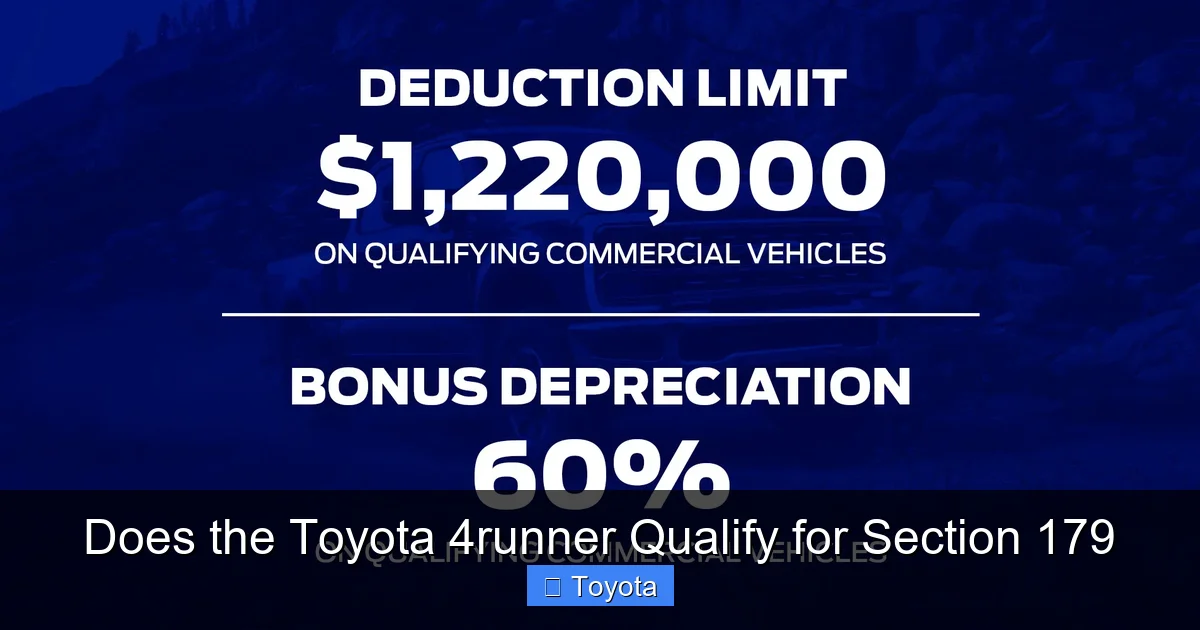
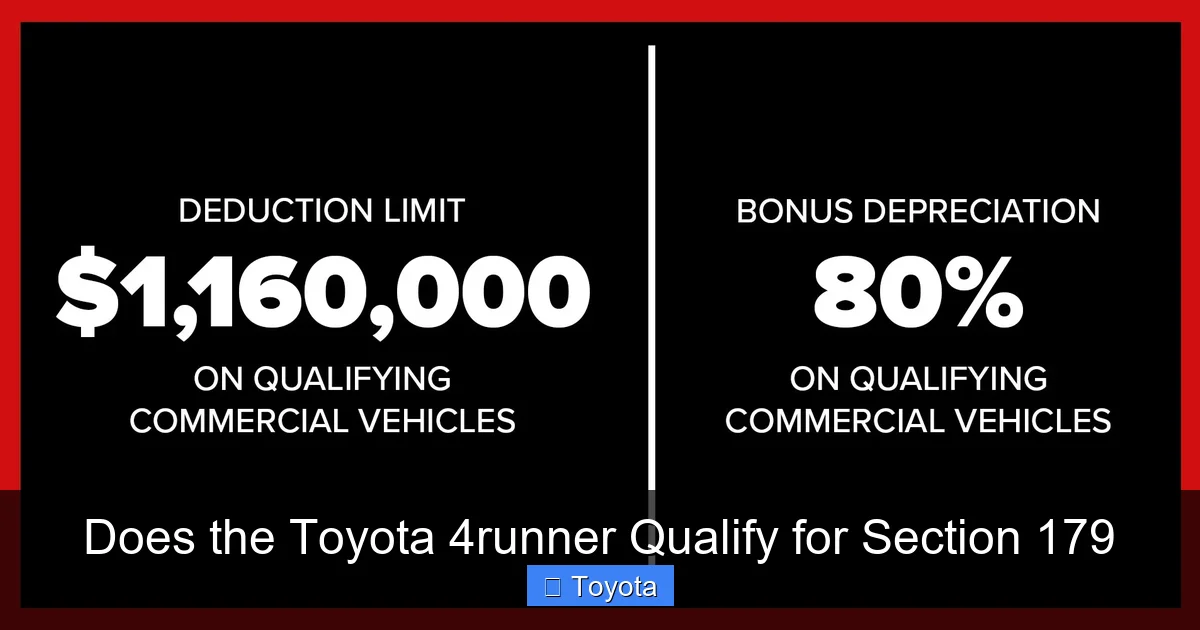
The deduction isn’t unlimited. For 2024, the maximum Section 179 deduction is $1,220,000, with a phase-out threshold of $3,050,000 in total equipment purchases. This means if your business buys more than $3.05 million in qualifying assets, the deduction begins to decrease dollar for dollar. However, for most small businesses, these limits are more than sufficient.
It’s also important to note that Section 179 applies only to new or used equipment and vehicles that are purchased (not leased, though lease payments may still be deductible under different rules). The asset must be used for business purposes more than 50% of the time, and it must be placed into service during the tax year you’re claiming the deduction.
Eligibility Requirements for Vehicles
Not every vehicle qualifies for Section 179. The IRS has specific rules to prevent abuse of the deduction, especially for luxury cars and personal vehicles. To qualify, a vehicle must meet one of two main criteria:
1. Gross Vehicle Weight Rating (GVWR) over 6,000 pounds: Vehicles with a GVWR above this threshold are generally considered “heavy” vehicles and are eligible for the full deduction, regardless of size or luxury features.
2. Passenger vehicles with specific business modifications: Some passenger cars may qualify if they’re modified for business use (e.g., cargo vans with no passenger seating), but these are subject to stricter limits.
For most SUVs and trucks, the GVWR rule is the key. If the vehicle weighs more than 6,000 pounds when fully loaded, it’s likely eligible. This is where the Toyota 4Runner shines.
How Section 179 Differs from Bonus Depreciation
It’s easy to confuse Section 179 with bonus depreciation, but they’re not the same. Bonus depreciation allows businesses to deduct a percentage (currently 60% for 2024) of the cost of qualifying property in the first year, regardless of business use percentage. However, unlike Section 179, bonus depreciation doesn’t require the asset to be used more than 50% for business.
You can often use both Section 179 and bonus depreciation together. For example, you might take the maximum Section 179 deduction first, then apply bonus depreciation to the remaining cost. This can result in near-total first-year write-offs for qualifying vehicles.
However, bonus depreciation is being phased down over the next few years (to 40% in 2025, 20% in 2026, and 0% in 2027), so timing your purchase can impact your total savings.
Does the Toyota 4Runner Meet the GVWR Requirement?
Visual guide about Does the Toyota 4runner Qualify for Section 179
Image source: prestonmotor.com
The most critical factor in determining whether the Toyota 4Runner qualifies for Section 179 is its Gross Vehicle Weight Rating (GVWR). GVWR is the maximum allowable weight of a fully loaded vehicle, including passengers, cargo, fuel, and accessories. It’s set by the manufacturer and listed on the vehicle’s door jamb sticker or in the owner’s manual.
For Section 179 eligibility, the GVWR must be over 6,000 pounds. Fortunately, most Toyota 4Runner models easily meet this requirement.
GVWR by 4Runner Trim and Model Year
Let’s look at recent model years to see how the 4Runner stacks up:
– 2023–2024 Toyota 4Runner: GVWR ranges from 6,300 to 6,500 pounds, depending on trim and drivetrain. Even the base SR5 trim exceeds 6,000 pounds.
– 2020–2022 Models: GVWR is consistently around 6,300–6,500 pounds.
– 2015–2019 Models: GVWR remains above 6,000 pounds across all trims.
This means that whether you’re buying a brand-new 4Runner or a used one from the last decade, it’s very likely to qualify based on weight alone.
Why GVWR Matters More Than Curb Weight
It’s important not to confuse GVWR with curb weight. Curb weight is the weight of the vehicle without passengers or cargo. For example, a 4Runner might have a curb weight of around 4,500 pounds, but its GVWR is over 6,000 pounds because it’s designed to carry significant loads.
The IRS uses GVWR—not curb weight—to determine eligibility. So even though the 4Runner doesn’t look like a heavy-duty truck, its engineering and load capacity place it firmly in the “heavy vehicle” category.
Checking the GVWR on Your 4Runner
If you’re considering a specific 4Runner, here’s how to verify its GVWR:
1. Look at the driver’s side door jamb: Open the driver’s door and check the sticker on the frame. It will list the GVWR, tire size, and other specs.
2. Check the owner’s manual: The manual includes detailed vehicle specifications, including GVWR.
3. Use Toyota’s VIN decoder: Enter the Vehicle Identification Number (VIN) on Toyota’s official website or a trusted VIN decoder to get accurate specs.
4. Ask the dealer or seller: Reputable sellers should be able to provide GVWR information.
Once you confirm the GVWR is over 6,000 pounds, you’re on solid ground for Section 179 eligibility.
Business Use Requirements and Documentation
Visual guide about Does the Toyota 4runner Qualify for Section 179
Image source: dovercdjr.com
Even if your Toyota 4Runner meets the GVWR requirement, you must use it for business purposes to qualify for the Section 179 deduction. The IRS requires that the vehicle be used more than 50% for business to claim the full deduction.
What Counts as Business Use?
Business use includes any mileage driven for work-related activities, such as:
– Traveling to job sites or client meetings
– Transporting tools, equipment, or materials
– Making deliveries or service calls
– Driving between multiple business locations
Personal use—such as commuting from home to a regular office (unless it’s a qualified home office), family trips, or weekend adventures—does not count toward the business percentage.
Calculating Business Use Percentage
To determine your business use percentage, divide your business miles by your total miles driven in the year. For example:
– Total miles driven: 15,000
– Business miles: 9,000
– Business use percentage: 9,000 ÷ 15,000 = 60%
In this case, you can deduct 60% of the vehicle’s cost under Section 179.
Keeping Accurate Records
The IRS may request documentation to support your deduction, so it’s essential to keep detailed records. Here’s what to track:
– Mileage logs: Use a logbook, app, or spreadsheet to record date, start/end odometer readings, destination, and purpose of each trip.
– Receipts and invoices: Keep records of the purchase price, financing, and any modifications.
– Usage notes: Note whether trips were for business or personal use.
Apps like MileIQ, QuickBooks Self-Employed, or even a simple Excel sheet can help automate this process. The more organized your records, the easier it will be to defend your deduction if audited.
Consequences of Falling Below 50% Business Use
If your business use drops below 50% in a later year, the IRS may require you to recapture part of the deduction. This means you’ll owe additional taxes on the portion of the deduction that no longer qualifies. To avoid this, monitor your usage annually and adjust your tax strategy if needed.
Leasing vs. Buying: Tax Implications for the 4Runner

Visual guide about Does the Toyota 4runner Qualify for Section 179
Image source: angelakrauselincoln.com
Another important consideration is whether to buy or lease your Toyota 4Runner. Both options can offer tax benefits, but they work differently under Section 179.
Buying the 4Runner
When you purchase a 4Runner, you own the vehicle and can claim the full Section 179 deduction (up to the limit) in the year it’s placed into service. You can also take advantage of bonus depreciation if applicable.
Financing the purchase doesn’t affect your ability to claim the deduction—you can still deduct the full purchase price even if you’re making monthly payments. However, interest on the loan may also be deductible as a business expense.
Leasing the 4Runner
Leasing doesn’t allow you to claim Section 179 on the vehicle itself, since you don’t own it. However, you can typically deduct the monthly lease payments as a business expense—again, based on your business use percentage.
For example, if you lease a 4Runner for $600 per month and use it 70% for business, you can deduct $420 per month ($600 × 70%).
Some leases also include a “Section 179 inclusion amount” for heavy vehicles, which allows a portion of the lease payments to be treated similarly to a purchase. This can further enhance your deductions.
Which Option Is Better?
The choice between buying and leasing depends on your financial situation, usage patterns, and long-term plans:
– Buying is better if: You plan to keep the vehicle long-term, drive high mileage, or want to maximize upfront deductions.
– Leasing is better if: You prefer lower monthly payments, want to upgrade frequently, or don’t want the hassle of selling a used vehicle.
In many cases, buying with Section 179 offers greater tax savings, especially for high-mileage business users.
Real-World Examples and Case Studies
Let’s look at a few practical scenarios to see how Section 179 works with the Toyota 4Runner.
Case Study 1: Landscaping Business Owner
Maria runs a landscaping company and needs a reliable vehicle to transport crews, tools, and plants. She buys a 2024 Toyota 4Runner TRD Off-Road for $52,000. The GVWR is 6,500 pounds, and she uses it 80% for business.
– Section 179 deduction: $52,000 × 80% = $41,600
– She can deduct $41,600 from her taxable income in the first year.
– If she’s in the 24% tax bracket, this saves her $9,984 in taxes ($41,600 × 0.24).
Maria also keeps a mileage log and saves all receipts, ensuring she can support her deduction if audited.
Case Study 2: Mobile Pet Groomer
James operates a mobile pet grooming service and leases a 2023 4Runner for $550 per month. He uses it 90% for business.
– Monthly deduction: $550 × 90% = $495
– Annual deduction: $495 × 12 = $5,940
– Over three years, he deducts $17,820 in lease payments.
While he doesn’t get the large upfront deduction of buying, the consistent write-off helps reduce his taxable income each year.
Case Study 3: Construction Contractor
David buys a used 2020 4Runner for $38,000. The GVWR is 6,300 pounds, and he uses it 100% for business.
– Full Section 179 deduction: $38,000
– Bonus depreciation (60% in 2024): $0 (since Section 179 covers the full cost)
– Total first-year deduction: $38,000
David saves over $9,000 in taxes and has a durable vehicle for his job sites.
These examples show how the 4Runner can be a smart financial move—not just a great SUV.
Common Mistakes to Avoid
Even with the best intentions, business owners sometimes make errors that reduce their Section 179 benefits or trigger IRS scrutiny. Here are common pitfalls to avoid:
Assuming All SUVs Qualify
Not all SUVs have a GVWR over 6,000 pounds. Popular models like the Honda CR-V, Toyota RAV4, or Ford Explorer typically fall below this threshold and are subject to passenger vehicle limits. Always check the GVWR before assuming eligibility.
Overestimating Business Use
It’s tempting to claim 100% business use, but if your records show frequent personal trips, the IRS may disallow part of your deduction. Be honest and accurate in your reporting.
Failing to Document Usage
Without mileage logs and receipts, you have no proof of business use. Keep records from day one—don’t wait until tax season.
Ignoring State Tax Rules
Some states don’t conform to federal Section 179 rules. Check your state’s tax laws to ensure you’re compliant.
Not Consulting a Tax Professional
Tax laws change frequently. A CPA or tax advisor can help you navigate the rules, maximize deductions, and avoid costly mistakes.
Conclusion: Is the Toyota 4Runner a Smart Business Investment?
So, does the Toyota 4Runner qualify for Section 179? In most cases, the answer is a resounding yes. With a GVWR well over 6,000 pounds, strong business utility, and a reputation for reliability, the 4Runner checks all the boxes for Section 179 eligibility.
Whether you’re a contractor, service provider, or outdoor entrepreneur, this SUV can offer both performance and tax advantages. By understanding the rules—GVWR, business use, documentation, and leasing vs. buying—you can make a confident decision that benefits your business and your bottom line.
Remember, the key to maximizing your savings is preparation. Verify the GVWR, track your mileage, and consult a tax professional to ensure you’re taking full advantage of available deductions. With the right approach, the Toyota 4Runner isn’t just a vehicle—it’s a strategic business asset.
Investing in the right equipment is about more than functionality. It’s about smart financial planning. And when it comes to combining rugged capability with tax savings, the Toyota 4Runner stands out as a top choice for business owners who want to go the extra mile—both on and off the road.
Frequently Asked Questions
Can I claim Section 179 on a used Toyota 4Runner?
Yes, you can claim Section 179 on a used Toyota 4Runner as long as it’s new to you and meets the GVWR and business use requirements. The IRS allows deductions on both new and used qualifying vehicles.
What if I use my 4Runner for both business and personal trips?
You can still claim the deduction, but only for the percentage of business use. For example, if you use it 70% for business, you can deduct 70% of the cost under Section 179.
Does the 4Runner qualify for bonus depreciation too?
Yes, if you don’t use the full Section 179 deduction, you may be able to apply bonus depreciation to the remaining cost. However, bonus depreciation is being phased down in future years.
Can I claim Section 179 if I lease the 4Runner?
You cannot claim Section 179 on a leased vehicle, but you can deduct lease payments as a business expense based on your business use percentage.
What happens if my business use drops below 50% after claiming Section 179?
The IRS may require you to recapture part of the deduction, meaning you’ll owe additional taxes on the portion that no longer qualifies. Keep usage above 50% to avoid this.
How do I find the GVWR of my Toyota 4Runner?
Check the driver’s side door jamb sticker, the owner’s manual, or use a VIN decoder online. The GVWR is listed clearly and must be over 6,000 pounds to qualify.
