
Can I Put 88 Gas in My Car

Yes, you can usually put 88 octane gas in your car if the owner’s manual allows it—but it’s not always the best choice. While many modern vehicles can run safely on 88 octane, using the recommended fuel ensures optimal performance, fuel efficiency, and engine longevity. Always check your vehicle’s specifications before making a switch.
Key Takeaways
- 88 octane gas is legal and available in most U.S. states: It’s a mid-grade fuel that blends 15% ethanol (E15) with regular unleaded, offering slightly higher octane than standard 87.
- Most cars can run on 88 octane without damage: Modern engines with knock sensors can adjust timing to prevent pre-ignition, making 88 octane safe for many vehicles.
- Check your owner’s manual first: Manufacturers specify the minimum octane rating your engine requires—using lower than recommended can void warranties or cause engine knock.
- Performance gains are minimal for most drivers: Unless your car is high-performance or turbocharged, you likely won’t notice improved power or mileage from 88 octane.
- Ethanol content matters more than octane for some engines: E15 (found in 88 gas) may reduce fuel economy and harm older or small engines not designed for ethanol blends.
- Using 88 octane won’t “clean” your engine: Unlike premium additives, higher octane doesn’t remove carbon buildup—use dedicated fuel system cleaners instead.
- Cost vs. benefit analysis is essential: If 88 octane costs more than 87 and your car doesn’t require it, you’re likely wasting money without real gains.
📑 Table of Contents
- What Is 88 Octane Gas—And Where Did It Come From?
- Can I Put 88 Gas in My Car? What the Manufacturers Say
- Performance, Efficiency, and Real-World Benefits of 88 Octane
- Environmental and Economic Considerations
- Best Practices: When to Use 88 Octane—and When to Avoid It
- Conclusion: Is 88 Octane Right for Your Car?
What Is 88 Octane Gas—And Where Did It Come From?
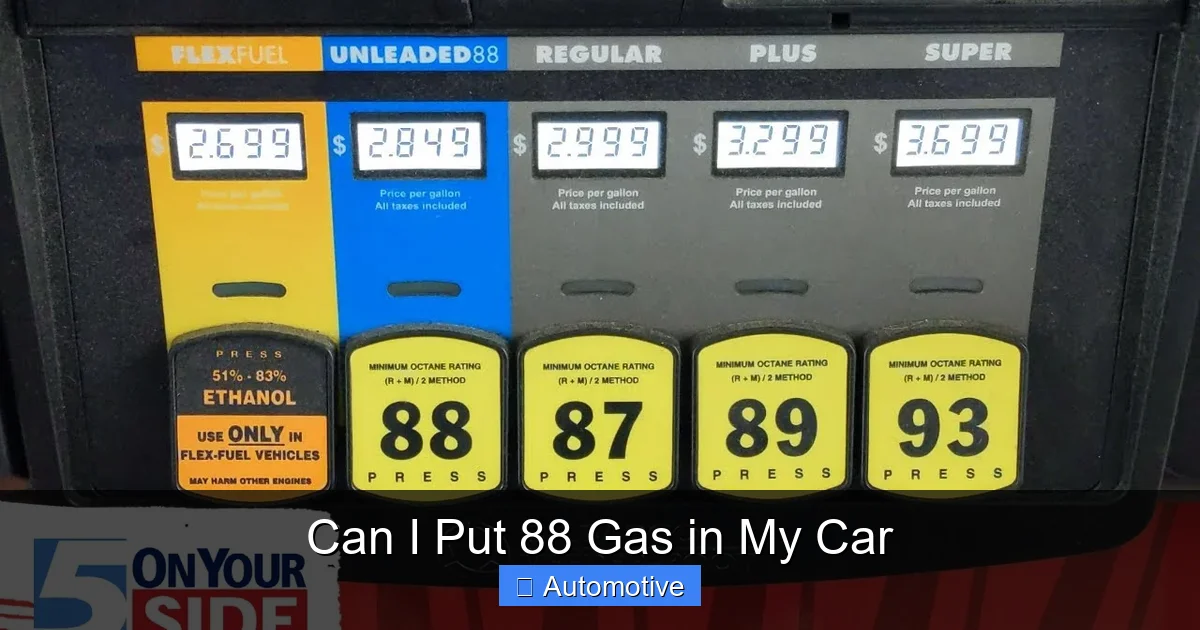
If you’ve ever pulled up to a gas pump and seen “88 octane” listed between regular (87) and premium (91–93), you’re not alone in wondering what it is and whether it’s safe for your car. Unlike traditional fuel grades that have been around for decades, 88 octane is a relatively new option in the U.S. fuel market, introduced as part of efforts to promote cleaner-burning, renewable fuels.
At its core, 88 octane gas is essentially regular unleaded gasoline blended with 15% ethanol—commonly known as E15. Standard regular gas contains up to 10% ethanol (E10), so 88 octane has a higher ethanol content. The increase in ethanol raises the octane rating slightly, which is why it’s labeled as 88 instead of 87. This blend was approved by the Environmental Protection Agency (EPA) in 2011 for use in vehicles model year 2001 and newer, though many states only began offering it widely in the late 2010s.
The push for E15 and 88 octane comes from environmental and agricultural interests. Ethanol is made primarily from corn in the U.S., and increasing its use reduces reliance on fossil fuels and lowers greenhouse gas emissions—at least in theory. Proponents argue that 88 octane offers a greener alternative without requiring major changes to existing fuel infrastructure or vehicle designs.
But here’s the catch: while 88 octane is legal and available at many stations—especially in the Midwest—it’s not universally accepted. Some automakers have been slow to approve its use, and not all vehicles are compatible. That’s why the big question remains: Can I put 88 gas in my car?
How Octane Ratings Work—And Why They Matter
Before deciding whether 88 octane is right for your vehicle, it helps to understand what “octane” actually means. Octane rating measures a fuel’s ability to resist “knocking” or “pinging” during combustion—the unwanted sound and vibration that occurs when fuel ignites prematurely in the engine cylinder.
Engines are designed with specific compression ratios. High-performance or turbocharged engines compress air and fuel more intensely, which increases the risk of pre-ignition. Higher octane fuel resists this premature ignition better than lower octane fuel. That’s why sports cars and luxury vehicles often require 91 or 93 octane.
But for the average commuter driving a sedan or compact SUV, 87 octane is usually sufficient. Modern engines are equipped with knock sensors that detect abnormal combustion and adjust ignition timing on the fly. This technology allows many cars to safely run on lower-octane fuel, even if the manufacturer recommends a higher grade.
So where does 88 octane fit in? It sits in a sweet spot—slightly higher than regular, but not quite premium. For drivers whose cars recommend 87 octane, 88 might offer a tiny buffer against knocking under heavy load or high temperatures. But for most daily driving conditions, the difference is negligible.
The Ethanol Factor: E15 vs. E10
One of the biggest concerns about 88 octane isn’t the octane itself—it’s the ethanol content. As mentioned, 88 octane contains 15% ethanol (E15), compared to the 10% (E10) found in standard regular gas. While that may not sound like a big jump, ethanol behaves differently than pure gasoline, and that can impact your car in several ways.
Ethanol has less energy per gallon than gasoline. That means burning E15 can reduce your fuel economy by 3–5%, depending on the vehicle. So even if 88 octane costs the same as 87, you might end up spending more per mile because you’re getting fewer miles per gallon.
Additionally, ethanol is hygroscopic—it attracts and holds water. Over time, this can lead to phase separation in your fuel tank, especially in older cars or vehicles that sit for long periods. When water and ethanol separate from gasoline, it can cause corrosion, fuel line blockages, and starting problems.
Small engines—like those in lawn mowers, chainsaws, and older motorcycles—are particularly vulnerable to ethanol damage. Many manufacturers void warranties if E15 is used in equipment not rated for it. While most modern cars can handle E15, it’s still wise to check your owner’s manual before filling up.
Can I Put 88 Gas in My Car? What the Manufacturers Say
Visual guide about Can I Put 88 Gas in My Car
Image source: i.ytimg.com
The short answer? Maybe. But the long answer depends entirely on your vehicle’s make, model, year, and manufacturer recommendations. Let’s break it down.
Most automakers have evaluated E15 and 88 octane for use in their vehicles. As of recent years, the majority of cars and light trucks from 2001 onward are approved for E15 by the EPA—but that doesn’t mean every manufacturer endorses it.
For example, General Motors (Chevrolet, GMC, Cadillac, Buick) has approved E15 for all vehicles from 2012 and newer. Ford allows E15 in most models from 2013 and later, including F-150s and Mustangs. Toyota, Honda, and Hyundai have also approved E15 for many of their recent models, though some high-performance or hybrid vehicles may have restrictions.
However, some brands are more cautious. Subaru, for instance, does not recommend E15 for any of its vehicles, citing potential long-term engine damage. Similarly, BMW, Mercedes-Benz, and Porsche often advise against using anything below their recommended octane rating, which is typically 91 or higher for performance models.
The best way to know for sure? Check your owner’s manual. Look for a section on “fuel requirements” or “recommended octane.” If it says “minimum 87 octane” or “87 AKI (Anti-Knock Index),” then 88 octane is likely safe. But if it specifies “premium fuel recommended” or “91 octane minimum,” stick with higher-octane fuel.
What Happens If You Use 88 Octane in a Car That Requires Premium?
Let’s say you drive a turbocharged sedan that recommends 91 octane, but you’re tempted to save money by filling up with 88. What could go wrong?
In the short term, probably nothing dramatic. Modern engines with knock sensors will detect the lower octane and retard ignition timing to prevent knocking. This protects the engine but may reduce power and fuel efficiency. You might notice the car feels less responsive, especially during acceleration or uphill driving.
Over time, however, consistently using lower-octane fuel than recommended can lead to increased carbon buildup, reduced engine performance, and even long-term damage. In extreme cases, uncontrolled knocking can damage pistons, valves, or spark plugs.
Additionally, using the wrong fuel may void your warranty. Many manufacturers explicitly state that damage caused by incorrect fuel is not covered. So even if your car seems fine now, a future repair claim could be denied if records show you used 88 octane in a premium-required engine.
Can Older Cars Handle 88 Octane?
If your car was built before 2001, the answer is generally no—88 octane (E15) is not approved for use in pre-2001 vehicles. These older engines weren’t designed to handle the higher ethanol content, and the risk of fuel system damage is significant.
Classic cars, vintage trucks, and older motorcycles are especially vulnerable. Ethanol can degrade rubber seals, gaskets, and fuel lines that were made for lower-ethanol fuels. It can also corrode metal components in the fuel system, leading to leaks or failures.
Even if your older car seems to run fine on 88 octane at first, the long-term effects can be costly. Replacing fuel lines, cleaning injectors, or repairing corrosion damage can add up quickly. For classic car enthusiasts, it’s always safer to stick with E10 (87 octane) or use ethanol-free fuel when available.
Performance, Efficiency, and Real-World Benefits of 88 Octane
Visual guide about Can I Put 88 Gas in My Car
Image source: wrench.com
Now that we’ve covered the safety and compatibility aspects, let’s talk about performance. Does 88 octane actually make your car run better?
For the vast majority of drivers, the answer is no—not in any noticeable way. Unless your car is designed for higher-octane fuel, you won’t see a meaningful improvement in horsepower, acceleration, or fuel economy from switching to 88 octane.
That said, there are a few scenarios where 88 might offer a slight edge:
– **Hot weather or high-altitude driving:** In extreme heat or at high elevations, engines are more prone to knocking. The slightly higher octane of 88 can provide a small buffer, especially in older vehicles without advanced knock sensors.
– **Towing or heavy loads:** If you frequently tow a trailer or carry heavy cargo, your engine works harder and generates more heat. In these cases, 88 octane might help prevent knocking under stress.
– **Vehicles with carbon buildup:** Over time, carbon deposits can form in combustion chambers, effectively increasing compression and raising the risk of knocking. Higher octane fuel can help resist this, though it won’t clean the deposits—only a dedicated cleaner can do that.
But again, these benefits are marginal. For everyday driving, the difference between 87 and 88 octane is barely perceptible. And if your car doesn’t require it, you’re likely just paying more for fuel with no real return.
Fuel Economy: Does 88 Octane Save or Cost You Money?
Let’s do the math. Suppose 87 octane costs $3.50 per gallon, and 88 octane costs $3.55. On the surface, it’s only a 5-cent difference—seems negligible, right?
But remember: E15 has about 3–5% less energy than E10. That means your car will get fewer miles per gallon on 88 octane. If you normally get 30 mpg on 87, you might drop to 28.5–29 mpg on 88.
Over 1,000 miles, that’s an extra 3–5 gallons of fuel needed. At $3.55 per gallon, that’s $10.65–$17.75 more in fuel costs—just to go 1,000 miles. And that’s before considering whether your car actually benefits from the higher octane.
In short: unless your car specifically recommends or requires 88 octane (or higher), you’re likely spending more money for no real gain.
Does 88 Octane Clean Your Engine?
You might have heard that higher-octane fuel “cleans” your engine or removes carbon buildup. This is a common myth.
Octane rating has nothing to do with cleaning ability. What cleans your engine are detergent additives in the fuel—and all major gasoline brands (Top Tier certified or not) contain some level of detergents.
In fact, many 88 octane fuels are sold by retailers that may not meet Top Tier standards, meaning they could have fewer cleaning additives than premium or even regular gas from top brands.
If you’re concerned about carbon buildup, use a fuel system cleaner additive every 3,000–5,000 miles. Products like Chevron Techron, Sea Foam, or Red Line Complete SI-1 are far more effective than switching fuel grades.
Environmental and Economic Considerations
Visual guide about Can I Put 88 Gas in My Car
Image source: d2j6dbq0eux0bg.cloudfront.net
Beyond performance and cost, there are broader implications to consider when choosing 88 octane.
From an environmental standpoint, E15 does reduce tailpipe emissions of carbon monoxide and some hydrocarbons. However, the overall lifecycle emissions—including farming, processing, and transporting corn-based ethanol—are debated. Some studies suggest the net environmental benefit is minimal or even negative when land-use changes and fertilizer runoff are factored in.
Economically, 88 octane supports the U.S. ethanol industry, which benefits corn farmers and rural economies. But it also means more corn is diverted from food production to fuel, which can affect global food prices.
For consumers, the economic impact is mixed. While 88 octane is often priced close to regular gas, the reduced fuel economy means you’re not really saving money. And in areas where 88 octane is marketed as a “premium” option, it may be priced higher than 87 for no good reason.
State Regulations and Availability
Not all states allow or encourage the sale of 88 octane. As of 2024, it’s most common in the Midwest—particularly in corn-producing states like Iowa, Illinois, and Nebraska. Other states have been slower to adopt it due to infrastructure challenges, consumer education gaps, or resistance from automakers.
Additionally, some states require special labeling or warnings at the pump. For example, pumps selling E15 must display a yellow and black label stating that the fuel is approved for vehicles 2001 and newer. Always read the labels carefully before fueling.
If you travel frequently, especially across state lines, be aware that 88 octane may not be available everywhere. Sticking to 87 or higher (as needed) ensures you won’t be stranded looking for a compatible fuel.
Best Practices: When to Use 88 Octane—and When to Avoid It
So, after all this, how do you decide whether to use 88 octane in your car?
Here’s a simple decision guide:
– **Use 88 octane if:**
– Your owner’s manual says “87 octane minimum” or “regular fuel recommended.”
– You drive in hot climates or at high altitudes.
– You frequently tow or carry heavy loads.
– It’s priced the same or lower than 87 octane.
– **Avoid 88 octane if:**
– Your car requires premium fuel (91+ octane).
– Your vehicle is pre-2001 or not EPA-approved for E15.
– You drive a classic car, motorcycle, or small engine.
– It costs more than 87 octane with no performance benefit.
– You’re concerned about ethanol-related fuel system issues.
And remember: when in doubt, stick with what the manufacturer recommends. Your car was engineered for a specific fuel type—and deviating from that can lead to problems down the road.
Tips for Safe Fueling
– Always check your owner’s manual before trying a new fuel.
– Look for Top Tier certified gasoline, which has higher detergent levels.
– Avoid topping off the tank—it can trigger the vapor recovery system and cause spills.
– If you accidentally put 88 octane in a car that requires premium, don’t panic. Fill up with the correct fuel as soon as possible and drive normally. The knock sensors will protect the engine in the short term.
– For long-term storage (e.g., winterizing a car), use a fuel stabilizer and consider ethanol-free gas if available.
Conclusion: Is 88 Octane Right for Your Car?
So, can you put 88 gas in your car? In most cases, yes—especially if your vehicle is 2001 or newer and the owner’s manual allows it. But just because you *can* doesn’t mean you *should*.
For the average driver, 88 octane offers little to no benefit over regular 87 octane. The slightly higher octane and ethanol content may help in specific conditions, but the reduced fuel economy and potential for long-term fuel system issues make it a questionable choice for everyday use.
The best approach is to follow your manufacturer’s recommendations. If your car runs fine on 87, stick with it. If it requires premium, don’t downgrade to save a few cents. And if you’re curious about 88 octane, try it once—but monitor your car’s performance, fuel economy, and any warning lights.
At the end of the day, your car is a significant investment. Treat it well by using the right fuel, maintaining it regularly, and avoiding unnecessary risks. Whether you choose 87, 88, or 93 octane, the goal is the same: keep your engine running smoothly, efficiently, and reliably for years to come.
Frequently Asked Questions
Can I put 88 gas in my car if it recommends 87 octane?
Yes, in most cases. If your owner’s manual states that 87 octane is the minimum requirement, 88 octane is safe to use and may offer a slight buffer against engine knocking under heavy load or high temperatures.
Will 88 octane damage my engine?
Not if your car is approved for E15 and was built in 2001 or later. However, using 88 octane in older vehicles, high-performance engines, or those requiring premium fuel can lead to knocking, reduced performance, or long-term damage.
Does 88 octane improve fuel economy?
No—in fact, it may reduce fuel economy by 3–5% due to the lower energy content of ethanol. You’ll likely spend more on fuel over time, even if the per-gallon price is similar to 87 octane.
Is 88 octane the same as premium gas?
No. Premium gas typically has an octane rating of 91–93 and is designed for high-compression or turbocharged engines. 88 octane is a mid-grade fuel with higher ethanol content, not a substitute for premium.
Can I use 88 octane in my motorcycle or lawnmower?
No. Most small engines and motorcycles are not approved for E15. Using 88 octane can damage fuel lines, carburetors, and seals. Always use E10 or ethanol-free fuel in small engines.
Why is 88 octane more expensive than 87 in some places?
Even though 88 octane has slightly less energy, some retailers price it higher due to marketing (positioning it as a “better” fuel) or limited supply. Always compare cost per mile, not just per gallon.
