
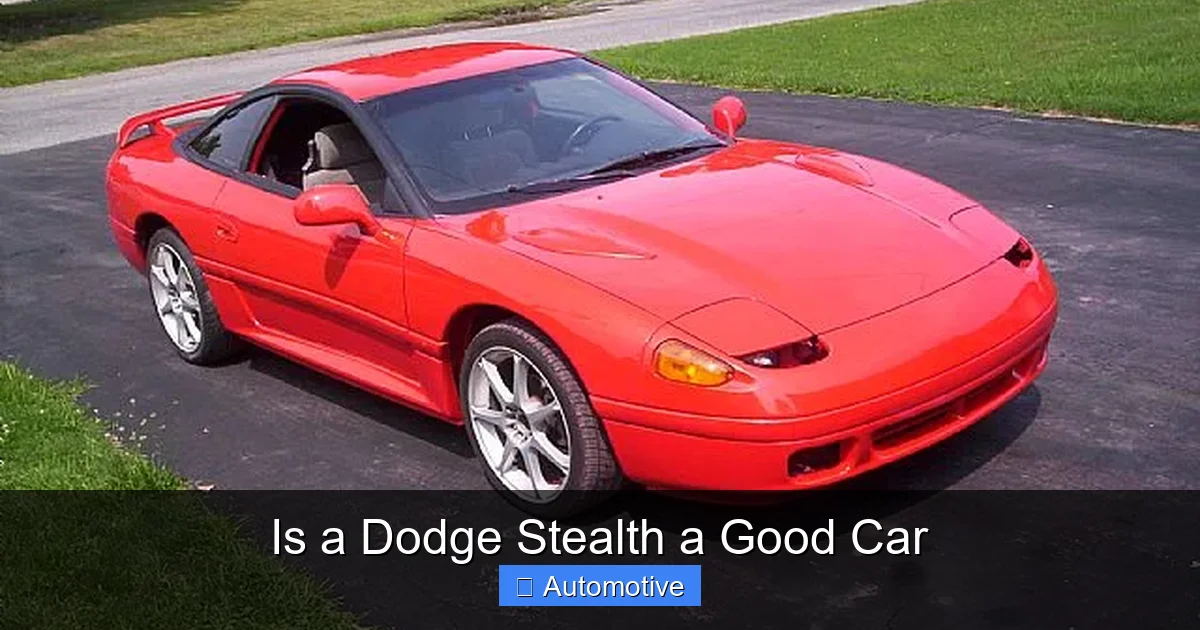
Is a Dodge Stealth a Good Car

The Dodge Stealth is a stylish, performance-oriented coupe from the 1990s that shares its DNA with the Mitsubishi 3000GT. While it offers impressive power, especially in the twin-turbo R/T trim, long-term reliability and maintenance costs can be concerns. For enthusiasts seeking a retro sports car with modern features for its time, the Stealth is a compelling—but niche—choice.
Key Takeaways
- Performance Powerhouse: The top-tier Stealth R/T Twin Turbo delivers 320 horsepower, making it one of the fastest production cars of the early ’90s.
- <>Shared Platform with Mitsubishi 3000GT: Built in a joint venture, the Stealth and 3000GT are mechanically identical but differ in styling and branding.
- <>Advanced Tech for Its Era: Features like all-wheel drive, active aerodynamics, and four-wheel steering were cutting-edge in the 1990s.
- <>Reliability Varies by Model: Naturally aspirated models are generally more reliable than twin-turbo variants, which require meticulous maintenance.
- <>Collectible Status Growing: Well-maintained examples are becoming sought-after among JDM and American performance car collectors.
- <>Higher Maintenance Costs: Parts can be expensive and hard to find, especially for turbocharged models and AWD systems.
- <>Fun to Drive, But Not Practical: With limited cargo space and two doors, it’s best suited as a weekend or secondary vehicle.
📑 Table of Contents
- Introduction: The Dodge Stealth – A Forgotten 90s Icon
- History and Development of the Dodge Stealth
- Performance and Driving Experience
- Interior, Features, and Comfort
- Reliability and Common Problems
- Cost of Ownership and Maintenance
- Collectibility and Resale Value
- Who Should Buy a Dodge Stealth?
- Conclusion: Is a Dodge Stealth a Good Car?
Introduction: The Dodge Stealth – A Forgotten 90s Icon
If you’re a fan of 1990s performance cars, you’ve probably heard of the Dodge Stealth. This sleek, wedge-shaped coupe rolled off the assembly line from 1991 to 1996, and while it never achieved the fame of the Nissan Skyline or Toyota Supra, it carved out a loyal following among gearheads and JDM enthusiasts. The Stealth was Dodge’s answer to the growing demand for high-performance sports cars, and it delivered—on paper, at least—with turbocharged engines, all-wheel drive, and futuristic styling.
But is a Dodge Stealth a good car in today’s market? That’s the million-dollar question. On one hand, it’s a rare piece of automotive history with impressive specs and a unique place in the performance car lineage. On the other, it comes with quirks, maintenance challenges, and a reputation for being temperamental if not properly cared for. Whether you’re considering buying one as a project car, a weekend cruiser, or a collector’s item, it’s important to weigh the pros and cons carefully.
History and Development of the Dodge Stealth

Visual guide about Is a Dodge Stealth a Good Car
Image source: cars-directory.net
The Dodge Stealth didn’t emerge from a vacuum. It was the result of a strategic partnership between Chrysler Corporation and Mitsubishi Motors, known as Diamond-Star Motors (DSM). This collaboration also produced the Mitsubishi Eclipse, Eagle Talon, and Plymouth Laser—all of which shared platforms and components. The Stealth, however, was positioned as the premium offering, with more aggressive styling and higher performance potential.
Launched in 1991, the Stealth was built at the DSM plant in Normal, Illinois, making it one of the few Japanese-designed cars assembled in the U.S. at the time. It shared its platform with the Mitsubishi 3000GT, but Dodge gave it a more aggressive front fascia, pop-up headlights (on early models), and a slightly more muscular stance. The car was available in multiple trims, ranging from the base model to the high-performance R/T Twin Turbo.
The Joint Venture That Shaped a Generation
The DSM partnership was groundbreaking in the early ’90s. It allowed Chrysler to offer sporty, front-wheel-drive-based performance cars without developing them entirely in-house. For Mitsubishi, it was a way to expand its presence in the North American market. The Stealth benefited from this synergy, combining Japanese engineering with American marketing and distribution.
Interestingly, the Stealth was marketed as a halo car for Dodge, meant to showcase the brand’s performance capabilities. It appeared in video games, movies, and magazines, helping to reshape Dodge’s image beyond muscle cars and minivans. While it never sold in huge numbers, it left a lasting impression on those who drove it.
Model Years and Generations
The Dodge Stealth was produced for only six model years, from 1991 to 1996. It underwent a mild refresh in 1994, which included updated headlights (replacing the pop-up units), revised interior trim, and minor suspension tweaks. The 1994–1996 models are often considered the most refined, with improved build quality and reliability.
There were four main trim levels:
– Base: 3.0L V6, 162 hp, front-wheel drive
– ES: Slightly upgraded interior and suspension
– R/T: 3.0L V6, 222 hp, all-wheel drive
– R/T Twin Turbo: 3.0L twin-turbo V6, 320 hp, all-wheel drive
The R/T Twin Turbo was the star of the lineup, offering supercar-level performance at a fraction of the price. It could sprint from 0 to 60 mph in under 5 seconds—blistering fast for the early ’90s.
Performance and Driving Experience
Visual guide about Is a Dodge Stealth a Good Car
Image source: collectorcarads.com
When it comes to performance, the Dodge Stealth—especially the R/T Twin Turbo—delivers a thrilling ride. The 3.0L 6G72 V6 engine, twin-turbocharged and intercooled, produces 320 horsepower and 315 lb-ft of torque. Paired with a five-speed manual transmission and full-time all-wheel drive, it offers excellent traction and acceleration.
Acceleration and Top Speed
The R/T Twin Turbo can hit 60 mph in approximately 4.9 seconds, according to period tests. That’s faster than many contemporary sports cars, including the Chevrolet Corvette of the same era. The top speed is electronically limited to 155 mph, but with the limiter removed, some owners report speeds exceeding 170 mph.
The naturally aspirated R/T model, while less powerful, still offers a respectable 222 hp and 205 lb-ft of torque. It’s more than capable of spirited driving, though it lacks the instant punch of the twin-turbo variant.
Handling and Suspension
The Stealth’s handling is one of its strong suits. The all-wheel-drive system (on R/T and R/T Twin Turbo models) provides excellent grip, especially in wet or slippery conditions. The suspension is tuned for a balance of comfort and sportiness, with MacPherson struts up front and a multi-link setup in the rear.
One standout feature is the four-wheel steering system available on the R/T Twin Turbo. At low speeds, the rear wheels turn in the opposite direction of the front wheels, improving maneuverability. At higher speeds, they turn in the same direction, enhancing stability during lane changes and high-speed cornering.
Braking and Safety
The Stealth comes equipped with four-wheel disc brakes and optional ABS (standard on higher trims). The braking performance is solid, though not exceptional by modern standards. The car lacks modern driver aids like traction control or stability control, which means drivers need to be more attentive, especially in the powerful twin-turbo model.
Safety ratings from the era were decent, with dual airbags standard by the mid-’90s. However, the lack of side airbags and advanced crumple zones means it doesn’t meet today’s safety standards. For this reason, it’s best suited as a secondary or weekend driver rather than a daily commuter.
Interior, Features, and Comfort

Visual guide about Is a Dodge Stealth a Good Car
Image source: media.carsandbids.com
Step inside a Dodge Stealth, and you’re greeted with a driver-focused cockpit that feels futuristic even by today’s standards. The dashboard wraps around the driver, with easy-to-reach controls and a sporty instrument cluster. The seats are supportive, especially in the R/T models, which feature bolstered sport seats.
Technology and Convenience Features
For a car from the early ’90s, the Stealth was surprisingly well-equipped. Standard features on higher trims included:
– Power windows, locks, and mirrors
– Cruise control
– Air conditioning
– AM/FM stereo with cassette (and optional CD player)
– Leather-wrapped steering wheel and shift knob
The R/T Twin Turbo also came with active aerodynamics—a rear spoiler that automatically raised at high speeds to increase downforce. It was one of the first production cars to feature such technology, showcasing Mitsubishi’s engineering prowess.
Interior Space and Practicality
As a two-door coupe, the Stealth isn’t exactly spacious. The front seats are comfortable for average-sized adults, but rear seat space is minimal—best suited for children or storage. Cargo capacity is limited, with a small trunk that’s further reduced by the spare tire and AWD components.
This lack of practicality is one reason the Stealth never became a mainstream success. It’s not a family car, nor is it ideal for long road trips. But for enthusiasts who prioritize driving dynamics over utility, it’s a worthy trade-off.
Build Quality and Materials
Build quality varies by model year and maintenance history. Early 1991–1993 models have a reputation for cheaper interior plastics and occasional electrical gremlins. The 1994–1996 refresh improved fit and finish, with better materials and more reliable electronics.
That said, many Stealths on the road today are nearing 30 years old, so wear and tear are inevitable. Common issues include cracked dashboards, fading upholstery, and malfunctioning power accessories. A well-cared-for example, however, can still feel solid and premium inside.
Reliability and Common Problems
Now, let’s address the elephant in the room: reliability. Is a Dodge Stealth a good car when it comes to long-term dependability? The answer depends largely on the model and how it’s been maintained.
Twin-Turbo Models: Performance Comes at a Cost
The R/T Twin Turbo is the most exciting version of the Stealth, but it’s also the most demanding. The twin-turbo setup adds complexity, and if the turbos, intercoolers, or wastegates aren’t properly maintained, performance can suffer—or worse, the engine can be damaged.
Common issues with twin-turbo models include:
– Turbo failure due to oil starvation or lack of warm-up/cool-down
– Boost leaks from aging hoses and clamps
– Wastegate rattle or sticking
– High fuel consumption (15–18 mpg combined)
Regular oil changes with high-quality synthetic oil are essential. Many owners recommend changing the oil every 3,000 miles, especially if the car is driven hard. Ignoring maintenance can lead to costly repairs, including turbo replacement ($1,500–$3,000 per turbo) or even engine failure.
Naturally Aspirated Models: Simpler and More Reliable
The base and R/T naturally aspirated models are far more reliable. Without turbos to worry about, they’re closer to a standard V6 sedan in terms of maintenance. The 3.0L V6 is a durable engine, known for lasting 200,000+ miles with proper care.
Still, no car is immune to age-related issues. Common problems across all models include:
– Cracked dashboards (due to sun exposure)
– Faulty window regulators
– ABS sensor failures
– Rust on body panels, especially in humid or snowy climates
All-Wheel Drive System: A Double-Edged Sword
The AWD system is a highlight for performance, but it adds weight and complexity. The transfer case, center differential, and rear differential all require regular fluid changes. Neglecting these can lead to premature wear or failure.
Some owners convert their Stealths to front-wheel drive to simplify maintenance, but this sacrifices the car’s unique handling characteristics. If you’re keeping the AWD, budget for periodic servicing.
Electrical and Sensor Issues
The Stealth’s advanced electronics, while impressive for the time, can be problematic today. Sensors for the turbo system, AWD, and active aerodynamics may fail or give false readings. Diagnosing these issues often requires specialized tools and knowledge.
Wiring harnesses can also degrade over time, leading to intermittent electrical faults. A thorough inspection by a knowledgeable mechanic is essential before purchasing a used Stealth.
Cost of Ownership and Maintenance
Owning a Dodge Stealth isn’t cheap—especially if you go for the twin-turbo model. While purchase prices have remained relatively stable (typically $5,000–$15,000 depending on condition), maintenance and repairs can add up quickly.
Parts Availability and Pricing
Parts for the Stealth are not as readily available as for more common cars. While some components are shared with the Mitsubishi 3000GT and other DSM models, many are unique. OEM parts can be expensive, and aftermarket support is limited compared to cars like the Honda Civic or Toyota Supra.
Common replacement parts like turbos, intercoolers, and AWD components can cost thousands. Even smaller items like window switches or interior trim may require sourcing from salvage yards or online forums.
Fuel Economy
Fuel economy is another consideration. The naturally aspirated models average around 18–22 mpg combined, which is decent for a V6 coupe. The twin-turbo model, however, drinks fuel aggressively—expect 15–17 mpg in mixed driving. Premium fuel is recommended, adding to the cost.
Insurance and Registration
Insurance for a Stealth can be higher than average, especially for younger drivers or high-performance trims. Some insurers may classify it as a “sports car,” leading to steeper premiums. Registration and emissions testing vary by state, but older models may be exempt from certain requirements.
DIY vs. Professional Maintenance
Many Stealth owners are DIY enthusiasts, and the car is relatively easy to work on—provided you have the right tools and knowledge. Online forums like DSMtuners and 3000GT.org are invaluable resources for troubleshooting and upgrades.
However, complex systems like the turbochargers, AWD, and active aerodynamics may require professional help. If you’re not mechanically inclined, factor in labor costs when budgeting for ownership.
Collectibility and Resale Value
In recent years, the Dodge Stealth has begun to gain recognition as a collectible car. While it hasn’t reached the stratospheric values of the Nissan Skyline GT-R or Toyota Supra MKIV, well-maintained examples—especially low-mileage R/T Twin Turbos—are becoming harder to find.
Market Trends
Prices have slowly risen over the past decade. A clean, stock R/T Twin Turbo in good condition can now fetch $12,000–$18,000, depending on mileage and documentation. Modified or project cars are cheaper, often under $8,000.
The naturally aspirated models are more affordable, typically ranging from $3,000 to $7,000. These are great options for first-time buyers or those looking for a weekend project.
Factors That Affect Value
Several factors influence a Stealth’s value:
– Originality (matching numbers, factory specs)
– Mileage (under 80,000 miles is ideal)
– Maintenance history (service records, receipts)
– Rust and body condition
– Modifications (stock cars are generally more valuable)
A documented, unmodified R/T Twin Turbo with low mileage and full service history will always command a premium.
Future Outlook
As ’90s performance cars continue to appreciate, the Stealth is poised to become more desirable. Its unique blend of American branding and Japanese engineering makes it a standout in the retro sports car market. For collectors and enthusiasts, now may be the time to buy before prices rise further.
Who Should Buy a Dodge Stealth?
So, is a Dodge Stealth a good car for you? Let’s break it down by buyer type.
The Enthusiast and Collector
If you love ’90s performance cars and appreciate rare, under-the-radar models, the Stealth is a fantastic choice. It’s not as common as a Supra or RX-7, which adds to its appeal. With proper care, it can be a rewarding long-term project or a fun weekend driver.
The Weekend Cruiser
For someone looking for a stylish, fast coupe to enjoy on sunny days, the Stealth fits the bill. Just be prepared for higher maintenance costs and limited practicality. It’s not a daily driver, but it’s perfect for canyon runs, car shows, or scenic drives.
The Budget-Conscious Buyer
If you’re on a tight budget, a naturally aspirated Stealth can be an affordable entry into performance car ownership. Just avoid high-mileage or neglected examples. A well-maintained base or ES model can be a reliable and fun car for under $6,000.
Who Should Avoid It?
The Stealth is not for everyone. If you need a practical, fuel-efficient daily driver, look elsewhere. It’s also not ideal for those unwilling or unable to handle maintenance and repairs. The twin-turbo model, in particular, demands attention and care.
Conclusion: Is a Dodge Stealth a Good Car?
So, is a Dodge Stealth a good car? The answer is: it depends. For the right person, it’s an excellent choice—a rare, stylish, and powerful coupe with a fascinating history. The R/T Twin Turbo, in particular, offers supercar performance at a fraction of the cost, and its advanced features were ahead of their time.
However, it’s not without drawbacks. Maintenance can be expensive, parts are not always easy to find, and reliability varies by model. The twin-turbo version, while thrilling, requires meticulous care to keep running smoothly.
If you’re an enthusiast who values driving excitement, retro styling, and a unique ownership experience, the Dodge Stealth is worth considering. Just go in with your eyes open, do your research, and be prepared to invest time and money into keeping it in top shape.
In the end, the Stealth isn’t just a car—it’s a piece of automotive history. And for those who appreciate its quirks and charms, it’s more than worth the effort.
Frequently Asked Questions
Is the Dodge Stealth reliable?
The reliability of a Dodge Stealth depends on the model and maintenance history. Naturally aspirated versions are generally reliable, while twin-turbo models require careful upkeep to avoid turbo and engine issues.
How fast is a Dodge Stealth R/T Twin Turbo?
The R/T Twin Turbo can accelerate from 0 to 60 mph in about 4.9 seconds and has a top speed of 155 mph (electronically limited), making it one of the fastest cars of the early 1990s.
What’s the difference between a Dodge Stealth and a Mitsubishi 3000GT?
The Dodge Stealth and Mitsubishi 3000GT are mechanically identical but differ in styling, badging, and marketing. The Stealth has a more aggressive front end and was sold through Dodge dealerships.
Are parts for the Dodge Stealth hard to find?
Parts can be harder to find than for more common cars, especially for twin-turbo and AWD components. However, online communities and salvage yards often have what you need.
Can you daily drive a Dodge Stealth?
While possible, daily driving a Stealth—especially a twin-turbo model—is not recommended due to higher maintenance costs, fuel consumption, and limited practicality. It’s better suited as a weekend or secondary car.
Is the Dodge Stealth a good investment?
Well-maintained, low-mileage examples—particularly R/T Twin Turbos—are becoming collectible and may appreciate in value. However, it’s not a guaranteed investment and should be bought for enjoyment first.
