
What Is Liability Car Insurance

Liability car insurance covers damages or injuries you cause to others in an accident. It’s legally required in most states and helps protect your finances from costly claims. Understanding your coverage limits and options ensures you stay protected without overpaying.
Key Takeaways
- Legal Requirement: Most states mandate liability insurance to legally drive a vehicle.
- Covers Others, Not You: Pays for other people’s medical bills and property damage when you’re at fault.
- Two Main Types: Bodily injury liability and property damage liability cover different aspects of an accident.
- Coverage Limits Matter: Choose limits wisely—low limits may leave you exposed to lawsuits.
- Doesn’t Cover Your Vehicle: You’ll need collision or comprehensive coverage for your own car repairs.
- State Minimums Vary: Each state sets its own minimum requirements—check your local laws.
- Can Prevent Financial Ruin: A serious accident without enough coverage could lead to wage garnishment or asset loss.
📑 Table of Contents
What Is Liability Car Insurance?
If you’ve ever shopped for car insurance—or even just glanced at your registration paperwork—you’ve probably seen the term “liability car insurance.” But what does it really mean? In simple terms, liability car insurance is a type of coverage that pays for injuries and property damage you cause to other people in a car accident where you’re at fault. Think of it as your financial safety net for other drivers, passengers, pedestrians, and their vehicles.
Unlike other types of car insurance that protect your own vehicle or health, liability insurance focuses entirely on protecting others—and by extension, protecting you from potentially devastating legal and financial consequences. It’s not optional in most places: nearly every U.S. state requires drivers to carry at least a minimum amount of liability coverage to legally operate a vehicle. Without it, you could face fines, license suspension, or even jail time in some cases.
But beyond the legal requirements, liability insurance plays a crucial role in responsible driving. Accidents happen—even to the most careful drivers. A fender bender might seem minor, but if someone gets injured or their car is totaled, the costs can spiral quickly. Medical bills, car repairs, lost wages, and legal fees can add up to tens or even hundreds of thousands of dollars. Liability insurance steps in to cover those expenses so you don’t have to pay out of pocket.
Why Is Liability Car Insurance Required?

Visual guide about What Is Liability Car Insurance
Image source: s3.amazonaws.com
You might wonder why the government insists on liability insurance. After all, isn’t it enough to just drive carefully? The truth is, no matter how cautious you are, accidents are unpredictable. A sudden sneeze, a distracted driver cutting you off, or a slippery road can turn a routine drive into a crisis. When you’re found at fault, you’re legally responsible for the harm you cause—and that responsibility comes with a price tag.
That’s where liability car insurance becomes essential. It ensures that victims of an accident caused by you can receive compensation for their injuries and property damage without having to sue you personally or go uncompensated. This protects both parties: the injured person gets the help they need, and you avoid being financially ruined by a single mistake.
Each state sets its own minimum liability requirements, usually expressed in a three-number format like 25/50/25. These numbers represent thousands of dollars and stand for:
– $25,000 for bodily injury per person
– $50,000 for total bodily injury per accident
– $25,000 for property damage per accident
For example, if you cause an accident that injures two people—one with $30,000 in medical bills and another with $20,000—your policy would cover up to $50,000 total. But if one person’s bills exceed $25,000, you’d be on the hook for the difference unless you have higher limits.
The Financial Risk of Driving Without Liability Insurance
Driving without liability insurance isn’t just illegal—it’s financially reckless. If you cause an accident and don’t have coverage, you could be sued for damages. Courts can garnish your wages, place liens on your property, or seize assets to satisfy judgments. In extreme cases, you might even face bankruptcy.
Consider this real-world scenario: You rear-end another car at a stoplight. The other driver suffers a concussion and needs surgery, physical therapy, and time off work. Their medical bills total $85,000, and their car is totaled at $22,000. If your liability limits are only 25/50/25, you’d cover $25,000 for their injury (even though it cost $85,000) and $25,000 for their car. That leaves $57,000 in uncovered costs—money you’d have to pay yourself.
Now imagine the other driver decides to sue. Legal fees, court costs, and potential punitive damages could push the total well over $100,000. Without adequate liability coverage, your savings, home equity, or future income could be at risk.
Types of Liability Car Insurance Coverage
Visual guide about What Is Liability Car Insurance
Image source: cdn.ramseysolutions.net
Liability car insurance isn’t a one-size-fits-all product. It’s actually made up of two distinct components, each designed to cover different kinds of losses. Understanding these parts helps you make smarter decisions when choosing a policy.
Bodily Injury Liability
Bodily injury liability (often abbreviated as BI) covers medical expenses, lost wages, pain and suffering, and other costs related to injuries you cause to others in an accident. This includes passengers in the other vehicle, pedestrians, cyclists, and even passengers in your own car if they’re not covered under your personal injury protection (PIP) or medical payments coverage.
For example, if you run a red light and hit a cyclist, breaking their leg, your bodily injury liability would pay for their hospital stay, surgery, rehabilitation, and any income they lose while recovering. It may also cover legal defense costs if they sue you.
It’s important to note that bodily injury liability has both per-person and per-accident limits. If three people are injured in a crash and each has $40,000 in medical bills, but your per-person limit is $25,000, you’d only get $25,000 per person—totaling $75,000. But if your per-accident limit is $50,000, the insurer would only pay up to that amount, leaving you responsible for the remaining $45,000.
Property Damage Liability
Property damage liability (PD) covers the cost of repairing or replacing someone else’s property that you damage in an accident. This typically includes other vehicles, but it can also extend to fences, mailboxes, buildings, or even utility poles.
Suppose you lose control of your car and crash into a neighbor’s garage door, damaging both the door and the siding. Your property damage liability would cover the repair costs. Or, if you sideswipe another vehicle, denting its door and breaking a window, your PD coverage would pay for those repairs.
Like bodily injury liability, property damage liability has a per-accident limit. If you cause $35,000 in damage but your limit is $25,000, you’ll need to pay the extra $10,000 yourself.
How These Coverages Work Together
In most accidents, both bodily injury and property damage occur simultaneously. Liability insurance handles both, but within the limits you’ve chosen. For instance, if you cause a multi-car pileup with several injuries and significant vehicle damage, your insurer will pay up to your bodily injury limits for medical costs and up to your property damage limit for repairs—whichever comes first.
This is why many financial advisors recommend carrying liability limits well above your state’s minimums. While minimum coverage might seem affordable, it often isn’t enough to protect your assets in a serious accident.
State Minimums vs. Recommended Coverage Levels
Visual guide about What Is Liability Car Insurance
Image source: insuredaily.co.uk
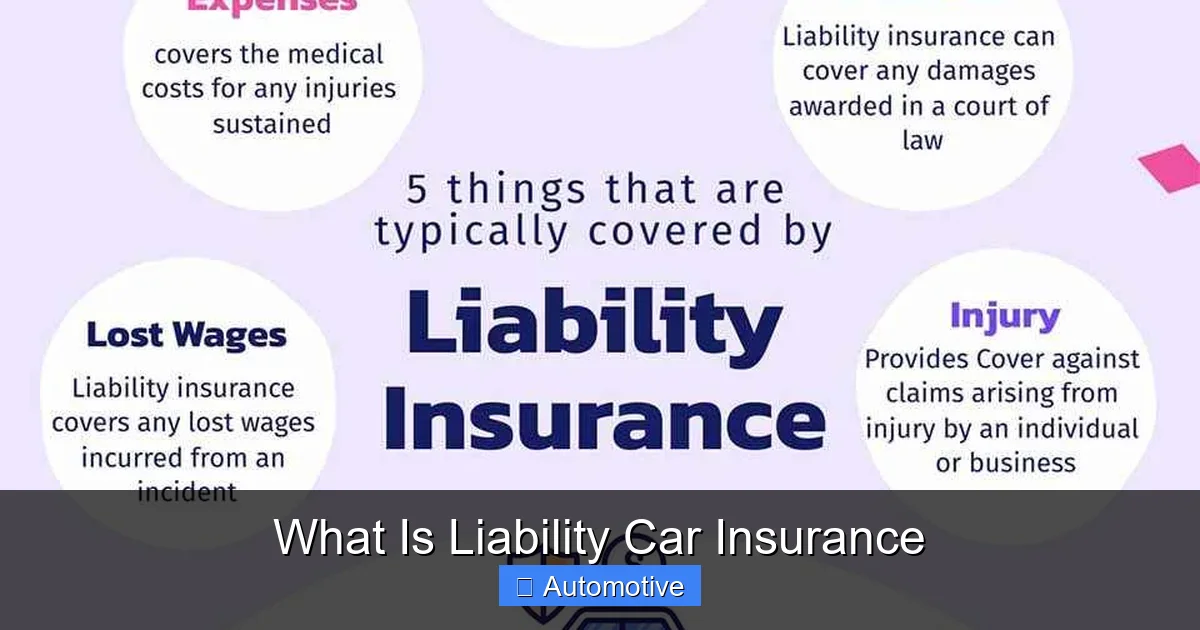
Every state sets its own minimum liability requirements, but these minimums are often far too low to provide real protection. They’re designed to meet legal standards, not to shield you from financial disaster.
For example, California requires 15/30/5, meaning $15,000 per person for injuries, $30,000 per accident, and $5,000 for property damage. That $5,000 property damage limit might cover a minor dent, but it won’t come close to replacing a luxury vehicle or repairing extensive structural damage.
Why Minimum Coverage Isn’t Enough
Relying solely on state minimums is like wearing a seatbelt but no airbag—it helps, but it’s not enough in a serious crash. Medical costs have skyrocketed in recent years. A single night in the ICU can cost $10,000 or more. Surgeries, imaging tests, and long-term care can easily push bills into six figures.
Similarly, modern cars are packed with advanced technology—sensors, cameras, infotainment systems—that make repairs more expensive. A simple bumper replacement on a new car can cost $3,000 or more. If you hit a Tesla or a high-end SUV, even minor damage can exceed $10,000.
Recommended Liability Limits
Most insurance experts suggest carrying at least 100/300/100 coverage:
– $100,000 per person for bodily injury
– $300,000 per accident for total bodily injury
– $100,000 for property damage
This level of coverage offers much stronger protection. It’s especially important if you own a home, have savings, or earn a steady income—assets that could be targeted in a lawsuit.
Some drivers opt for even higher limits, especially if they have significant wealth or drive frequently. You can also consider an umbrella policy, which provides additional liability coverage beyond your auto insurance limits (typically starting at $1 million).
How to Choose the Right Limits
When deciding on liability limits, consider:
– Your net worth (savings, home equity, investments)
– Your annual income
– How often you drive and where (urban areas have higher accident risks)
– The value of the vehicles you typically share the road with
If you’re unsure, talk to an independent insurance agent. They can help assess your risk and recommend appropriate coverage based on your lifestyle and financial situation.
What Liability Insurance Does NOT Cover
One of the biggest misconceptions about liability car insurance is that it covers everything after an accident. In reality, it has clear boundaries. Knowing what’s excluded helps you avoid gaps in protection.
Your Own Injuries and Medical Bills
Liability insurance does not pay for your own medical expenses if you’re injured in a crash. For that, you’ll need:
– **Medical Payments Coverage (MedPay):** Pays for your and your passengers’ medical bills regardless of fault.
– **Personal Injury Protection (PIP):** Available in no-fault states, covers medical costs, lost wages, and sometimes even childcare or household services.
– **Health Insurance:** Your regular health plan may cover accident-related injuries, but it won’t pay for car repairs or other non-medical costs.
Damage to Your Own Vehicle
If your car is damaged in an accident—even one you cause—liability insurance won’t cover the repairs. For that, you need:
– **Collision Coverage:** Pays to repair or replace your car after a crash, regardless of fault.
– **Comprehensive Coverage:** Covers non-collision incidents like theft, vandalism, fire, or weather damage.
Without these, you’ll have to pay out of pocket for your own vehicle repairs.
Other Exclusions
Liability insurance also doesn’t cover:
– Intentional damage you cause
– Damage from uninsured or underinsured motorists (unless you have that specific coverage)
– Wear and tear or mechanical breakdowns
– Personal belongings stolen from your car
Understanding these limits helps you build a well-rounded insurance portfolio that truly protects you from all angles.
How to Get Liability Car Insurance
Getting liability car insurance is straightforward, but it pays to shop around and understand your options.
Shop Around for Quotes
Start by getting quotes from multiple insurers—national companies like State Farm, Geico, and Progressive, as well as regional or local providers. Online comparison tools make this easy, but don’t skip calling agents directly. They can often offer discounts or bundle deals not available online.
When comparing quotes, make sure you’re comparing apples to apples. Use the same coverage limits, deductibles, and driver details across all quotes.
Understand Discounts
Many insurers offer discounts that can lower your premium, such as:
– Safe driver discount (clean record)
– Multi-car discount
– Bundling with home or renters insurance
– Good student discount (for young drivers)
– Low mileage discount
– Defensive driving course completion
Ask about every discount you might qualify for—it could save you hundreds per year.
Maintain Continuous Coverage
Insurers view lapses in coverage as a red flag. If you go without insurance—even for a few days—you may be labeled a high-risk driver and charged higher rates. Always keep your policy active, even if you’re not driving regularly.
If you’re selling your car or taking a long break from driving, consider switching to a storage or non-owner policy instead of canceling entirely.
Review Your Policy Annually
Your life changes—so should your insurance. Review your policy each year to ensure your liability limits still match your needs. Major life events like buying a home, getting married, or having a child are good times to reassess coverage.
Common Misconceptions About Liability Insurance
Despite its importance, liability car insurance is often misunderstood. Clearing up these myths can help you make better decisions.
“I’m a Good Driver, So I Don’t Need Much Coverage”
Even the safest drivers can be involved in serious accidents caused by others—or by unpredictable events like weather or mechanical failure. And if you’re at fault, your driving record won’t protect your wallet.
“My Health Insurance Will Cover Everything”
While health insurance pays for medical treatment, it doesn’t cover property damage, lost wages for others, or legal fees. Plus, it may not cover all treatments or have high deductibles.
“Liability Insurance Covers My Car Too”
No—this is a common mistake. Liability only covers others. To protect your own vehicle, you need collision and comprehensive coverage.
“Minimum Coverage Is Fine Because Courts Rarely Award More”
While not every accident leads to a lawsuit, high-dollar claims are more common than you think. A single serious injury can result in a six-figure judgment. Don’t gamble with your financial future.
Conclusion
Liability car insurance is more than just a legal requirement—it’s a vital part of responsible car ownership. It protects you from the potentially devastating financial consequences of causing harm to others on the road. By understanding how it works, what it covers, and how much you really need, you can drive with confidence knowing you’re prepared for the unexpected.
Don’t settle for the bare minimum. Take the time to evaluate your assets, driving habits, and risk tolerance. Invest in adequate liability coverage today to avoid regret tomorrow. After all, peace of mind is priceless—and it starts with the right insurance.
Frequently Asked Questions
Is liability car insurance required in every state?
Almost every state requires liability car insurance, with only New Hampshire and Virginia offering alternatives (like proof of financial responsibility or uninsured motorist fees). Even in those states, most drivers still choose to carry liability coverage for protection.
Does liability insurance cover my passengers?
Generally, no—liability insurance only covers injuries to people outside your vehicle. Passengers in your car would typically be covered under medical payments (MedPay) or personal injury protection (PIP), depending on your policy and state laws.
Can I be sued even if I have liability insurance?
Yes, if your liability limits are too low to cover all damages, the injured party can sue you for the difference. That’s why many experts recommend higher limits or an umbrella policy for added protection.
What happens if I cause an accident in another state?
Your liability insurance follows you across state lines. It will cover you up to your policy limits, even if the other state has higher minimum requirements. However, you must still meet your home state’s legal requirements.
Does liability insurance cover hit-and-run accidents?
No, liability insurance only applies when you’re at fault. If someone hits you and flees, you’d need uninsured motorist coverage (if you have it) to pay for your injuries and damages.
How much does liability car insurance cost?
Costs vary widely based on location, driving record, age, vehicle type, and coverage limits. On average, minimum liability coverage costs $50–$150 per month, while higher limits (like 100/300/100) may cost $100–$250 monthly.
