
How Much Is Car Insurance for a 23-year-old per Month

Car insurance for a 23-year-old typically ranges from $150 to $300 per month, depending on location, driving history, and coverage level. While young drivers pay more than older adults, smart choices like safe driving, good grades, and shopping around can significantly lower costs.
Key Takeaways
- Average monthly cost: Most 23-year-olds pay between $150 and $300 for full coverage car insurance, with liability-only plans starting around $80–$120.
- Age and experience matter: At 23, you’re still considered a relatively new driver, which increases risk in insurers’ eyes—but rates drop steadily after age 25.
- Location plays a big role: Urban areas with high traffic and theft rates (like New York or Los Angeles) often have much higher premiums than rural towns.
- Good grades and discounts help: Many insurers offer student discounts, safe driver programs, and low-mileage savings that can cut your bill by 10–25%.
- Vehicle type affects pricing: Sporty or luxury cars cost more to insure than safe, economical models like a Honda Civic or Toyota Corolla.
- Shop around annually: Comparing quotes from at least 3–5 insurers can save you hundreds each year—don’t auto-renew without checking.
- Maintain a clean record: One speeding ticket or accident can spike your rate by 20–40%, so defensive driving pays off long-term.
📑 Table of Contents
- How Much Is Car Insurance for a 23-Year-Old Per Month?
- Why Is Car Insurance So Expensive for 23-Year-Olds?
- Factors That Influence Your Monthly Premium
- How to Lower Your Car Insurance Premium at 23
- Real-Life Examples: What 23-Year-Olds Actually Pay
- When Will Your Rates Go Down?
- Final Thoughts: Smart Choices Now Pay Off Later
How Much Is Car Insurance for a 23-Year-Old Per Month?
If you’re 23 and shopping for car insurance for the first time—or just trying to understand why your premium seems so high—you’re not alone. At this age, you’re likely balancing student loans, entry-level jobs, and the excitement of newfound independence. But adding car insurance to your monthly budget can feel like a financial gut punch. So, how much is car insurance for a 23-year-old per month, really?
The short answer? It depends—but most 23-year-olds pay between $150 and $300 per month for full coverage. If you’re okay with just meeting your state’s minimum liability requirements, you might pay closer to $80–$120. That’s a wide range, and it reflects how many variables go into pricing your policy. Your age is just one piece of the puzzle. Where you live, what you drive, your driving history, and even your credit score (in most states) all influence your rate.
But here’s the good news: being 23 means you’re on the cusp of better rates. Insurance companies see drivers under 25 as higher risk because statistically, younger drivers are more likely to get into accidents. However, once you hit 25, your premiums often drop significantly—sometimes by 20% or more. So while your current rate might sting, it’s not forever. And with the right strategies, you can lower your monthly cost right now.
Why Is Car Insurance So Expensive for 23-Year-Olds?
Visual guide about How Much Is Car Insurance for a 23-year-old per Month
Image source: investopedia.com
You might be wondering: “I’m a careful driver—why am I paying so much?” The truth is, insurance companies don’t base your rate solely on your personal behavior. Instead, they use actuarial data—fancy term for statistics—to predict how likely you are to file a claim. And when it comes to young adults, the numbers aren’t great.
According to the Insurance Information Institute, drivers aged 16 to 24 are involved in more crashes per mile driven than any other age group. Even though you may drive safely, insurers group you with your peers—and that group has a higher accident rate. This is why your premium is higher than someone in their 30s or 40s, even if they have the same car and driving record.
Another factor is inexperience. At 23, you’ve probably had your license for only a few years. Insurers see less time behind the wheel as a risk factor. It’s not that you’re a bad driver—it’s that you haven’t had enough time to build a long track record of safe driving. Over time, as you accumulate clean years on your record, your rate will naturally decrease.
The Role of Age in Insurance Pricing
Age is one of the biggest predictors of risk in the eyes of insurers. Here’s how it typically breaks down:
– **Under 25:** Highest premiums due to inexperience and higher accident rates.
– **25–34:** Rates begin to drop as drivers gain experience and maturity.
– **35–64:** Lowest premiums, as this group has the best safety records.
– **65+:** Rates may rise again due to slower reaction times and health issues.
At 23, you’re still in that high-risk bracket, but you’re closer to the turning point than teens or 20-year-olds. Every year you drive safely brings you closer to that sweet spot where rates stabilize.
Gender Can Also Affect Your Rate (But Less Than You Think)
In many states, gender still plays a role in insurance pricing—especially for young drivers. Historically, male drivers under 25 have paid more than females because they’re statistically more likely to speed, drive under the influence, or be involved in severe crashes. However, this gap is narrowing. Some states (like California, Hawaii, and Massachusetts) have banned gender-based pricing altogether, and others are moving in that direction.
Even where it’s allowed, the difference at age 23 is usually modest—maybe $20–$50 per month. But it’s worth noting if you’re comparing quotes.
Factors That Influence Your Monthly Premium
Visual guide about How Much Is Car Insurance for a 23-year-old per Month
Image source: image6.slideserve.com
Now that we’ve covered why 23-year-olds pay more, let’s dig into the specific factors that determine your exact rate. Understanding these can help you make smarter choices and potentially save money.
1. Location: Where You Live Matters—A Lot
Your ZIP code might be the single biggest factor in your insurance cost. Urban areas with heavy traffic, high crime rates, and frequent accidents tend to have much higher premiums. For example:
– A 23-year-old in Detroit, Michigan, might pay over $400 per month for full coverage.
– The same driver in Boise, Idaho, could pay under $150.
Why? Cities like Detroit have high rates of vehicle theft, vandalism, and uninsured drivers—all of which increase risk for insurers. Rural areas, with less traffic and lower crime, are cheaper to insure in.
Even within the same state, rates can vary. Living in a busy downtown area versus a quiet suburb can mean a $50–$100 difference per month.
2. Driving History: Clean Record = Lower Rates
This one’s straightforward: the fewer tickets, accidents, or DUIs on your record, the lower your premium. At 23, you may not have a long history yet, but every clean year counts.
For example:
– A clean record at 23 might get you a rate of $180/month.
– One speeding ticket could push that to $220.
– An at-fault accident might spike it to $280 or more.
Some insurers offer accident forgiveness programs, but they’re not universal—and they often come at a higher initial cost. The best strategy? Drive defensively, obey speed limits, and avoid distractions like texting.
3. Type of Vehicle You Drive
Your car isn’t just a way to get around—it’s a major factor in your insurance cost. Insurers look at:
– **Safety ratings:** Cars with high crash-test scores (like those from IIHS or NHTSA) are cheaper to insure.
– **Repair costs:** Luxury and imported cars cost more to fix, so premiums are higher.
– **Theft rates:** Vehicles that are frequently stolen (like certain Honda or Toyota models) may cost more to insure.
– **Performance:** Sports cars and high-horsepower vehicles are seen as riskier.
For a 23-year-old on a budget, a reliable, safe, and modest car is usually the best choice. Think Honda Civic, Toyota Corolla, Subaru Impreza, or Hyundai Elantra. Avoid flashy models like Mustangs, BMWs, or Dodge Challengers unless you’re prepared for a much higher premium.
4. Coverage Level and Deductible
The type of coverage you choose directly affects your monthly cost. Here’s a quick breakdown:
– **Liability-only:** Covers damage and injuries you cause to others. Cheapest option, but doesn’t protect your own car.
– **Full coverage:** Includes liability, collision (covers your car in an accident), and comprehensive (covers theft, weather, vandalism, etc.). More expensive but recommended if you have a newer or financed car.
Your deductible—the amount you pay out of pocket before insurance kicks in—also matters. A higher deductible (like $1,000) lowers your monthly premium, but means you’ll pay more if you file a claim. A lower deductible (like $250) increases your monthly cost but reduces your out-of-pocket expense when you need repairs.
For most 23-year-olds, a $500 deductible with full coverage offers a good balance of affordability and protection.
5. Credit Score (In Most States)
Believe it or not, your credit score can affect your insurance rate in 47 states (not in California, Hawaii, or Massachusetts). Insurers use a credit-based insurance score—not your FICO score—to predict risk. People with lower scores are statistically more likely to file claims.
Improving your credit—by paying bills on time, reducing debt, and checking for errors—can lead to lower premiums over time. Even a small jump from “fair” to “good” credit could save you $20–$40 per month.
6. Annual Mileage and Usage
How much you drive also impacts your rate. If you commute 50 miles a day, you’re on the road more—and more time behind the wheel means higher risk. Conversely, if you work from home or use public transit, you may qualify for a low-mileage discount.
Some insurers offer pay-per-mile or usage-based programs (like Allstate’s Drivewise or Progressive’s Snapshot), which track your driving habits via a mobile app or device. Safe driving—like smooth braking, avoiding hard accelerations, and not speeding—can earn you discounts of 10–20%.
How to Lower Your Car Insurance Premium at 23
Now that you know what drives up your cost, let’s talk about how to bring it down. The good news? There are several proven strategies to save money—even as a young driver.
1. Take Advantage of Discounts
Most insurers offer a variety of discounts. Here are some common ones for 23-year-olds:
– **Good student discount:** Maintain a B average or higher (usually requires proof like a transcript).
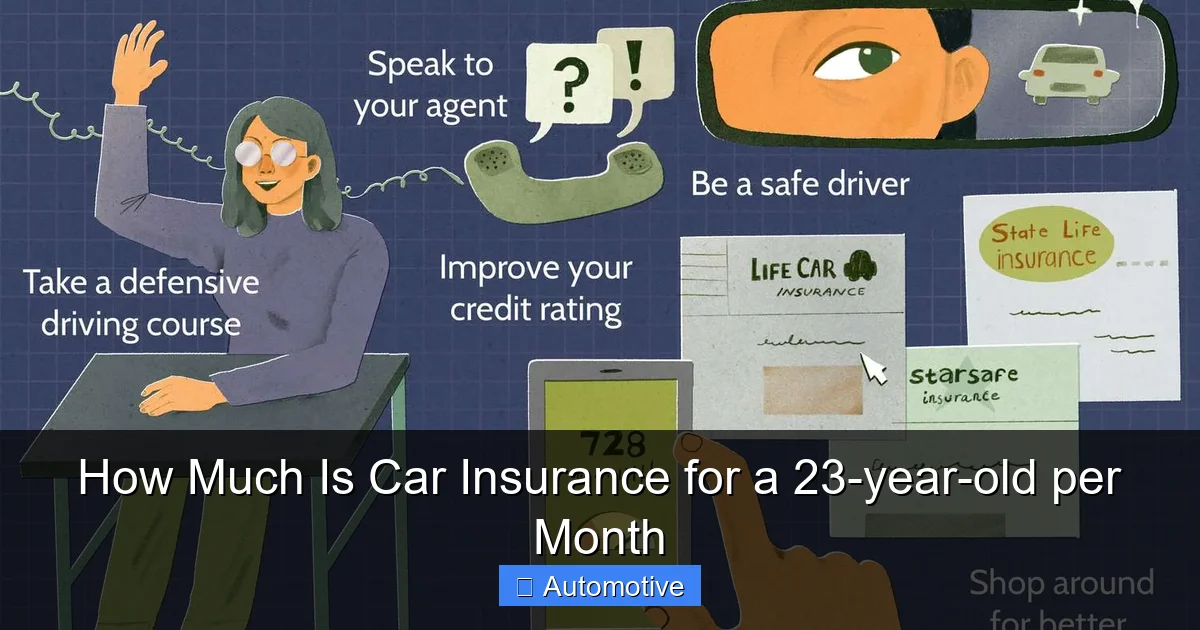
– **Defensive driving course:** Completing an approved course can reduce your rate by 5–10%.
– **Multi-policy discount:** Bundle your car insurance with renters or homeowners insurance.
– **Low-mileage discount:** Drive less than 7,500–10,000 miles per year.
– **Safe driver discount:** Maintain a clean record for 3–5 years.
– **Pay-in-full discount:** Pay your annual premium upfront instead of monthly.
– **Paperless billing or auto-pay discount:** Small but easy savings.
Ask your insurer about every discount they offer—you might be surprised how much you qualify for.
2. Shop Around Every Year
Never auto-renew your policy without comparing quotes. Rates change frequently, and new discounts or competitors may offer better deals. Use online comparison tools or work with an independent agent to get quotes from at least 3–5 companies.
Popular insurers for young drivers include:
– **Geico:** Known for competitive rates and strong discounts.
– **State Farm:** Offers good student and safe driver discounts.
– **Progressive:** Great for usage-based programs and accident forgiveness.
– **USAA:** If you’re military-affiliated, this is often the cheapest option.
Even if you love your current insurer, checking alternatives once a year can save you $200–$500 annually.
3. Consider Raising Your Deductible
If you have an emergency fund, increasing your deductible from $250 to $500 or $1,000 can lower your monthly premium by $15–$30. Just make sure you can afford to pay that amount if you need to file a claim.
4. Drive a Safer, More Affordable Car
If you’re in the market for a car, choose one with high safety ratings, low repair costs, and low theft rates. Avoid modifications like aftermarket exhausts or spoilers—they can increase your premium.
5. Maintain a Clean Driving Record
This might sound obvious, but it’s worth repeating: every ticket or accident increases your rate. At 23, you’re building your driving history—make it a good one. Use apps like Waze to avoid traffic, and always wear your seatbelt.
6. Improve Your Credit Score
If your state allows credit-based pricing, work on boosting your score. Pay bills on time, keep credit card balances low, and check your credit report annually for errors.
Real-Life Examples: What 23-Year-Olds Actually Pay
Let’s look at a few realistic scenarios to give you a better sense of what to expect.
Example 1: Urban Driver with a Clean Record
– Age: 23
– Location: Chicago, IL
– Car: 2018 Honda Civic
– Coverage: Full coverage, $500 deductible
– Driving history: Clean
– Monthly premium: ~$210
This driver pays a moderate rate thanks to a safe car and clean record, but the urban location keeps costs elevated.
Example 2: Rural Driver with a Sports Car
– Age: 23
– Location: Des Moines, IA
– Car: 2020 Ford Mustang
– Coverage: Full coverage, $1,000 deductible
– Driving history: One speeding ticket
– Monthly premium: ~$290
Even in a low-cost area, the sports car and ticket push the rate higher.
Example 3: Student with Good Grades and Low Mileage
– Age: 23
– Location: Austin, TX
– Car: 2016 Toyota Corolla
– Coverage: Liability-only
– Driving history: Clean
– Discounts: Good student, low-mileage, paperless billing
– Monthly premium: ~$95
This driver saves significantly by choosing minimal coverage and maximizing discounts.
When Will Your Rates Go Down?
The biggest question on many 23-year-olds’ minds: “When will this get cheaper?” The answer? Soon.
Most insurers offer a significant rate reduction once you turn 25. Why? By then, you’ve likely gained more driving experience, and statistically, your risk drops. Some companies even offer a “maturity discount” at 25.
But don’t wait passively. Every year you drive safely, your rate should decrease slightly—even before 25. And if you maintain good credit, take advantage of discounts, and shop around, you can accelerate those savings.
Final Thoughts: Smart Choices Now Pay Off Later
So, how much is car insurance for a 23-year-old per month? On average, $150–$300 for full coverage, with liability-only plans starting around $80–$120. While that might seem steep, it’s a temporary phase. With smart decisions—like driving safely, choosing the right car, and shopping for discounts—you can lower your cost today and set yourself up for even better rates in the future.
Remember, insurance isn’t just a bill—it’s protection. It covers you when the unexpected happens, from a fender bender to a totaled car. Paying a little more now can save you thousands later.
And as you approach 25, keep an eye on your renewal notice. That’s when you’ll likely see your first big drop in premiums. Until then, drive smart, stay informed, and don’t be afraid to ask your insurer about ways to save.
Frequently Asked Questions
Is car insurance cheaper at 23 than at 21?
Yes, generally. While both ages are considered high-risk, 23-year-olds typically pay less than 21-year-olds because they have more driving experience. The rate difference can be $30–$80 per month, depending on the insurer and location.
Can I stay on my parents’ insurance at 23?
Yes, in most cases. As long as you’re a dependent or live at home, you can usually remain on your parents’ policy. This can save you money, especially if they have a good driving record and multi-car discounts.
What’s the cheapest car to insure at 23?
Safe, reliable, and economical cars like the Honda Civic, Toyota Corolla, or Subaru Impreza are usually the cheapest to insure. Avoid sports cars, luxury vehicles, and models with high theft rates.
Does getting a speeding ticket really increase my rate?
Yes—often by 20–40%. A single ticket can add $50–$100 to your monthly premium, and the increase may last 3–5 years. Defensive driving courses can sometimes reduce the impact.
Should I choose liability-only or full coverage at 23?
If you own an older car outright, liability-only may be sufficient. But if your car is newer, financed, or valuable, full coverage is recommended to protect your investment.
How often should I shop for car insurance?
At least once a year—preferably before your policy renews. Rates change, and new discounts or competitors may offer better deals. Even small savings add up over time.
