
Are Maseratis Worth the Money?

Buying a Maserati is more than just purchasing a car—it’s embracing Italian passion, performance, and prestige. While they offer thrilling driving dynamics and head-turning design, potential owners must weigh high maintenance costs and reliability concerns against the emotional payoff of owning a luxury sports car.
So, you’re thinking about buying a Maserati. Maybe you’ve seen one glide past you on the highway, its low-slung silhouette and growling exhaust note turning heads. Or perhaps you’ve been captivated by the brand’s rich racing heritage, dating back to 1914. Either way, you’re not alone—Maserati has long been a symbol of Italian luxury, performance, and passion. But here’s the real question: Are Maseratis worth the money?
That’s a tough one. On one hand, these cars are breathtaking. From the sleek lines of the Ghibli to the futuristic MC20 supercar, Maserati blends art and engineering in a way few automakers can match. They’re not just vehicles—they’re statements. But on the other hand, they come with a reputation for high maintenance, questionable reliability, and steep depreciation. So, is the emotional thrill worth the financial risk?
In this article, we’ll dive deep into what it really means to own a Maserati. We’ll explore the performance, luxury, and prestige they offer, while also being honest about the costs and challenges. Whether you’re eyeing a used Quattroporte or dreaming of a new MC20, this guide will help you decide if a Maserati is truly worth the investment.
Key Takeaways
- Stunning Design and Craftsmanship: Maseratis stand out with handcrafted interiors, bold styling, and unmistakable Italian flair that few rivals match.
- Thrilling Performance: From the Ghibli’s turbocharged V6 to the MC20’s twin-turbo V6, Maseratis deliver exhilarating acceleration and sporty handling.
- Higher Ownership Costs: Maintenance, repairs, and insurance are significantly more expensive than average, especially as the car ages.
- Reliability Concerns: Maseratis often rank below industry averages in long-term reliability, which can affect resale value and peace of mind.
- Emotional Appeal Over Practicality: Owning a Maserati is as much about the experience and status as it is about transportation—ideal for enthusiasts, not daily commuters.
- Strong Resale Value (for Certain Models): Limited-production models like the MC20 or GranTurismo retain value better than sedans like the Ghibli.
- Warranty and Service Plans Help: Extended warranties and prepaid maintenance can ease the financial burden of ownership.
📑 Table of Contents
- The Allure of Maserati: Why People Love Them
- The Cost of Ownership: What You’re Really Paying For
- Are Maseratis Reliable? The Truth About Long-Term Ownership
- Resale Value: Do Maseratis Hold Their Worth?
- Who Should Buy a Maserati?
- Alternatives to Consider
- Final Verdict: Are Maseratis Worth the Money?
The Allure of Maserati: Why People Love Them
There’s something undeniably magnetic about Maserati. It’s not just the trident logo or the Ferrari-derived engines—it’s the entire package. Maserati cars are designed to stir emotions. They’re built for people who don’t just want to get from point A to point B, but who want to feel alive while doing it.
Italian Design That Turns Heads
Let’s start with the looks. Maseratis are among the most visually striking cars on the road. Whether it’s the aggressive front grille of the Ghibli or the sculpted curves of the Levante SUV, these vehicles are designed to be noticed. The design language is bold, athletic, and unmistakably Italian. Unlike some German luxury cars that prioritize understated elegance, Maseratis scream confidence.
Take the Maserati MC20, for example. This mid-engine supercar looks like it’s moving even when it’s standing still. Its butterfly doors, carbon fiber body, and aerodynamic lines make it a rolling work of art. And inside? It’s just as impressive. The cabin features premium materials like Alcantara, leather, and carbon fiber, with a driver-focused layout that puts performance first.
Even the more practical models, like the Ghibli sedan, offer a level of style that rivals far more expensive competitors. It’s not just about looking fast—it’s about feeling fast, even when you’re parked.
Performance That Delivers
Of course, style means nothing without substance. And when it comes to performance, Maserati doesn’t disappoint. Most models are powered by turbocharged V6 or V8 engines, many of which are built in collaboration with Ferrari. The result? Blistering acceleration, responsive handling, and a soundtrack that’s music to any gearhead’s ears.
The Ghibli S, for instance, rockets from 0 to 60 mph in just 5.0 seconds—impressive for a midsize luxury sedan. The Levante Trofeo, Maserati’s high-performance SUV, does it in under 4 seconds, thanks to its 580-horsepower V8. And the MC20? It’s a different beast altogether, with a 621-horsepower twin-turbo V6 that launches it to 60 mph in 2.9 seconds.
But it’s not just about straight-line speed. Maseratis are engineered for driving enjoyment. They feature adaptive suspension, rear-wheel or all-wheel drive, and precise steering that makes them feel alive on twisty roads. Whether you’re carving through mountain passes or cruising along the coast, a Maserati makes every drive feel special.
The Emotional Experience
Let’s be honest—most people don’t buy a Maserati for fuel efficiency or cargo space. They buy it for the feeling. There’s a sense of pride that comes with driving a car that’s hand-assembled in Italy, with a legacy that includes Formula 1 victories and iconic models like the 3500 GT and the Birdcage.
It’s the sound of the engine starting up—a deep, guttural roar that announces your arrival. It’s the way the car hugs the road, making you feel connected to the pavement. It’s the admiring glances from pedestrians and the nods of respect from other car enthusiasts.
For many owners, that emotional connection is worth more than any spreadsheet calculation. A Maserati isn’t just transportation—it’s an experience.
The Cost of Ownership: What You’re Really Paying For
Visual guide about Are Maseratis Worth the Money?
Image source: robpaulsenlive.com
Now, let’s talk about the elephant in the room: cost. Yes, Maseratis are expensive to buy, but the real expense comes after you drive off the lot. From maintenance to insurance, owning a Maserati is a financial commitment that goes far beyond the sticker price.
Higher Maintenance and Repair Costs
Maseratis are complex machines, and that complexity comes at a price. Routine maintenance—oil changes, brake pads, tire rotations—is more expensive than average. But it’s the unexpected repairs that can really hurt.
Common issues include electrical problems, suspension wear, and turbocharger failures. And because Maseratis use specialized parts and require certified technicians, labor costs are high. A simple brake job can cost twice as much as it would on a BMW or Mercedes.
For example, replacing the rear differential on a Ghibli can run upwards of $3,000. A new turbocharger? Easily $4,000–$6,000. And if you need a transmission rebuild, you’re looking at $8,000 or more.
Reliability and Longevity
Here’s where Maserati has struggled in recent years. According to reliability surveys from J.D. Power and Consumer Reports, Maserati consistently ranks near the bottom among luxury brands. The 2020 Ghibli, for instance, received a predicted reliability rating of just 2 out of 5.
That doesn’t mean every Maserati will break down—many owners report trouble-free driving for years. But the risk is higher than with brands like Lexus or Porsche. And when things do go wrong, they tend to go wrong in expensive ways.
Insurance and Depreciation
Insurance premiums for Maseratis are among the highest in the industry. Why? Because they’re expensive to repair, prone to theft, and often driven aggressively. A 30-year-old driver with a clean record might pay $3,000–$5,000 per year to insure a Ghibli—double what they’d pay for a similarly sized BMW 5 Series.
And then there’s depreciation. Maseratis lose value quickly. A new Ghibli might cost $80,000, but after three years, it could be worth less than $40,000. That’s a 50% drop in value—far worse than the 30–35% average for luxury sedans.
Fuel Economy
Let’s not forget fuel costs. Maseratis are not fuel-efficient. The Ghibli averages around 18 mpg combined, while the Levante SUV struggles to hit 16 mpg. If you drive 15,000 miles a year, you could spend $3,000 or more on gas—especially with today’s prices.
Are Maseratis Reliable? The Truth About Long-Term Ownership
Visual guide about Are Maseratis Worth the Money?
Image source: coinvaluechecker.com
Reliability is one of the biggest concerns for potential Maserati buyers. And for good reason. While the brand has made strides in recent years, it still lags behind its German and Japanese rivals in long-term dependability.
Common Problems and Recalls
Some of the most frequently reported issues include:
– Electrical glitches (dashboard warnings, infotainment failures)
– Suspension and steering problems
– Transmission hesitation or failure
– Cooling system leaks
– Turbocharger and intercooler issues
Maserati has issued several recalls in the past decade, including one for faulty airbag sensors and another for potential fuel leaks. While these recalls are addressed under warranty, they highlight the brand’s ongoing quality control challenges.
Owner Experiences
That said, not all Maserati owners have bad experiences. Many report that their cars run smoothly for years with proper maintenance. The key is staying on top of service and using only certified technicians.
One owner of a 2018 Ghibli said, “I’ve put 60,000 miles on it, and aside from regular oil changes and brake pads, I haven’t had a single major repair.” Another, however, shared a different story: “My Levante needed a new transmission at 30,000 miles. The repair took three weeks and cost $7,500 out of pocket.”
The difference? Maintenance habits, driving conditions, and luck.
Warranty and Extended Coverage
To ease concerns, Maserati offers a 4-year/50,000-mile basic warranty and a 6-year/75,000-mile powertrain warranty. That’s competitive with other luxury brands.
But many experts recommend purchasing an extended warranty or prepaid maintenance plan. These can cover major repairs and reduce the financial risk of ownership. Just be sure to read the fine print—some plans exclude certain components or require service at authorized dealers.
Resale Value: Do Maseratis Hold Their Worth?
Visual guide about Are Maseratis Worth the Money?
Image source: fastlaneonly.com
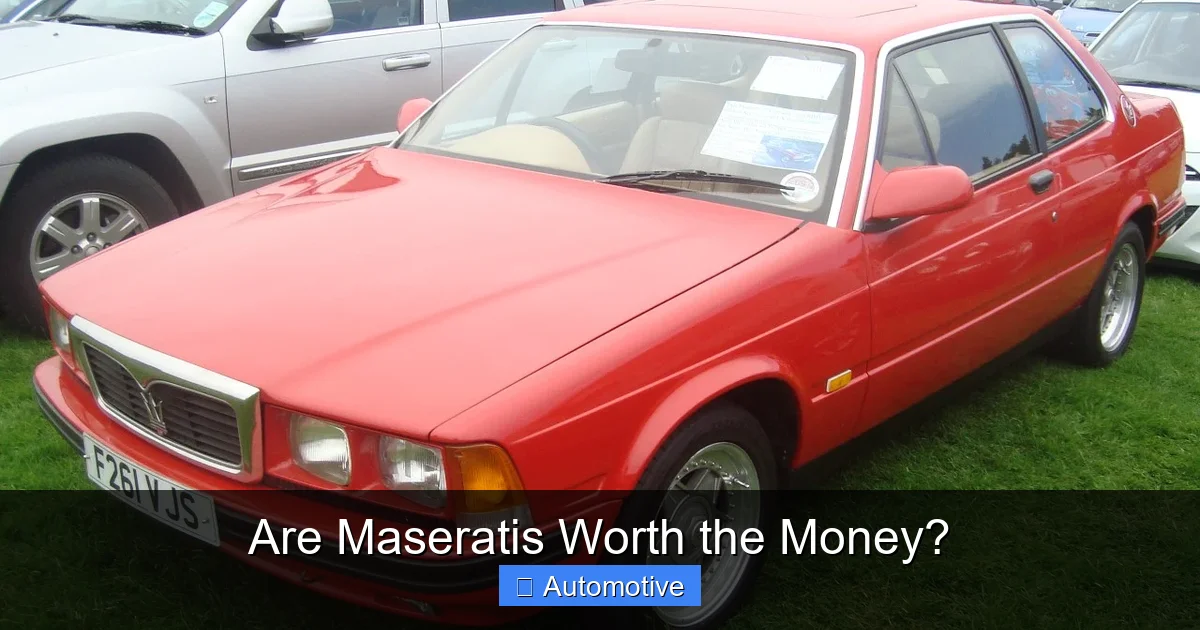
When it comes to resale value, Maseratis are a mixed bag. Some models depreciate rapidly, while others—especially limited-production or high-performance variants—hold their value surprisingly well.
Depreciation Trends
On average, a new Maserati loses about 50% of its value in the first three years. That’s worse than BMW, Mercedes, and Audi, which typically lose 30–40% in the same period.
For example, a $90,000 Ghibli might be worth $45,000 after three years. A $120,000 Levante could drop to $60,000. That’s a significant loss, especially if you plan to sell or trade in the car.
Which Models Hold Value Best?
Not all Maseratis depreciate equally. High-demand, low-production models tend to retain value better. The MC20, for instance, has seen strong demand since its launch, with used prices often close to—or even above—MSRP.
Similarly, the GranTurismo and GranCabrio, especially in rare trims or special editions, can hold their value well among collectors. The Quattroporte, Maserati’s flagship sedan, also tends to depreciate slower than the Ghibli, thanks to its exclusivity and executive appeal.
Tips for Maximizing Resale Value
If you’re planning to sell your Maserati down the line, here are a few tips:
– Keep detailed service records
– Avoid excessive modifications
– Store the car properly (garage, climate-controlled if possible)
– Maintain the exterior and interior meticulously
– Consider certified pre-owned (CPO) programs when buying used
Buying a CPO Maserati can also be a smart move. These vehicles come with extended warranties and have been inspected by certified technicians, offering more peace of mind.
Who Should Buy a Maserati?
So, who is a Maserati really for? The answer isn’t as simple as “rich people” or “car enthusiasts.” It’s about priorities, lifestyle, and expectations.
The Enthusiast Buyer
If you’re a car lover who values driving dynamics, sound, and style over practicality, a Maserati could be perfect. These cars are built for people who enjoy the act of driving—who want to feel the road, hear the engine, and turn heads.
The MC20, for example, is a pure driver’s car. It’s not the most comfortable or spacious, but it delivers an experience that few supercars can match. For someone who tracks their car or takes weekend drives on scenic roads, that’s worth the cost.
The Status-Seeking Buyer
Maseratis also appeal to those who want to make a statement. In a world of ubiquitous BMWs and Mercedes, a Maserati stands out. It says, “I appreciate the finer things—and I’m not afraid to show it.”
For executives, entrepreneurs, or creatives who value image and exclusivity, a Maserati can be a powerful symbol of success.
The Weekend Driver
Many Maserati owners don’t use their cars as daily drivers. Instead, they keep them as weekend or special-occasion vehicles. This reduces wear and tear, lowers maintenance costs, and preserves the car’s condition.
If you already have a reliable daily driver—a Toyota, Honda, or even a Tesla—adding a Maserati to your garage can be a rewarding indulgence.
Who Should Think Twice?
On the flip side, a Maserati is probably not the best choice if:
– You need a reliable daily commuter
– You’re on a tight budget
– You dislike frequent trips to the mechanic
– You prioritize fuel efficiency or cargo space
– You plan to sell the car within 3–5 years
For these buyers, a used BMW M5, Mercedes-AMG E63, or even a Porsche Panamera might offer better value and reliability.
Alternatives to Consider
If you’re drawn to the performance and luxury of a Maserati but concerned about the costs, there are several alternatives worth considering.
Porsche Panamera
The Panamera offers similar performance and luxury, but with far better reliability and resale value. It’s also more practical, with a spacious rear seat and hatchback design. Prices start around $90,000—comparable to a Ghibli—but long-term ownership costs are significantly lower.
BMW M5
The M5 is a high-performance sedan that rivals the Ghibli in speed and handling, but with a more refined interior and better build quality. It’s also more widely supported by independent mechanics, reducing repair costs.
Mercedes-AMG E63 S
With 603 horsepower and all-wheel drive, the E63 S is a beast on the road. It’s more expensive than a Ghibli, but it offers superior technology, comfort, and reliability.
Lexus LC 500
For a more reliable grand tourer, the LC 500 combines a naturally aspirated V8 with stunning design and Lexus’s legendary dependability. It’s not as fast as a Maserati, but it’s far more trouble-free.
Used Ferrari or Lamborghini
Believe it or not, some used Ferraris and Lamborghinis are now within reach of Maserati buyers. A 2010 Ferrari California or a 2012 Lamborghini Gallardo can be found for $100,000–$150,000—similar to a new MC20. While maintenance is still expensive, the brand prestige and performance are unmatched.
Final Verdict: Are Maseratis Worth the Money?
So, are Maseratis worth the money? The answer depends on what you value most.
If you’re looking for a car that delivers thrilling performance, stunning design, and an emotional driving experience, then yes—a Maserati can be worth every penny. It’s a car that makes you smile every time you get behind the wheel, and that’s something money can’t always buy.
But if you’re focused on reliability, low maintenance costs, and strong resale value, then a Maserati might not be the best choice. The high cost of ownership, combined with potential reliability issues, means you’re paying a premium for passion—not practicality.
Ultimately, owning a Maserati is about more than just transportation. It’s about embracing a lifestyle, a heritage, and a sense of adventure. If that resonates with you, and you’re prepared for the financial commitment, then a Maserati could be one of the most rewarding purchases you’ll ever make.
Just remember: with great power comes great responsibility—and great repair bills. Drive wisely, maintain diligently, and enjoy the ride.
Frequently Asked Questions
Are Maseratis expensive to maintain?
Yes, Maseratis are significantly more expensive to maintain than average vehicles. Routine services, parts, and labor costs are higher due to the brand’s specialized engineering and limited service network. Unexpected repairs can be particularly costly.
Do Maseratis break down often?
Maseratis have a reputation for lower reliability compared to German and Japanese luxury brands. While not all models are problematic, they do experience more electrical and mechanical issues over time, especially as they age.
Is it worth buying a used Maserati?
Buying a used Maserati can be a good value if you find a well-maintained example with full service history. However, be prepared for higher maintenance costs and consider a certified pre-owned (CPO) model for added peace of mind.
Which Maserati model is the most reliable?
Among current models, the Ghibli and Levante have similar reliability ratings, though the Quattroporte tends to fare slightly better due to its lower production volume and more conservative tuning. The MC20, being newer, has limited long-term data but shows promise.
Can you drive a Maserati every day?
Yes, but it’s not ideal for everyone. While Maseratis are capable daily drivers, their stiff suspension, firm ride, and high maintenance costs make them better suited as weekend or secondary vehicles for most owners.
Do Maseratis hold their value?
Most Maseratis depreciate faster than competitors, losing up to 50% of their value in three years. However, limited-production models like the MC20 and special editions tend to hold their value much better.
