
Does a Car Have to Pass Inspection to Sell

Selling a car doesn’t always require a passed inspection, but it depends on your state’s laws. Some states mandate a valid inspection before transfer, while others allow private sales without one. Always check local regulations to avoid legal issues and ensure a smooth transaction.
So, you’ve decided it’s time to sell your car. Maybe you’re upgrading to something newer, downsizing, or just ready for a change. But before you list it online or put up that “For Sale” sign in the window, there’s one big question on your mind: *Does a car have to pass inspection to sell?*
It’s a fair and important question—one that can affect everything from legality to how quickly you sell your vehicle. The short answer? It depends. And not just on the condition of your car, but on where you live. Every state in the U.S. has its own rules when it comes to vehicle inspections and sales. Some are strict, requiring a valid inspection before you can legally transfer ownership. Others are more relaxed, allowing you to sell a car “as-is” without any inspection at all.
But here’s the catch: even if your state doesn’t require an inspection to sell, skipping it could cost you time, money, and potential buyers. A car that’s recently passed inspection signals to buyers that it’s roadworthy, safe, and compliant with emissions standards. It builds trust. On the flip side, selling a car without an inspection—especially if it’s known to have issues—can lead to disputes, failed test drives, or even legal trouble down the line.
Key Takeaways
- State laws vary widely: Some states require a passed inspection before selling, while others do not.
- Inspection ensures safety and emissions compliance: Passing inspection confirms the vehicle meets safety and environmental standards.
- Private vs. dealer sales differ: Dealerships often handle inspections, but private sellers may need to provide one.
- Failing inspection doesn’t block the sale: You can still sell a car that hasn’t passed inspection, but disclosure may be required.
- Buyers prefer inspected vehicles: A recent inspection report increases buyer confidence and can speed up the sale.
- Timing matters: In some states, the inspection must be current at the time of sale or transfer.
- Check your local DMV: Always verify requirements with your state’s Department of Motor Vehicles (DMV) or equivalent agency.
📑 Table of Contents
- Understanding Vehicle Inspections: What They Are and Why They Matter
- State-by-State Rules: Where Inspections Are Required to Sell
- Private Sales vs. Dealer Sales: What’s the Difference?
- Can You Sell a Car That Failed Inspection?
- Tips for Selling Your Car with or Without an Inspection
- Conclusion: Make the Smart Choice for Your Sale
Understanding Vehicle Inspections: What They Are and Why They Matter
Before diving into whether you *need* an inspection to sell your car, let’s first understand what a vehicle inspection actually is. At its core, a vehicle inspection is a thorough check of your car’s safety systems, mechanical components, and emissions output. The goal is to ensure the vehicle is safe to operate on public roads and meets environmental standards.
Types of Inspections
There are generally two main types of inspections:
1. **Safety Inspections** – These focus on critical systems like brakes, lights, tires, steering, suspension, and seat belts. The inspector checks that all components are functioning properly and meet minimum safety standards.
2. **Emissions Inspections** – These test the vehicle’s exhaust system to measure pollutants like carbon monoxide, hydrocarbons, and nitrogen oxides. They’re especially common in urban areas with air quality concerns.
Some states require both, while others only mandate one. For example, California requires both safety and emissions inspections for most vehicles, while states like Florida and Arizona have no statewide inspection requirements at all.
Who Performs Inspections?
Inspections are typically conducted by certified mechanics or state-approved inspection stations. In some states, you can choose any licensed mechanic, while in others, you must go to a DMV-approved facility. The process usually takes 30 to 60 minutes and costs between $20 and $100, depending on your location and the type of inspection.
Why Inspections Matter for Sellers
Even if your state doesn’t require an inspection to sell, getting one can be a smart move. Here’s why:
– **Builds buyer confidence:** A recent inspection report shows the car is in good working order.
– **Reduces negotiation friction:** Buyers are less likely to lowball if they know the car has been professionally checked.
– **Speeds up the sale:** Cars with valid inspections often sell faster because buyers feel more secure.
– **Avoids surprises:** You’ll know about any hidden issues before listing, so you can fix them or price accordingly.
For example, imagine you’re selling a 2015 Honda Civic. You know it runs well, but the brake pads are getting thin. If you get it inspected and the report shows “brakes at 40% life,” you can either replace them before selling or disclose the issue upfront. Either way, you’re being transparent—and that builds trust.
State-by-State Rules: Where Inspections Are Required to Sell

Visual guide about Does a Car Have to Pass Inspection to Sell
Image source: i.ytimg.com
Now, let’s get into the heart of the matter: *Does your state require a passed inspection to sell a car?* The answer varies widely, so it’s crucial to know your local laws. Below is a breakdown of how different states handle vehicle inspections in the context of private sales.
States That Require Inspection Before Sale
In some states, a valid inspection is a legal requirement before you can transfer ownership. This means you cannot complete the sale unless the car has passed inspection and the certificate is current.
– **New York:** Requires a valid safety and emissions inspection within 12 months of the sale. The inspection must be current at the time of transfer.
– **Pennsylvania:** Mandates a safety inspection within 90 days of sale. Emissions inspections are also required in certain counties.
– **Massachusetts:** Requires both safety and emissions inspections, valid for up to 12 months.
– **Virginia:** Safety inspection must be current (within 12 months) at the time of sale. Emissions testing is required in Northern Virginia and other metro areas.
– **Texas:** While Texas doesn’t require an inspection *before* sale, the buyer must get one within 30 days of registration. However, some counties (like Harris County) require emissions testing, so it’s wise to check local rules.
In these states, failing to provide a valid inspection can result in the sale being rejected by the DMV. The buyer won’t be able to register the vehicle until the inspection is completed, which could delay or even cancel the transaction.
States With No Inspection Requirement
On the other end of the spectrum, several states have no statewide inspection requirements. In these areas, you can legally sell a car without any inspection—even if it’s not roadworthy.
– **Florida:** No safety or emissions inspections required for private sales.
– **Arizona:** No inspections needed, though emissions testing is required in Maricopa County (Phoenix area) for registration.
– **Nevada:** No statewide inspection, but emissions testing is required in Clark County (Las Vegas) and Washoe County (Reno).
– **South Carolina:** No inspections required for private sales.
– **Alaska:** No inspections, though some remote areas may have local rules.
Even in these states, it’s still a good idea to get an inspection if your car is older or has known issues. Why? Because buyers in no-inspection states often assume the car is in good condition—unless told otherwise. If you sell a car with serious problems and don’t disclose them, you could face legal action for fraud.
Gray Areas and Local Variations
Some states have partial requirements or local exceptions. For example:
– **California:** Requires smog checks (emissions inspections) for most vehicles, but only when selling to a new owner. The seller must provide a valid smog certificate issued within 90 days of the sale.
– **Illinois:** No statewide inspection, but Chicago and surrounding areas require emissions testing for certain vehicles.
– **New Jersey:** Requires a safety inspection for vehicles over 4 years old, but only at the time of registration—not necessarily at sale. However, the buyer must get it inspected within 30 days.
Always check with your local DMV or equivalent agency to confirm the rules in your area. Rules can change, and local jurisdictions (like counties or cities) may have additional requirements.
Private Sales vs. Dealer Sales: What’s the Difference?
Visual guide about Does a Car Have to Pass Inspection to Sell
Image source: i.ytimg.com
Another key factor in whether an inspection is required is *who* you’re selling to. The rules can differ significantly between private sales and dealership transactions.
Selling to a Private Buyer
When you sell your car directly to another person (a private sale), you’re typically responsible for ensuring the vehicle meets legal requirements—unless your state says otherwise.
In states that require inspections, you’ll need to provide a valid certificate at the time of sale. In states without requirements, you can sell “as-is,” but you must still disclose known defects. For example, if your brake lights are out, you can’t pretend they work. Doing so could be considered fraud.
Private buyers often expect transparency. They may ask for maintenance records, a recent inspection, or even a pre-purchase inspection (PPI) from a mechanic of their choice. While you’re not obligated to provide a PPI, refusing one could scare off serious buyers.
Selling to a Dealership
When you trade in or sell your car to a dealership, the process is usually smoother—but not because inspections are waived. In fact, dealerships often require a passed inspection before they’ll accept your vehicle.
Why? Because they need to ensure the car is safe and roadworthy before resale. If your car fails inspection, the dealer may still buy it—but likely at a much lower price, especially if repairs are needed.
For example, if you’re trading in a 2018 Toyota Camry with a failing emissions test, the dealer might offer $2,000 less to cover the cost of repairs. In contrast, a private buyer might pay full price if they’re willing to fix it themselves.
Certified Pre-Owned (CPO) Programs
Some dealerships offer certified pre-owned programs, which include a multi-point inspection, warranty, and reconditioning. If your car qualifies, it can command a higher price. However, CPO inspections are stricter than standard state inspections and often include checks on the transmission, engine, and interior systems.
Can You Sell a Car That Failed Inspection?
Visual guide about Does a Car Have to Pass Inspection to Sell
Image source: cdn.www3.dps.texas.gov
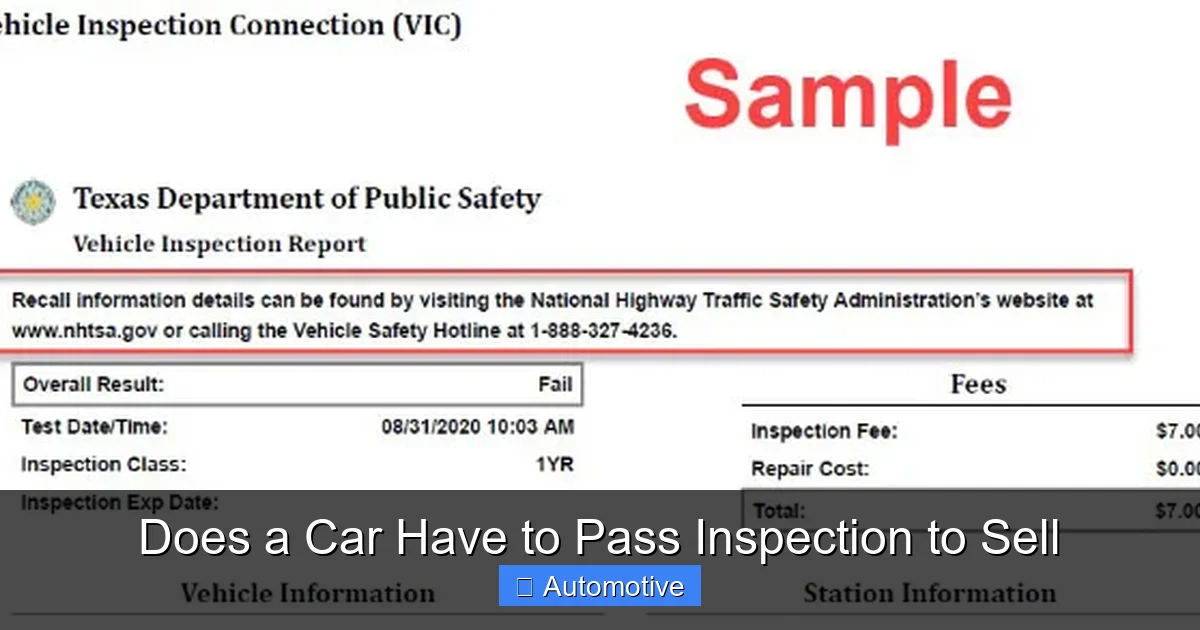
Yes—you *can* sell a car that failed inspection, but there are important caveats.
Legal Considerations
In most states, it’s legal to sell a car that hasn’t passed inspection, as long as you disclose the status. For example, in Texas, you can sell a car without an inspection, but the buyer must get one within 30 days. In California, you must provide a smog certificate—so if your car failed, you either need to fix it or sell it to someone who will.
However, selling a car with known safety issues (like faulty brakes or no airbags) without disclosure can lead to liability. If the buyer gets into an accident and sues you for negligence, you could be on the hook.
Disclosure Requirements
Many states require sellers to complete a “Vehicle History and Condition Disclosure” form. This document asks about accidents, flood damage, odometer discrepancies, and mechanical issues. Failing to disclose a failed inspection or known defects can result in fines or legal action.
For example, in New York, sellers must sign a statement confirming the vehicle’s condition. If you lie about the inspection status, you could be charged with fraud.
Market Impact
Even if it’s legal, selling a car that failed inspection can be tough. Buyers are wary of vehicles with known problems. You may need to lower the price significantly or offer to cover repair costs.
Let’s say your car failed emissions due to a faulty oxygen sensor. Repairing it might cost $200. You could either fix it and sell at full price, or sell “as-is” for $200 less. The choice depends on your timeline and budget.
Tips for Selling Your Car with or Without an Inspection
Whether your state requires an inspection or not, here are some practical tips to help you sell your car smoothly and ethically.
1. Know Your State’s Rules
Start by visiting your state’s DMV website or calling their customer service line. Ask:
– Is an inspection required to sell a car?
– How recent must the inspection be?
– Are there emissions requirements?
– What forms do I need to complete?
2. Get an Inspection Early
Even if it’s not required, consider getting an inspection before listing. It gives you a clear picture of the car’s condition and helps you price it fairly. If repairs are needed, you can fix them upfront or adjust the price.
3. Be Transparent with Buyers
Honesty builds trust. Disclose any known issues, including failed inspections, in your listing and during conversations. Use phrases like:
– “Passed inspection in June 2024”
– “Needs new brake pads—recently inspected”
– “Failed emissions due to [issue], repair estimate available”
4. Provide Documentation
Include the inspection report, maintenance records, and repair receipts in your sale package. This shows you’ve taken care of the car and helps buyers feel confident.
5. Consider a Pre-Purchase Inspection (PPI)
If a serious buyer requests a PPI, consider allowing it. It’s a small inconvenience that can close the deal. Most mechanics charge $100–$150 for a thorough check.
6. Price Accordingly
A car with a recent inspection can command a higher price. Conversely, a car that failed inspection should be priced lower to reflect the cost of repairs.
7. Use Online Tools
Websites like Kelley Blue Book (KBB) and Edmunds let you estimate your car’s value based on condition, mileage, and market trends. Use these tools to set a fair price.
Conclusion: Make the Smart Choice for Your Sale
So, does a car have to pass inspection to sell? The answer isn’t one-size-fits-all. It depends on your state’s laws, the type of sale, and your ethical approach to transparency.
In states like New York or California, a passed inspection is not just recommended—it’s required. In others, like Florida or Arizona, you have more flexibility. But even where it’s optional, getting an inspection can make your sale faster, smoother, and more profitable.
At the end of the day, selling a car is about trust. Buyers want to know they’re getting a reliable vehicle, not a money pit. By understanding your local requirements, being honest about the car’s condition, and providing documentation, you set yourself up for a successful sale—no matter where you live.
So before you list that car, do your homework. Check your state’s rules, consider getting an inspection, and prepare to sell with confidence. Your next buyer—and your peace of mind—will thank you.
Frequently Asked Questions
Can I sell my car without an inspection in any state?
Yes, in many states you can legally sell a car without an inspection, especially in private sales. However, some states require a valid inspection before transfer, so always check your local DMV rules.
What happens if I sell a car that failed inspection?
You can sell it, but you must disclose the failed inspection and any known issues. In some states, the buyer won’t be able to register the car until it passes inspection.
Do I need an inspection to trade in my car?
Dealerships often require a passed inspection before accepting a trade-in, especially if they plan to resell the vehicle. If your car fails, they may offer less or require repairs.
How long is a vehicle inspection valid?
Most inspections are valid for 6 to 12 months, depending on the state. Some states require annual inspections, while others only require them at registration or sale.
Can a buyer back out if the car fails inspection after purchase?
Generally, no—once the sale is complete and ownership is transferred, the buyer assumes responsibility. However, if you misrepresented the car’s condition, they may have legal recourse.
Is an emissions test the same as a safety inspection?
No. An emissions test checks pollution levels, while a safety inspection evaluates mechanical and safety systems. Some states require both, others only one.
