
How to Sell a Car in Kentucky

Selling a car in Kentucky doesn’t have to be complicated. With the right preparation, paperwork, and pricing strategy, you can complete the process quickly and legally. This guide walks you through every step—from cleaning your car to transferring ownership—so you can sell with confidence.
Selling a car in Kentucky might seem like a daunting task, especially if it’s your first time. Between figuring out the right price, preparing paperwork, and finding a trustworthy buyer, it’s easy to feel overwhelmed. But here’s the good news: with a clear plan and the right information, the process can be smooth, legal, and even profitable.
Whether you’re upgrading to a newer model, downsizing, or simply ready to part ways with your current vehicle, selling your car privately in Kentucky gives you more control over the price and the sale experience. Unlike trading in at a dealership—where you might get less than market value—a private sale often results in a higher payout. Plus, you’re not limited by trade-in offers or dealer incentives.
In this guide, we’ll walk you through every step of how to sell a car in Kentucky, from prepping your vehicle to finalizing the transfer. We’ll cover everything you need to know about pricing, paperwork, advertising, and safety. By the end, you’ll feel confident and ready to sell your car the right way—legally, efficiently, and with peace of mind.
Key Takeaways
- Prepare your vehicle: Clean it inside and out, fix minor issues, and gather maintenance records to boost buyer confidence.
- Set a fair price: Use tools like Kelley Blue Book or Edmunds to research market value based on your car’s year, mileage, and condition.
- Gather required documents: You’ll need the title, bill of sale, odometer disclosure, and a vehicle inspection certificate if applicable.
- Complete the title transfer correctly: Sign over the title to the buyer and submit a Notice of Sale to the Kentucky Transportation Cabinet (KYTC).
- Advertise effectively: Use online platforms like Facebook Marketplace, Craigslist, or AutoTrader to reach local buyers.
- Ensure a safe transaction: Meet in public places, accept secure payment methods, and avoid scams.
- Cancel insurance after sale: Notify your insurer once the sale is complete to avoid unnecessary premiums.
📑 Table of Contents
- Step 1: Prepare Your Vehicle for Sale
- Step 2: Determine the Right Price
- Step 3: Gather the Required Paperwork
- Step 4: Advertise Your Car Effectively
- Step 5: Complete the Sale and Transfer Ownership
- Step 6: After the Sale – What to Do Next
- Common Mistakes to Avoid When Selling a Car in Kentucky
- Conclusion
Step 1: Prepare Your Vehicle for Sale
Before you even think about listing your car, take the time to get it in the best possible shape. A clean, well-maintained vehicle not only attracts more buyers but also helps you justify a higher asking price. Think of it this way: first impressions matter, especially when someone is considering spending thousands of dollars.
Start with a thorough cleaning. Wash the exterior, wax it if possible, and clean the windows inside and out. Don’t forget the tires—cleaning and dressing them can make your car look newer. Inside, vacuum the carpets, wipe down surfaces, and remove any personal items. A clutter-free interior makes the space feel larger and more inviting. If you have air fresheners, use them sparingly; some buyers are sensitive to strong scents.
Next, address minor mechanical issues. You don’t need to invest in major repairs unless they’re deal-breakers (like a failing transmission), but fixing small things can make a big difference. Replace burnt-out bulbs, top off fluids, and consider replacing worn windshield wipers. If your car has a check engine light on, it’s worth getting it diagnosed—even if it’s a minor sensor issue. Buyers will appreciate transparency and may be more willing to negotiate if they know the car is in good working order.
Gather your maintenance records. Having a folder with receipts for oil changes, brake jobs, tire replacements, and other services shows that you’ve taken care of the vehicle. This builds trust and can help you command a higher price. If you don’t have all the records, that’s okay—just be honest about what you do have.
Finally, take high-quality photos. Use natural light and shoot from multiple angles: front, back, sides, interior, trunk, and engine bay. Clean photos with good lighting can significantly increase interest in your listing. Avoid filters or heavy editing—buyers want to see the real condition of the car.
Should You Fix Major Issues Before Selling?
This is a common dilemma. If your car needs a major repair—like a new transmission or engine work—it’s usually not worth fixing before selling. The cost of repair often exceeds the increase in resale value. Instead, price the car accordingly and disclose the issue upfront. Some buyers are mechanics or enthusiasts who are willing to take on a project car at a discount.
However, if the issue is safety-related—like bad brakes or steering problems—you should either fix it or clearly state that the car is sold “as-is” and not safe to drive. Selling a car with undisclosed safety issues can lead to legal trouble.
Step 2: Determine the Right Price
Visual guide about How to Sell a Car in Kentucky
Image source: ussellmycar.com
Pricing your car correctly is one of the most important steps in how to sell a car in Kentucky. Set it too high, and you’ll scare off buyers. Set it too low, and you’ll lose money. The goal is to find that sweet spot where your car is competitively priced but still reflects its true value.
Start by researching similar vehicles in your area. Use trusted online tools like Kelley Blue Book (KBB), Edmunds, or NADA Guides. Enter your car’s make, model, year, mileage, trim level, and condition. These tools will give you a range—typically labeled as “Trade-In Value,” “Private Party Value,” and “Dealer Retail Value.” For a private sale, aim for the “Private Party Value” as your baseline.
But don’t stop there. Look at actual listings on platforms like Facebook Marketplace, Craigslist, Autotrader, and Cars.com. Filter by your car’s year, make, model, and mileage, and see what others are asking. Pay attention to how long those listings have been active. If a similar car has been listed for weeks without a sale, it might be overpriced.
Adjust your price based on condition. If your car is in excellent shape with low mileage and a clean history, you can price it at the higher end of the range. If it has high mileage, wear and tear, or minor issues, price it lower. Be realistic—buyers will inspect the car and do their own research.
Example: Pricing a 2018 Honda Civic in Louisville
Let’s say you have a 2018 Honda Civic LX with 60,000 miles, good condition, and a clean title. According to Kelley Blue Book, the private party value might be around $16,500. But when you check local listings, you see similar Civics priced between $15,800 and $17,200. One has been listed for 45 days with no offers—likely overpriced. Another sold quickly at $16,200. Based on this, you might list your car at $16,400 to stay competitive but leave room for negotiation.
Should You Leave Room for Negotiation?
Yes—most buyers expect to negotiate. Pricing your car slightly above your minimum acceptable price gives you flexibility. For example, if you need at least $16,000, list it at $16,500. That way, if a buyer offers $16,200, you can accept without feeling shortchanged.
Avoid pricing in odd numbers like $16,999. While it’s a common marketing tactic, it can make your car seem less serious or even suspicious. Round numbers like $16,500 appear more professional and trustworthy.
Step 3: Gather the Required Paperwork

Visual guide about How to Sell a Car in Kentucky
Image source: flippmycar.com
Selling a car in Kentucky involves more than just handing over the keys. You need to complete several legal documents to ensure the transfer is valid and protect yourself from future liability. Missing or incorrect paperwork can delay the sale or even lead to fines.
The most important document is the **vehicle title**. This proves you own the car and have the right to sell it. Make sure the title is signed correctly by all owners listed. If you’re the only owner, sign in the “Seller” section. If there are multiple owners, all must sign. If the title is lost, you’ll need to apply for a duplicate from the Kentucky Transportation Cabinet (KYTC) before selling.
Next, you’ll need a **bill of sale**. While not always required by law, it’s highly recommended. This document records the sale details, including the buyer’s and seller’s names, addresses, vehicle information, sale price, and date. It serves as proof of the transaction and can help resolve disputes. You can find free bill of sale templates online or use the one provided by the KYTC.
You must also complete an **odometer disclosure statement**. Federal law requires this for vehicles under 10 years old. The statement confirms the mileage at the time of sale. This is usually included on the back of the title, but if not, you can use a separate form. Be honest—lying about mileage is a federal offense.
If your car is less than 8 years old and has been registered in Kentucky for at least 30 days, it may need a **vehicle inspection**. Kentucky requires emissions and safety inspections for certain counties, including Jefferson, Fayette, and Kenton. Check the KYTC website to see if your county requires an inspection. If so, get it done before listing the car. The inspection certificate must be provided to the buyer.
What If the Title Is in Someone Else’s Name?
If the car is still financed, the title may be held by the lender. In that case, you’ll need to pay off the loan before selling. Contact your lender to get a payoff amount and arrange for the title to be released. Some lenders allow you to transfer the title directly to the buyer, but this process can be complex. It’s usually easier to pay off the loan first.
If the title is in a family member’s name (like a spouse or parent), that person must sign the title as the seller. If they’re unable to sign (due to illness or absence), you may need a power of attorney.
Step 4: Advertise Your Car Effectively
Visual guide about How to Sell a Car in Kentucky
Image source: donateacar2charity.com
Once your car is ready and priced, it’s time to find a buyer. The key to a quick sale is reaching the right audience with a compelling listing. In today’s market, most buyers start their search online, so your listing needs to stand out.
Start with a clear, honest title. Include the year, make, model, and key features. For example: “2018 Honda Civic LX – Low Miles, Clean Title, Excellent Condition.” Avoid vague titles like “Car for Sale” or “Nice Honda.”
Write a detailed description. Highlight the car’s best features: low mileage, recent maintenance, new tires, backup camera, fuel efficiency, etc. Be transparent about any flaws—this builds trust and reduces the chance of disputes later. Mention if the car has a clean Carfax report or has never been in an accident.
Use high-quality photos. Take pictures in daylight, from multiple angles. Include close-ups of the interior, engine, tires, and any unique features. If there’s minor damage, take a photo of it and mention it in the description. Buyers appreciate honesty.
Choose the right platforms. Facebook Marketplace is great for local sales and has a large user base. Craigslist is still popular, especially in smaller towns. Autotrader and Cars.com attract serious buyers but may charge a listing fee. Consider using more than one platform to increase visibility.
Set your availability. Be clear about when buyers can see the car. Weekday evenings and weekends are usually best. Respond to inquiries quickly—many buyers move fast.
Example Listing Description
“Selling my well-maintained 2018 Honda Civic LX with only 58,000 miles. Clean title, no accidents, and all service records available. Recently had new tires, oil change, and brake inspection. Features include backup camera, Bluetooth, and excellent fuel economy (32 mpg city / 42 mpg highway). Non-smoker, garage-kept, and always serviced on time. Asking $16,400 OBO. Serious inquiries only—please call or text. Test drives available with valid license and proof of insurance.”
Avoiding Scams and Fraud
Unfortunately, car scams are common. Be cautious of buyers who:
– Offer to pay with a cashier’s check or money order and ask for a refund.
– Want to ship the car without seeing it.
– Send a fake payment confirmation email.
– Ask for your personal information like Social Security number or bank details.
Always meet in a public place, like a police station parking lot. Accept cash, cashier’s check, or bank transfer. Never accept personal checks. If a buyer seems too eager or asks unusual questions, trust your instincts.
Step 5: Complete the Sale and Transfer Ownership
Once you’ve found a buyer and agreed on a price, it’s time to finalize the sale. This step is crucial to protect both you and the buyer and ensure the transfer is legal.
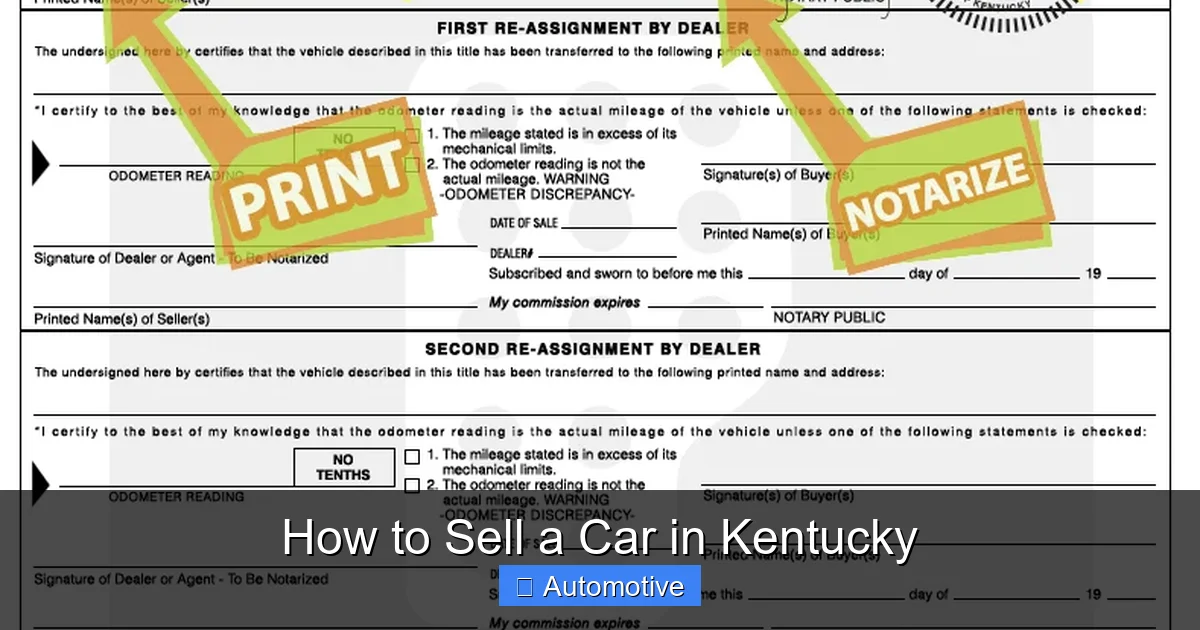
Start by completing the title transfer. Both you and the buyer must sign the title in the designated sections. Make sure all information is accurate, including the sale price and odometer reading. The buyer will take the signed title to the KYTC to register the vehicle in their name.
Provide the buyer with a bill of sale. This document should include:
– Seller and buyer names and addresses
– Vehicle make, model, year, VIN, and license plate number
– Sale price and date
– Odometer reading
– Signatures of both parties
You can find free bill of sale templates on the KYTC website or use a generic one. Keep a copy for your records.
Next, notify the KYTC that you’ve sold the car. Submit a **Notice of Sale** form (Form TC 94-177) within 10 days of the sale. This protects you from liability if the buyer gets a ticket or is involved in an accident before registering the car. You can submit the form online, by mail, or in person at a KYTC office.
What Happens If You Don’t Submit the Notice of Sale?
If you fail to submit the Notice of Sale, you could still be held responsible for traffic violations, parking tickets, or even accidents involving the vehicle—even after you’ve sold it. The KYTC may not update their records until the buyer registers the car, which could take weeks. Submitting the form ensures you’re off the hook legally.
Releasing Liability
In addition to the Notice of Sale, you should also notify your insurance company that you’ve sold the car. Once the sale is complete, cancel or transfer the policy. Most insurers require proof of sale, so keep your bill of sale and Notice of Sale confirmation.
Step 6: After the Sale – What to Do Next
Your responsibilities don’t end when the buyer drives away. There are a few final steps to ensure everything is wrapped up properly.
First, remove your license plates. In Kentucky, license plates stay with the owner, not the vehicle. You can either transfer them to a new car or return them to the KYTC. If you’re buying a new car, you can often transfer the plates at the time of registration.
Second, keep records of the sale. Store copies of the title, bill of sale, Notice of Sale confirmation, and any communication with the buyer. These documents may be needed if there’s a dispute or if the buyer fails to register the car.
Third, update your personal records. If you used the car for business or claimed deductions, update your logs. If you’re replacing the car, start the process of insuring your new vehicle.
Finally, celebrate! Selling a car can be stressful, but you’ve done it the right way—legally, safely, and efficiently.
What If the Buyer Doesn’t Register the Car?
It’s not uncommon for buyers to delay registering a vehicle, especially if they’re using it temporarily or waiting for a better deal on insurance. However, this doesn’t affect you as long as you’ve submitted the Notice of Sale. Once that form is processed, your liability ends. The buyer is responsible for registering the car and obtaining insurance.
If you’re concerned, you can check the status of the vehicle registration online through the KYTC website using the VIN. But in most cases, submitting the Notice of Sale is all you need to do.
Common Mistakes to Avoid When Selling a Car in Kentucky
Even with the best intentions, sellers often make avoidable mistakes. Here are some common pitfalls and how to avoid them:
– **Not cleaning the car:** A dirty car turns off buyers. Take the time to clean it thoroughly.
– **Overpricing:** Research the market and price competitively. Overpriced cars sit on the market for weeks.
– **Incomplete paperwork:** Missing signatures or incorrect information can delay the sale.
– **Not disclosing issues:** Hiding problems can lead to disputes or even legal action.
– **Meeting in unsafe locations:** Always meet in public, well-lit areas.
– **Accepting risky payment methods:** Stick to cash, cashier’s check, or bank transfer.
– **Forgetting to cancel insurance:** You’re still paying for coverage on a car you no longer own.
By avoiding these mistakes, you’ll have a smoother, safer selling experience.
Conclusion
Selling a car in Kentucky doesn’t have to be a headache. With the right preparation, pricing, and paperwork, you can complete the process quickly and legally. Start by cleaning and inspecting your vehicle, then research a fair price using trusted tools. Gather all required documents—title, bill of sale, odometer disclosure, and inspection certificate if needed. Advertise your car with clear photos and an honest description, and meet buyers in safe, public locations.
Once you’ve found a buyer, complete the title transfer, provide a bill of sale, and submit a Notice of Sale to the KYTC. Cancel your insurance and remove your license plates. Keep records of the transaction for your protection.
By following these steps, you’ll not only sell your car efficiently but also protect yourself from future liability. Whether you’re upgrading, downsizing, or just ready for a change, selling your car the right way gives you peace of mind and a fair return on your investment.
Frequently Asked Questions
Do I need a vehicle inspection to sell a car in Kentucky?
It depends on your county. Vehicles in certain counties—like Jefferson, Fayette, and Kenton—require emissions and safety inspections before sale. Check the Kentucky Transportation Cabinet website to see if your area requires an inspection.
Can I sell my car if I still owe money on it?
Yes, but you must pay off the loan first. Contact your lender for the payoff amount and arrange to release the title. Some lenders allow a lien release during the sale, but it’s often easier to pay off the loan before listing the car.
How long do I have to submit a Notice of Sale in Kentucky?
You must submit the Notice of Sale (Form TC 94-177) within 10 days of the sale. This protects you from liability for any incidents involving the vehicle after the sale.
What payment methods are safest when selling a car?
Cash, cashier’s check, or bank transfer are the safest options. Avoid personal checks, money orders from unknown sources, or wire transfers. Always verify the payment before handing over the keys.
Can I sell my car without a title in Kentucky?
No, you must have a valid title to sell a car in Kentucky. If your title is lost or damaged, apply for a duplicate from the Kentucky Transportation Cabinet before listing the vehicle.
What happens if the buyer doesn’t register the car?
As long as you’ve submitted the Notice of Sale, your liability ends. The buyer is responsible for registering the vehicle and obtaining insurance. You can check the registration status online using the VIN if needed.
