How Much to Wrap a Tesla Model Y: Ultimate Cost Guide

If you own a Tesla Model Y, you already know how much attention it gets. It is sleek, modern and everywhere, which is exactly why many owners start looking for a way to make theirs feel a little more personal. A new color, a satin or matte finish, a protective layer over the paint, or simple company branding: a vinyl wrap can do all of that without touching the factory paint. That is when the practical question arrives: how much does it cost to wrap a Tesla Model Y?
The honest answer is that it depends, much like buying a suit. The fabric, the tailor and the amount of detail all shape the final bill. In this guide we walk through the typical price range, what pushes it up or down, how wraps compare with paint, what the job involves, how long the film lasts and how to avoid the mistakes that cost owners the most. Prices below are typical United States figures and vary by city, shop and film, so treat them as a planning guide and always ask for a written quote.
Key Takeaways
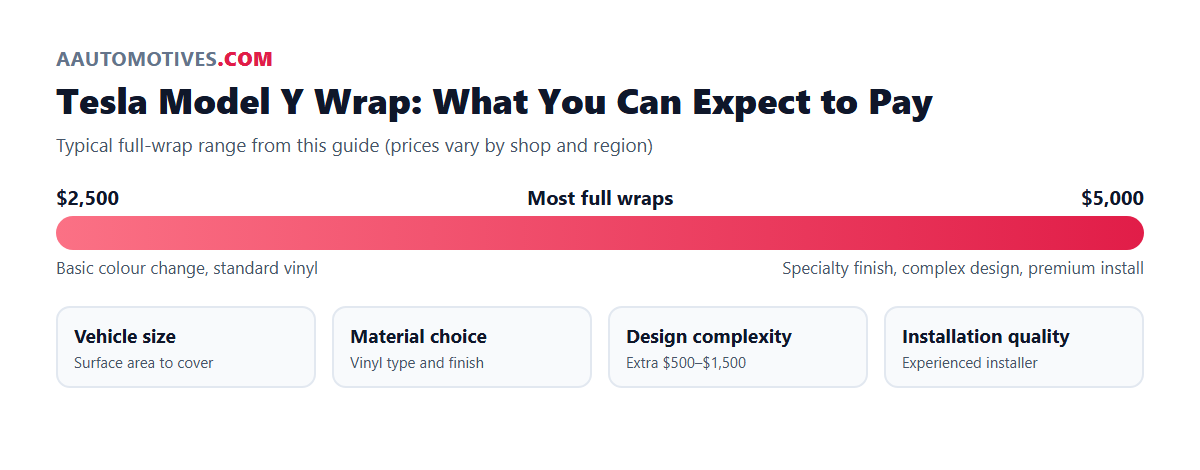
- Typical price: most full Model Y wraps land between about $2,500 and $5,000 for a standard color change, with premium films and complex designs going higher.
- Four things drive the cost: the size of the car, the film you choose, the complexity of the design and the skill of the installer.
- Finish matters: gloss is usually the cheapest, matte and satin cost more, textured films such as carbon fiber cost more again, and chrome is the most expensive and hardest to install.
- Allow a few days: a professional job usually takes two to five days, longer for printed or multi-color work.
- Protection, not just looks: a wrap shields the factory paint from UV light, light scratches and stone chips, and it can be removed later.
- Choose the installer carefully: a cheap, rushed job is the most common reason wraps bubble, lift at the edges or fail early.
Table of Contents
- Why Tesla Owners Choose Vinyl Wraps
- What Shapes the Cost of a Tesla Model Y Wrap
- The Typical Price Range for a Tesla Model Y Wrap
- Material Choices That Shift the Price
- The Work That Happens Before the Wrap
- Why Experienced Installers Charge More
- Benefits That Make Wrapping Worth the Cost
- How Long the Wrap Process Usually Takes
- Additional Customization Options and Their Costs
- DIY vs Professional Installation
- Maintaining Your Tesla Wrap
- Resale Value and Wrap Removal
- Key Considerations Before Wrapping
- Common Mistakes to Avoid
- Conclusion
Why Tesla Owners Choose Vinyl Wraps
Car wrapping has grown quickly over the past few years, and the Model Y is one of the most popular cars to wrap. A wrap lets you change how the car looks without a permanent decision. The paint stays underneath the film, a little like a phone case protects the phone, and the look on top can change whenever you like.
Owners usually wrap for one of four reasons. The first is color: Tesla’s factory palette is small and some colors carry an extra charge when ordering, so a wrap opens up hundreds of shades and finishes. The second is protection, since good vinyl absorbs UV exposure, light scratches and small chips that would otherwise reach the paint. The third is branding, because many small businesses turn a Model Y into a rolling advertisement. The fourth is resale: when the film comes off, the paint underneath is typically in far better shape than an unprotected car of the same age.
A wrap is not magic armour. It resists light abrasion and fading, but it will not stop a hard impact or a deep key scratch, and it needs sensible care. We cover maintenance later in this guide.
What Shapes the Cost of a Tesla Model Y Wrap
When someone asks how much to wrap a Tesla Model Y, nobody can give a single number, because the price moves with several variables.
Vehicle size and shape
The Model Y is a compact crossover, yet it is bigger than a sedan such as the Model 3, so it needs more film. Installers commonly quote around 60 to 75 feet of standard 60-inch-wide vinyl for a full wrap, although the exact figure depends on the shop and on whether door jambs are included. More film means a higher material cost and more labour. The smooth, simple body panels are a plus, because there are fewer deep recesses than on many other vehicles. The newer Model Y body styles have different bumper and light shapes, so ask the shop whether they have wrapped your specific generation before.
Film quality and finish
The material is often the single biggest variable. Basic gloss colors sit at the low end. Matte, satin and metallic finishes cost more, and specialist films such as carbon fiber, brushed metal, color-shift and chrome cost the most. Well-known brands such as 3M, Avery Dennison and KPMF generally cost more than unbranded rolls, but they offer better adhesive technology, more consistent color and manufacturer-backed warranties. Cheap film can fade, crack, shrink back from edges or leave stubborn adhesive behind when removed.
Design complexity
A single-color wrap is the simplest job. Printed graphics, two-tone roofs, racing stripes or color-shift films demand extra time, precision and sometimes specialist printing. As a rough guide, complex designs can add roughly $500 to $1,500 to the price, and custom artwork can exceed that.
Labour and preparation
Labour often accounts for more than half of the bill. A simple color change is quicker than a job where the installer must remove old film, remove trim and handles, tuck edges into door frames or repair small paint flaws first. Think of it like a haircut: a simple trim is quick and cheap, while a detailed color and style takes longer and costs more.
Location and shop reputation
Shops in large metropolitan areas usually charge more per hour than those in smaller towns. Well-reviewed installers with certified training and a clean workshop also charge more, and that premium is usually justified, as we explain below.
The Typical Price Range for a Tesla Model Y Wrap
As of today, most owners pay between about $2,500 and $5,000 for a complete Model Y wrap in the United States. A basic gloss or matte color from a reputable brand sits toward the lower end. Satin, textured or color-shift films sit toward the higher end. Chrome, printed designs and very detailed work can push the total well above $5,000.
These are typical ranges rather than guaranteed prices. Quotes from a quality shop in an expensive city may sit higher, and very low quotes should be treated with caution, since a price far below the market usually means thin film, rushed preparation or missing steps such as wrapping door edges. Paying a little more at the start is almost always cheaper than redoing a failed wrap later.
Partial wraps and smaller upgrades
You do not have to wrap the whole car. Many owners choose a partial wrap to get most of the visual impact for less money.
- Roof wrap: a gloss black roof or panoramic-look effect typically costs a few hundred dollars.
- Hood, mirrors or spoiler: small accents are quick and inexpensive compared with a full wrap.
- Chrome delete: covering bright window trim and badges in black is a popular and relatively low-cost job, often a few hundred dollars depending on the shop.
- Stripe or accent graphics: cost depends on the design and the length of the lines.
Ask for itemized pricing so you can see what each part costs and decide where the best value lies.
Material Choices That Shift the Price
Vinyl comes in many styles, and each one changes the final cost. The table below shows common types and their typical price level relative to each other.
| Wrap type | Typical cost level | Notes |
|---|---|---|
| Gloss | Lower | Clean look similar to fresh paint |
| Matte | Medium | Soft, modern finish; shows oils and fingerprints more easily |
| Satin | Medium to high | Smooth look with light reflection; popular on Teslas |
| Textured (carbon fiber, brushed metal) | High | Distinct feel and look; can be harder to work around curves |
| Color-shift | High | Color changes with the light and viewing angle |
| Chrome | Very high | Eye-catching but difficult to install and easy to damage |
Each option sets a different mood. Gloss shines like a fresh paint job, matte looks soft and modern, satin sits between the two, textured films add bold personality, and chrome demands attention. Your choice depends on your taste, your budget and how much maintenance you are willing to do. Matte and satin films, for example, cannot be polished or waxed the same way as gloss, so they need specialist cleaning products.
Wrap versus paint protection film
Color vinyl and clear paint protection film (PPF) are different products. A color wrap changes the appearance and gives modest protection. PPF is a thicker, self-healing urethane film that is chiefly about protecting the paint from chips and scratches, and it typically costs considerably more per panel. Some owners combine both, using PPF on the front end where stone chips happen and color vinyl elsewhere. If protection is your main goal, ask the shop about PPF rather than assuming a color wrap will do the same job.
Wrap versus a repaint
A quality repaint generally costs more than a wrap and cannot be undone. It also requires sanding and masking, and any mistake becomes permanent. On a car that is still under warranty, a repaint can complicate matters and is usually harder on resale value than preserving the original finish. A wrap, in contrast, is reversible, so it lets you try a bold color without a lifetime commitment.
The Work That Happens Before the Wrap
Many drivers think wrapping means sticking vinyl onto a clean car. That is only half the story. Before any film goes on, the car needs thorough preparation, and a good shop will explain the steps.
- Deep cleaning: the surface is washed and treated with a clay bar or a similar process so that wax, grease and road film do not stop the adhesive bonding.
- Inspection: the installer checks for chips, dents, rust or poorly repaired panels. Vinyl cannot hide these and may lift in damaged areas.
- Disassembly where needed: depending on the shop, door handles, badges, lights or trim may be removed so the film can tuck behind edges rather than stopping short.
- Final wipe-down: an isopropyl-based cleaner removes the last traces of oil right before the film is applied.
This preparation is why wrapping takes days rather than hours and why labour is such a large part of the price. Skipping it is the fastest way to get peeling, lifting and bubbles. When you ask how much to wrap a Tesla Model Y, remember you are paying for those hours of careful work as well as the film.
A Model Y also carries cameras and sensors that Tesla’s driver-assistance and safety systems rely on. Reputable installers know to leave camera lenses, sensors and other critical areas clear, and they will tell you which items they remove, cut around or leave alone. If a shop cannot explain how it treats these parts, that is a warning sign.
Why Experienced Installers Charge More
A cheap wrap can end up costing more. The Model Y has smooth but complex curves, tight panel gaps and a handful of components that must not be covered. A novice can easily overstretch the film, which distorts the color and shortens its life, or leave knife marks in the paint by cutting directly on the car. A skilled installer knows where to cut, where not to cut, how much heat to apply and how to finish edges so they stay flat.
Paying more for an expert is like choosing a good dentist: the work is hard to judge on day one and expensive to fix later. Look for shops with manufacturer certification, strong recent reviews, a portfolio of Model Ys and a written warranty that covers peeling, lifting, bubbling and fading. Ask how long the warranty lasts, what it excludes and whether it covers labour as well as material.
Questions to ask before you book
- Which film brand and exact product line will be used?
- Does the quote include door jambs, edges and the rear and front bumpers?
- How will cameras, sensors and badges be handled?
- How long will my car be in the shop?
- What does the warranty cover, and is it in writing?
- Can I see a Model Y you wrapped recently?
Benefits That Make Wrapping Worth the Cost
Wrapping a Tesla Model Y brings several long-term benefits that help explain why many owners accept the cost.
- Protects the original paint from UV light, light scratches, bird droppings and some road grime.
- Gives you control over the look with hundreds of colors and finishes.
- Is reversible, so you can return to the original color or change styles every few years.
- Helps preserve resale value by keeping the factory finish in better condition underneath.
- Usually costs less than a high-quality repaint, and without permanent changes to the car.
The film works like a protective layer on top of the paint rather than a replacement for it. Because it is removable, you are never locked into one look.
How Long the Wrap Process Usually Takes
Most professional full wraps take between two and five days. Complex designs, chrome or printed films and cars that need extensive preparation can take up to a week. The time depends on how busy the shop is, how detailed the design is and how much disassembly the job requires. Rushing is never a good idea: the adhesive needs time to bond, and good installers also allow the film to settle and then check edges before handing the car back. Plan to be without the car for most of a working week and ask for a firm completion date in writing.
Additional Customization Options and Their Costs
A wrap can do much more than change the color. Options include textured finishes, printed graphics, two-tone layouts, contrasting roofs, mirror caps, wheel accents and even matte-to-gloss transitions. These touches give the car personality but add cost, for instance printed graphics or color-shift films demand extra preparation, specialist materials and more labour, and a typical extra of roughly $500 to $1,500 is a reasonable planning allowance for elaborate work.
It is like adding embroidery to a plain shirt. It looks great, but it takes a skilled hand and time. The more intricate the work, the higher the labour cost, which is why it pays to discuss the design with the installer before work begins and to agree on the price in writing.
DIY vs Professional Installation
Some owners consider wrapping the car themselves. DIY kits and film are available online at lower prices, but the risks are real. The Model Y has large, curved panels, recessed areas and delicate edges that are hard to handle without practice. Mistakes can mean bubbles, wrinkles, creases that cannot be fixed, wasted film and even cuts in the paint, so a failed DIY attempt can end up costing more than a professional job.
If you are tempted, a sensible compromise is to practice on small parts such as a mirror cap, a trim piece or a smaller accent before attempting a larger panel, and to leave the hood, roof and bumpers to a professional. Professional installers have the training, the heat control and the experience to deliver a clean finish, and many offer warranties that DIY work cannot match. If quality and resale value matter to you, a professional installation is almost always the smarter choice.
Maintaining Your Tesla Wrap
A wrap is not permanent, but it can last many years with proper care. Most quality films are generally expected to last roughly five to seven years, depending on the film, the climate and how the car is stored, and cars parked outdoors in strong sun tend to be at the lower end of that range, especially on horizontal surfaces such as the roof and hood. These simple habits help:
- Hand wash with a gentle car shampoo and a clean microfiber mitt, and rinse off dirt before touching the surface.
- Avoid high-pressure washers held close to edges and seams, which can lift the film.
- Avoid automatic brush washes and harsh solvents or abrasive polishes.
- Wipe off bird droppings, tree sap and fuel spills promptly, because they can stain or soften the film.
- Use products designed for your finish. Matte and satin films need matte-safe cleaners, and ordinary wax can leave shiny patches on them.
- Park in shade or a garage whenever you can, to slow UV aging.
Treat the wrap like a delicate garment: no rough scrubbing and no harsh detergents. Many shops will also fit a ceramic coating made for vinyl, which can make washing easier, but check that it is compatible with your film first.
Resale Value and Wrap Removal
One of the biggest advantages of wrapping a Tesla Model Y is keeping the original paint safe. When you sell or trade in the car, you can remove the film, and a professional will usually do this without damaging the factory finish, leaving paint that looks as fresh as when it was wrapped. Removal typically costs a few hundred dollars to somewhat more depending on the film and how long it was on the car.
There are exceptions. If a panel was repainted at some point, if the clear coat is already failing or if the film has been left on far beyond its life, the adhesive can pull up paint or leave residue that takes time to clean. That is another reason to remove an old wrap on schedule rather than waiting until it cracks. Some buyers prefer a car with the factory color, so keep the receipt and the details of the film in case a buyer asks.
Does a wrap affect the Tesla warranty?
In the United States a wrap does not automatically void a vehicle warranty, because the manufacturer generally has to show that an aftermarket product caused a particular failure before refusing to cover it. In practice, though, Tesla may decline to cover paint or body issues linked to the film or to a poor installation, and rules differ outside the US. Keep the installation invoice, choose a reputable installer and check Tesla’s current policy or ask your service centre if you want certainty. You may also need to update your registration or notify your insurer after a color change in some places, so check local rules before you wrap.
Key Considerations Before Wrapping
Before you commit, think through these points:
- Budget: decide on a range and stick to it, and remember that cheaper is rarely better with film and labour.
- Design: pick a finish and color you will still enjoy in a few years, and ask to see a physical sample in daylight.
- Installer reputation: check reviews and photos of recent work, and ask for customer references.
- Warranty: get the terms for peeling, fading and material defects in writing.
- Paint condition: fix any chips, rust or loose clear coat first, since vinyl will not hide them.
- Time: be prepared to leave the car for several days.
Planning ahead avoids disappointment. Think of it like planning a holiday: you research, choose the right provider, and then enjoy the result without stress.
Common Mistakes to Avoid
Many owners make avoidable mistakes when wrapping a Tesla:
- Choosing the cheapest film without checking the brand or quality.
- Ignoring the installer’s experience, training and portfolio.
- Rushing the job and expecting same-day results.
- Skipping preparation or cleaning, which leads to lifting and bubbles.
- Covering cameras or sensors, or letting an installer cut directly on the paint.
- Forgetting aftercare, such as using automatic brush washes or leaving contaminants on the surface.
Avoiding these mistakes saves money, time and frustration. A little research before you book goes a long way.
Conclusion
So how much does it cost to wrap a Tesla Model Y? For most owners the realistic range is about $2,500 to $5,000, with complex finishes, custom graphics and premium installers pushing the price higher. The final figure depends on the size of the car, the film you choose, the design and the installer you trust, so collect two or three written quotes and compare them like for like.
A well-done wrap is more than a cosmetic upgrade. It protects the paint, lets you express your taste and can help the car hold its value. Take your time choosing the film, the finish and the shop, prepare the car properly and look after the wrap, and your Model Y can look fresh for years.
Frequently Asked Questions
How much does it cost to wrap a Tesla Model Y?
The typical range is about $2,500 to $5,000 for a full wrap, depending on the film, the design complexity, your location and the shop. Chrome, printed graphics and premium installers can cost more.
Is wrapping a Tesla Model Y permanent?
No. A professional can remove the vinyl, and on healthy factory paint it generally comes off without harm, so you can change the look later or return to the original color.
How long does it take to wrap a Tesla Model Y?
Most professional installations take two to five days. Complex designs or cars that need extra preparation can take up to a week.
Can I wrap only part of my Tesla Model Y?
Yes. Roofs, hoods, mirrors, trim and chrome delete are all common partial jobs and cost less than a full wrap, although a full wrap offers the most protection and the most dramatic change.
Does wrapping affect my Tesla warranty?
A properly installed wrap does not by itself void the vehicle warranty in the United States, but damage caused by the film or by a poor installation may not be covered. Keep the installation paperwork and ask Tesla or your service centre if you need certainty.
How long does a Tesla wrap last?
Quality films are generally expected to last about five to seven years with proper care, and sometimes longer when the car is garaged. Sun exposure, harsh washing and cheap film shorten that.
How do I care for a wrapped Tesla?
Wash by hand with gentle soap and microfiber cloths, avoid high-pressure washers near edges and brush-type automatic washes, clean contaminants quickly and use products made for your finish, especially on matte and satin films.
Can a wrap protect my paint from sun damage?
Yes, to a degree. The film absorbs UV exposure and light abrasion instead of the paint, but it is not a substitute for paint protection film if you want serious chip protection.
Will a wrap peel over time?
High-quality film applied by an experienced installer on clean, sound paint should not peel early. Poor preparation, cheap material, rough washing and heavy sun are the common causes of lifting and peeling.