
Maxi-Cosi Pria Max All-in-One Convertible Car Seat: 2026 Guide

Quick Answer
The Maxi-Cosi Pria Max All-in-One Convertible Car Seat is a three-mode seat designed to carry children from 5 to 100 pounds, depending on the mode. It combines rear-facing, forward-facing harness, and high-back booster use in one seat, but the right choice still depends on your child’s size and how well the seat fits your vehicle. Before moving between modes, follow the manufacturer’s limits and NHTSA car-seat guidance.
Why families may like it
- Three modes: It moves from rear-facing to forward-facing harness use and then a belt-positioning booster.
- Long usable range: Manufacturer limits span 5 to 100 pounds across the three configurations.
- Quick adjustment: QuikFit adjusts the headrest and harness together without rethreading.
- Easier buckling: ClipQuik uses a one-handed magnetic chest clip.
- Washable fabrics: The removable fabrics are listed as machine-washable and dryer-safe.
- Simple extras: Two removable cup holders are dishwasher-safe.
Before buying
- Check rear-seat space, your child’s measurements, installation method, and the exact model number on the seat.
If you’re researching the Maxi-Cosi Pria Max, you’re probably trying to decide whether one seat can realistically handle several stages of childhood. That’s the question I focus on here rather than treating the broad age range as the whole story.
As of 2026, the current U.S. Pria Max is an all-in-one model with three restraint modes and several convenience features. This guide covers its limits, installation, daily usability, safety considerations, strengths, and compromises.
In This Guide
What Is the Maxi-Cosi Pria Max All-in-One?
The Maxi-Cosi Pria Max is an all-in-one child restraint that changes configuration as a child grows. It starts rear-facing, converts to a forward-facing harness seat, and later becomes a high-back belt-positioning booster.
An all-in-one car seat is a child restraint designed to cover multiple seating stages instead of being replaced at every transition. That doesn’t mean every child will use every mode until the published maximum.
The current U.S. Maxi-Cosi Pria Max product listing identifies the seat as item CC416. Maxi-Cosi describes it as suitable across three modes from 5 to 100 pounds.
What makes the Pria Max different?
The biggest appeal is convenience over several years. You aren’t buying a removable infant carrier, but you are getting one fixed seat that can adapt through several child-restraint stages.
Its main convenience features include:
- ClipQuik: A magnetic chest clip designed for one-handed opening.
- QuikFit: An integrated headrest and harness adjustment that doesn’t require rethreading.
- Out-of-the-Way harness: Harness holders keep straps from falling into the seating area.
- ReclineFit: Three available recline positions.
- 1-click LATCH connectors: Lower-anchor connectors intended to simplify compatible installations.
- Washable fabric: Seat fabrics can be machine washed and dried according to Maxi-Cosi’s care instructions.
When I evaluate an all-in-one seat, I don’t put much weight on a phrase like “one seat for 10 years” by itself. Child fit, vehicle fit, installation quality, and day-to-day usability matter more.
That’s especially important with a seat you may move through several configurations. What works well rear-facing today may feel different when the same child reaches booster age.
Section Takeaway: The Pria Max is designed as a long-term, three-mode seat, but its real value depends on proper fit at every stage rather than the maximum age claim alone.
What Are the Pria Max Weight and Height Limits?
The current Pria Max uses different weight and height ranges for each mode. Your child needs to meet the requirements for the configuration you’re using.
| Pria Max Mode | Weight Range | Height Range | Restraint Type |
|---|---|---|---|
| Rear-facing | 5–40 lb | 19–40 in. | Integrated harness |
| Forward-facing | 30–65 lb | 34.4–49 in. | Integrated harness |
| High-back booster | 40–100 lb | 43.4–52 in. | Vehicle lap-and-shoulder belt |
Those overlapping ranges don’t mean you should move a child forward as soon as the next mode becomes technically available. The limits tell you when a mode can be used, not necessarily when you should leave the previous one.
How long should a child stay rear-facing?
NHTSA recommends keeping a young child rear-facing as long as possible within the car seat manufacturer’s height and weight limits. For the current Pria Max, the published rear-facing maximum is 40 pounds and 40 inches.
That means a 30-pound child doesn’t need to turn forward simply because the forward-facing mode begins at 30 pounds. Continue checking the complete Pria Max manual for all fit requirements.
When should you switch to booster mode?
The booster range starts at 40 pounds and 43.4 inches, but those numbers are only part of the decision. A child must also be ready to sit correctly with the vehicle belt positioned as the manufacturer requires.
NHTSA advises keeping children in a forward-facing harness and tether until they reach the seat’s allowable height or weight limit. The booster comes afterward.
Section Takeaway: Treat each Pria Max limit as a boundary, not a race to the next stage. Stay in the more protective appropriate mode until your child reaches the applicable manufacturer limit.
How Do You Install the Maxi-Cosi Pria Max?
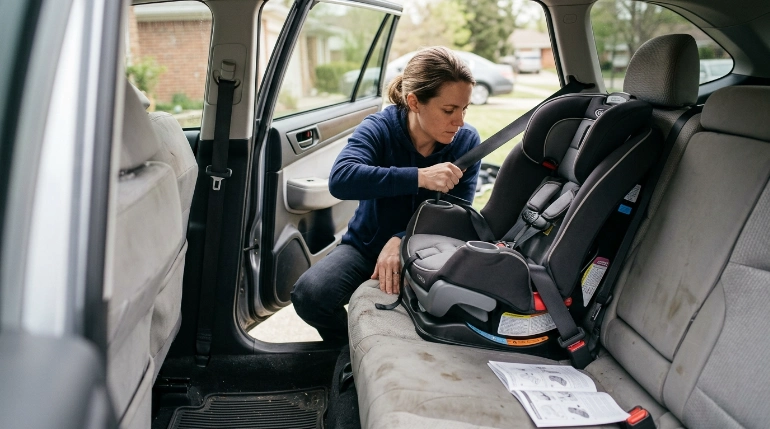
The Pria Max can be installed differently depending on its current mode and your vehicle. Maxi-Cosi provides separate instructions for rear-facing, forward-facing, lower-anchor, and vehicle-belt installations.
Read both the car-seat manual and your vehicle owner’s manual before starting. Anchor locations and vehicle-seat restrictions vary more than many first-time installers expect.
Rear-facing installation
For rear-facing use, place the Pria Max in an approved rear seating position and select the correct recline setting. Then secure it using the installation method allowed by the manual.
After tightening, test movement at the belt path. NHTSA’s car-seat installation guidance says a correctly secured seat shouldn’t move more than one inch side-to-side or front-to-back at the belt path.
Forward-facing installation
Forward-facing installation also requires the correct belt path and a tight installation. Use the top tether when instructed and permitted by both the car-seat and vehicle manufacturers.
NHTSA stresses the importance of the tether for forward-facing seats because it helps limit forward movement in a crash. Don’t leave it hanging unused simply because the lower anchors or vehicle belt already feel tight.
LATCH or vehicle seat belt?
Both can be legitimate installation methods when the manufacturer allows them. One isn’t automatically safer simply because it feels more modern or convenient.
- Use the lower anchors only within the limits stated by the car-seat and vehicle manufacturers.
- Use the vehicle belt according to the correct belt path and locking instructions.
- Don’t combine lower anchors and the vehicle belt unless the Pria Max manual specifically permits that configuration.
- Use the top tether as directed for forward-facing installation.
Will the Pria Max fit every car?
No child seat should be assumed to fit every vehicle equally well. Rear-seat contours, lower-anchor access, head restraints, front-seat position, and belt geometry can all change the installation.
A recent Kelley Blue Book guide to car-seat fit also recommends physically checking a child seat in a vehicle rather than relying only on published cabin dimensions.
If you’re buying for a compact sedan or trying to place several restraints across one row, test-fitting becomes even more important. A large rear bench doesn’t guarantee three compatible installations.
Mechanic Alert: Car-seat installation isn’t a vehicle repair, but don’t improvise anchors, drill mounting points, modify seat hardware, or alter a vehicle restraint system. Get help from a certified child-passenger-safety technician if you cannot achieve the installation described in the manuals.
Section Takeaway: Installation quality matters as much as the seat you buy. Follow the exact Pria Max and vehicle instructions, check movement at the belt path, and use the tether correctly when forward-facing.
What Is the Pria Max Like for Everyday Use?
The Pria Max puts much of its design effort into the things caregivers touch every day. That’s useful because small frustrations become much bigger after hundreds of school runs and grocery trips.
ClipQuik magnetic chest clip
ClipQuik is one of the Max model’s headline features. Maxi-Cosi says the magnetic chest clip can be opened with one hand, which can make getting a child out less awkward.
Don’t treat convenience as a substitute for correct positioning. The harness and chest clip still need to be used exactly as the manual describes on every trip.
QuikFit headrest and harness adjustment
QuikFit raises the headrest and harness together without manually rethreading the harness through a different slot. That’s handy during growth spurts when shoulder position changes.
The current Pria Max listing describes a five-position headrest system. Always confirm the selected position produces the required harness fit for the mode you’re using.
ReclineFit positions
The seat provides three recline positions. The correct position depends on the installation mode, child, and vehicle setup rather than personal comfort alone.
Rear-facing recline deserves particular attention with younger babies. Follow the seat’s angle indicator and manual rather than judging the angle by eye.
Cleaning the Pria Max
Spilled drinks, crumbs, and car-sick kids are normal parts of car-seat ownership. A cover that’s difficult to clean can turn into a long-term frustration.
Maxi-Cosi lists the Pria Max fabrics as machine-washable and dryer-safe. It also instructs owners to use milder cleaning methods on the harness, buckle, plastic, vinyl, and metal components.
- Machine wash and dry seat fabrics only according to the manufacturer’s instructions.
- Clean the harness using the method specified in the manual.
- Wipe the outside of the buckle instead of immersing it.
- Don’t lubricate the buckle.
- Avoid bleach, harsh chemicals, and dry cleaning unless specifically authorized.
Cup holders and harness storage
The two removable cup holders are listed as dishwasher-safe. That’s a small feature, but it makes sticky drink residue much easier to deal with.
The Out-of-the-Way harness system also holds straps away from the seating area. In daily use, that can reduce the familiar problem of finding straps trapped underneath a child.
Section Takeaway: The Pria Max’s strongest convenience features are the magnetic chest clip, no-rethread adjustment, washable fabrics, harness holders, and removable cup holders.
Is the Maxi-Cosi Pria Max Safe?
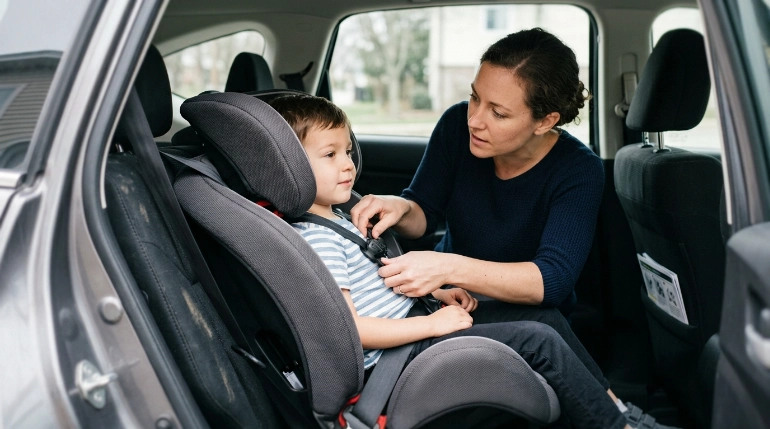
The current Pria Max is marketed as engineered and tested to meet or exceed applicable federal safety standards. Maxi-Cosi also states that the current model meets the federal side-impact standard.
That statement shouldn’t be turned into a claim that the Pria Max is safer than another compliant seat. Comparative crash performance requires controlled test data, not marketing language or appearance.
Correct fit matters more than premium features
A premium fabric or magnetic clip cannot compensate for a loose installation or incorrect harness position. The seat must fit your child, vehicle, and installation location.
A useful buying framework from the Consumer Reports car-seat buying guide is to consider the correct restraint type together with fit and ease of use. A seat that you can install and use correctly every trip has a practical advantage.
What about Maxi-Cosi Pria recalls?
Be careful when reading old recall headlines. A 2021 NHTSA recall involved certain older Maxi-Cosi Pria 70, Pria 85, and Pria 85 Max seats, while the current Pria Max U.S. listing identifies the product as item CC416.
Don’t assume an older recall applies to your seat simply because both products contain “Pria” in the name. Check the exact model number and manufacture information on your seat against NHTSA and manufacturer recall records.
Register the seat
Registering a child restraint gives the manufacturer a direct way to contact you about important safety notices. Maxi-Cosi’s Pria owner resources specifically encourage owners to register their seats.
Keep your registration information, manual, and model details somewhere accessible. You’ll want the exact identifiers if you ever need to check a safety notice.
Can you use the Pria Max on an airplane?
Maxi-Cosi lists the Pria Max as certified for aircraft use. Aircraft use still requires following the specific instructions in the user guide and the airline’s rules.
A belt-positioning booster mode depends on a lap-and-shoulder vehicle belt, so don’t assume every Pria Max configuration works the same way in an aircraft cabin. Verify the permitted mode before travel.
Section Takeaway: The Pria Max meets the manufacturer’s stated federal requirements, but safety still depends on choosing the correct mode, installing it tightly, securing the child correctly, and checking model-specific recall information.
Is the Maxi-Cosi Pria Max Worth Buying?
The Pria Max makes the most sense for families who value convenience features and want one fixed seat to cover rear-facing, forward-facing, and booster stages. Its strongest case isn’t simply the 100-pound maximum.
The more meaningful advantages are the no-rethread adjustment, magnetic chest clip, washable fabrics, recline choices, harness holders, and three-mode design.
Reasons to consider the Pria Max
- Long-term design: Three configurations reduce the number of different restraint types you may need to buy.
- Easy harness adjustment: QuikFit allows the headrest and harness to move together.
- Convenient chest clip: ClipQuik is designed for one-handed opening.
- Practical cleaning: Machine-washable, dryer-safe seat fabrics help after spills.
- Useful storage: Harness holders keep straps out of the way while seating a child.
- Three recline positions: ReclineFit gives you several approved adjustment options.
- Two removable cup holders: Both can be removed and cleaned separately.
Reasons to look at another seat
- You need an infant carrier: The Pria Max remains installed in the vehicle rather than clicking onto a stroller like a removable infant seat.
- You have limited rear-seat space: Always test the rear-facing fit before committing to any full-size all-in-one seat.
- You need three seats across: Width and vehicle geometry may make a narrower model a better solution.
- You want rotation: The standard Pria Max isn’t being presented here as a rotating-seat design.
- You prefer fewer features: A simpler seat may meet the same restraint need without premium convenience features.
Who is the Pria Max best for?
I’d put it highest on the list for a family that intends to leave one car seat installed most of the time. Its features make more sense when you’re buckling and unbuckling a child daily rather than carrying the seat between vehicles.
It’s also appealing if easy cleaning and quick harness adjustment matter to you. Those aren’t dramatic features on day one, but they can matter after years of use.
Who should skip it?
Skip an all-in-one seat if your priority is moving a sleeping newborn from car to stroller in a detachable carrier. That’s an infant-seat job.
I’d also look elsewhere if a test installation creates unacceptable front-seat interference or doesn’t work cleanly with your other child restraints. Vehicle compatibility should win over brand preference.
Section Takeaway: The Pria Max is most compelling as a convenient long-term fixed seat. Buy it for fit and everyday usability, not merely because the box promises several years of use.
Frequently Asked Questions
What is the weight limit for the Maxi-Cosi Pria Max?
The Pria Max covers different weight ranges in each mode. Rear-facing is listed for 5–40 pounds, forward-facing for 30–65 pounds, and high-back booster use for 40–100 pounds.
How tall can a child be in the Maxi-Cosi Pria Max?
The current manufacturer ranges are 19–40 inches rear-facing, 34.4–49 inches forward-facing, and 43.4–52 inches in booster mode. Check all other fit rules in the model-specific manual before changing modes.
Does the Maxi-Cosi Pria Max turn into a booster?
Yes. The Pria Max converts to a high-back belt-positioning booster for children who meet its booster requirements. In that mode, the vehicle lap-and-shoulder belt provides the restraint rather than the integrated five-point harness.
Does the Maxi-Cosi Pria Max have a removable infant carrier?
No. It is an all-in-one seat intended to remain installed in the vehicle. If you want a shell that can be removed from a base and attached to a compatible stroller, you’ll generally want an infant car seat instead.
Is the Maxi-Cosi Pria Max machine washable?
Maxi-Cosi lists the seat fabrics as machine-washable and dryer-safe. The harness, buckle, plastic, vinyl, and metal parts have different cleaning instructions, so don’t put those components through the same cleaning process.
Can the Maxi-Cosi Pria Max be installed with LATCH?
The Pria Max includes lower-anchor connectors for compatible installations. Follow the model manual and vehicle owner’s manual because lower-anchor use has specific requirements and shouldn’t automatically be combined with a vehicle-belt installation.
Is the Maxi-Cosi Pria Max good for newborns?
The current U.S. model lists rear-facing use beginning at 5 pounds and 19 inches. A newborn must still meet every manufacturer fit requirement, so check the harness position, inserts, recline, weight, height, and manual before the first ride.
Final Takeaway
The Maxi-Cosi Pria Max All-in-One Convertible Car Seat offers a practical mix of three-mode longevity and everyday convenience. Its 5–100-pound overall range, QuikFit adjustment, ClipQuik magnetic chest clip, washable fabrics, and removable cup holders make it appealing for families wanting one fixed seat for several stages.
Still, the best car seat isn’t determined by the longest specification list. Make sure the Pria Max fits your child, your rear seat, your normal front-seat positions, and your installation needs before deciding.
If it passes those tests, the Pria Max can be a sensible long-term choice. Keep the manual available, register the seat, check safety notices, and delay each stage transition until your child has genuinely outgrown the appropriate current mode.
