
Evenflo All4Stages Slim 4-in-1 Convertible Car Seat Reviews: Is It Worth It in 2026?

Quick Answer
The Evenflo All4Stages Slim 4-in-1 is a strong choice for families who want a narrow, long-use car seat without moving to a booster-only product later. Its 16.9-inch width, four modes, no-rethread harness, and 4-to-120-pound overall range make it especially appealing for crowded back seats, although you should still confirm child fit and installation using NHTSA car-seat guidance.
Why I think it stands out
- Slim footprint: The seat measures 16.9 inches wide, making it easier to consider for tight second rows.
- Four stages: It works rear-facing, forward-facing, as a high-back booster, and as a backless booster.
- Wide weight range: Manufacturer limits span from 4 pounds through 120 pounds, depending on mode.
- Easy adjustments: A 12-position headrest and no-rethread harness reduce repeated setup work as a child grows.
- Installation focus: Evenflo’s SecureTight system is designed to help caregivers achieve a tight installation with less effort.
- Main limitation: A narrow shell does not guarantee three-across compatibility in every vehicle.
Best for
- Families wanting one seat that can cover several stages while preserving valuable back-seat width.
If you’re searching for Evenflo All4Stages Slim 4 in 1 convertible car seat reviews, you’re probably deciding whether its narrow design is worth choosing over a more conventional all-in-one seat.
That is the right question. I would judge this seat less by its feature count and more by how those features affect installation, child fit, back-seat space, and everyday use.
In This Guide
- Is the Evenflo All4Stages Slim worth buying?
- What are the All4Stages Slim weight limits and specifications?
- How easy is the Evenflo All4Stages Slim to install and adjust?
- Can the Evenflo All4Stages Slim really fit three across?
- How practical is it for everyday family use?
- What are the biggest drawbacks?
- Frequently asked questions
Is the Evenflo All4Stages Slim worth buying?
Yes, for the right vehicle and family. Its biggest advantage is combining a genuinely narrow 16.9-inch shell with four useful seating modes instead of making width reduction its only selling point.
I would put it high on a shopping list for a family trying to preserve second-row space. I would not buy it solely because the box says it can fit three across.
What makes this seat different?
An all-in-one car seat is a child restraint designed to serve several stages of a child’s growth. The All4Stages Slim goes from rear-facing use through a backless booster configuration.
Evenflo lists the seat at 23.6 pounds, with assembled dimensions of 16.9 inches wide, 24.3 inches high, and 22 inches deep.
- Rear-facing: 4 to 40 pounds.
- Forward-facing harness: 30 to 65 pounds.
- High-back booster: 40 to 100 pounds.
- No-back booster: 40 to 120 pounds.
- Headrest: 12 adjustable positions.
- Harness: No-rethread design.
Those specifications give the seat useful range. They don’t mean a child should move to the next stage as soon as the minimum number is reached.
NHTSA recommends keeping children rear-facing until they reach the maximum rear-facing height or weight allowed by their seat. The same principle applies before moving from a forward-facing harness into a booster.
Who gets the most value from it?
The most obvious customer is a family with limited side-to-side space. That could mean two child restraints plus an adult passenger, or an attempt to install three restraints in one row.
It also makes sense for someone who dislikes buying a different seat for every stage. One shell covering rear-facing, harnessed forward-facing, high-back booster, and backless booster use is convenient.
- Compact sedans with limited rear-seat width.
- Families installing two or more child restraints.
- Parents who want a no-rethread harness.
- Caregivers who regularly adjust a seat for a growing child.
- Buyers who value long-term configuration flexibility.
Section Takeaway: The All4Stages Slim earns its strongest recommendation when back-seat width and long-term flexibility matter more than having the lightest possible car seat.
What are the All4Stages Slim weight limits and specifications?

The All4Stages Slim covers four modes with different child-fit limits. Always use the limits printed on your specific seat and in its manual because the appropriate mode depends on more than weight alone.
| Mode | Weight Range | Key Fit Detail | My Take |
|---|---|---|---|
| Rear-facing | 4–40 lb | 17–43 in | Useful from infancy, but monitor the rear-facing limit carefully as the child grows. |
| Forward-facing harness | 30–65 lb | 35–49 in; manufacturer also specifies a minimum age requirement. | A practical next stage after the child has truly outgrown rear-facing use. |
| High-back booster | 40–100 lb | Uses the vehicle lap-and-shoulder belt. | Useful when the child is mature enough for booster use and meets all manufacturer requirements. |
| No-back booster | 40–120 lb | Vehicle head support and proper belt fit remain essential. | Extends the useful life of the product after the high-back stage. |
Don’t treat the minimum limits as transition targets
A child being heavy enough for a mode doesn’t automatically mean that mode is the safest next move. Development, height, harness position, belt fit, and the manufacturer’s instructions all matter.
For example, Evenflo lists forward-facing use beginning at 30 pounds but also specifies that the child must be at least two years old. Its product information lists a minimum age of five for booster use.
NHTSA’s broader guidance is more important than rushing toward those minimums. Keep a child in the current appropriate stage until that stage is outgrown.
What about the 4-to-120-pound marketing range?
The 4-to-120-pound figure describes the combined span across all four modes. It does not mean every mode works throughout that entire range.
This sounds obvious, but it matters when comparing all-in-one seats. A large total range can hide much narrower limits within each individual configuration.
You can review the current manufacturer specifications on the official Evenflo All4Stages Slim product page before purchasing.
Section Takeaway: Read the four mode limits separately. The correct transition point is based on the child’s fit and the manual, not the largest number printed in the product description.
How easy is the Evenflo All4Stages Slim to install and adjust?
Installation convenience is one of the seat’s more attractive features. Evenflo uses its SecureTight system and says it is designed to achieve a secure installation with less tightening effort.
That claim should not replace the usual installation test. A child restraint still needs to be installed exactly according to both the car-seat manual and vehicle owner’s manual.
SecureTight can reduce one common frustration
One of the hardest parts of installing some convertible seats is getting enough tension without fighting the belt or lower-anchor strap. A tensioning aid can make that process less frustrating.
I would still judge the final result, not how easy the tightening step felt. NHTSA says an installed seat should not move more than one inch side-to-side or front-to-back when checked at the belt path.
- Place the seat in the correct rear- or forward-facing orientation.
- Use the correct belt path for that mode.
- Use either an approved seat-belt installation or lower-anchor method as directed.
- Remove slack and secure the seat.
- Check movement at the belt path.
- Confirm the required recline angle.
- For forward-facing harness use, follow the manual’s tether instructions.
Mechanic Alert: Child-seat installation isn’t automotive repair, but it is safety-critical. If you’re uncertain about the installation, use a certified Child Passenger Safety Technician rather than guessing.
The no-rethread harness is a meaningful convenience
The 12-position headrest and no-rethread harness move together without requiring you to remove and reroute the shoulder straps through different shell slots.
That is especially useful during growth spurts. It also reduces the temptation to postpone a needed harness-height adjustment because changing it feels inconvenient.
NHTSA offers car-seat ease-of-use information for parents who want to compare everyday usability factors before choosing a restraint.
Four rear-facing recline positions add flexibility
Evenflo lists four rear-facing recline options and two forward-facing recline options. Extra adjustment choices can help when vehicle seat cushions have aggressive slopes.
Still, the correct position comes from the indicator and manual. Don’t choose a recline setting only because it creates more front-passenger legroom.
Section Takeaway: The adjustment hardware looks family-friendly, but a convenient tightening system never changes the need for a correct belt path, recline angle, harness fit, and movement check.
Can the Evenflo All4Stages Slim really fit three across?
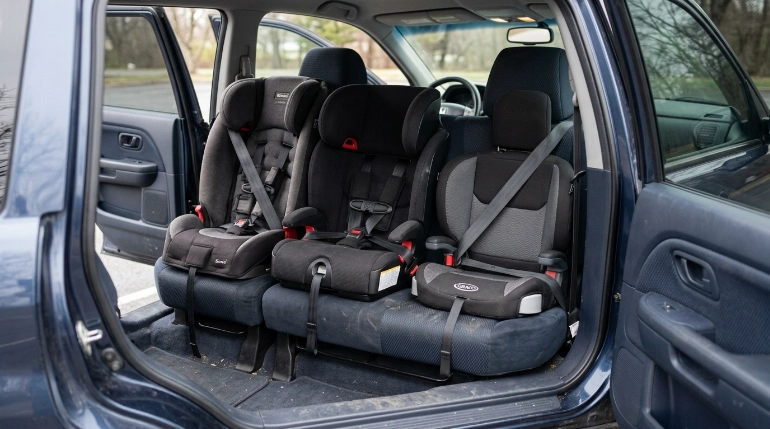
It can make three-across installations more realistic, but no 16.9-inch seat can guarantee that three restraints will fit every rear bench. Vehicle geometry matters too much.
This is the part of the All4Stages Slim that I would evaluate most carefully before buying three identical seats.
Why 16.9 inches is useful
A few inches matter quickly when several restraints share one row. Narrower shells leave more room for adjacent seats, buckles, doors, and sometimes an adult passenger.
Consumer Reports has noted that narrow restraints are an important starting point when trying to fit three child seats across. The publication also currently includes the All4Stages Slim in its car-seat review database.
- Seat width: The All4Stages Slim is 16.9 inches wide.
- Vehicle width: Usable bench width varies substantially between vehicles.
- Seat contours: Raised bolsters can reduce usable space.
- Buckle position: Fixed or recessed buckles may interfere with adjacent restraints.
- Door shape: Door panels can narrow the outer seating positions.
- Restraint shape: Two narrow seats may still collide at the shoulders or bases.
Three-across is a geometry problem
Car seats don’t behave like rectangular boxes. Their widest points can occur at different heights.
Sometimes two seats that appear too wide on paper can “puzzle” beside one another because their widest areas don’t overlap. The opposite can also happen.
That is why I would never treat a combined width calculation as proof of fit. Installation must remain independent and correct for each restraint.
Test your exact vehicle when possible
If three-across is the main reason you’re choosing the All4Stages Slim, buy from a seller with a reasonable return policy or test the seat before committing to multiples.
Make sure one installed restraint isn’t depending on the adjacent seat to remain upright or tight. Each seat needs to work correctly on its own.
Section Takeaway: The 16.9-inch width is a legitimate advantage, but “fits three across” should be read as a possibility, not a universal vehicle-fit promise.
How practical is the Evenflo All4Stages Slim for everyday family use?
Daily usability looks like another strong point. The seat combines a relatively narrow shell with adjustable padding, removable cupholders, recline choices, and a harness that doesn’t need manual rethreading.
That feature combination matters because parents interact with these details far more often than they interact with a specification sheet.
Owner reviews favor the slim design
As of August 2026, Evenflo’s own product page displayed an overall rating of about 4.23 out of 5 from 118 reviews. Its review summary highlighted car fit, installation ease, slim design, and adjustable straps as recurring themes.
Manufacturer-hosted reviews aren’t the same as an independent laboratory evaluation. I use them mainly to identify repeated convenience complaints or praise.
There are also complaints worth noticing
Not every owner likes the seat. Published feedback includes complaints about strap behavior, cupholder interference, perceived installation tightness, and the size or shape of the head-area padding.
Those comments don’t prove a safety defect. They do show why trying a child’s fit in the seat is worthwhile when possible.
- Check shoulder comfort: Confirm the headrest and harness positions work for your child’s build.
- Check cupholder clearance: Make sure removable accessories don’t create unnecessary interference beside another seat.
- Check harness operation: Tighten and loosen it several times before deciding you like the mechanism.
- Check loading room: Make sure your vehicle’s roofline and door opening leave enough space.
- Check front-seat impact: Rear-facing depth can affect front-passenger space even when a seat is narrow.
The 23.6-pound weight matters if you move it often
This isn’t an infant carrier designed for frequent removal. At 23.6 pounds, it makes more sense as a seat that stays installed most of the time.
Families regularly switching one restraint between several vehicles may value the installation system. They should still consider whether carrying the shell itself becomes annoying.
Long-term use is convenient, but don’t overvalue it
Evenflo describes the All4Stages Slim as usable for up to 10 years. That sounds attractive because it reduces the number of seat types you may need to purchase.
However, I would never choose a current seat based only on a promise that it will still suit your family many years later. Vehicle changes, child fit, condition, recalls, and personal needs can change.
Section Takeaway: Everyday convenience is one of this seat’s better arguments, especially the narrow shell and no-rethread adjustment. Just make sure your child finds the head and shoulder area comfortable.
What are the biggest drawbacks of the Evenflo All4Stages Slim?
The All4Stages Slim solves a specific problem well, but it is not automatically the best convertible seat for every household. Its compromises become clearer when back-seat width isn’t your main concern.
Rear-facing ends at 40 pounds
The rear-facing mode tops out at 40 pounds. Some parents shopping specifically for extended rear-facing use may prefer a seat offering a higher rear-facing weight limit.
That doesn’t make the Evenflo unsuitable. It simply means rear-facing longevity should be compared carefully against your child’s growth pattern.
Slim does not mean compact in every direction
The shell is narrow side-to-side, but Evenflo lists a 22-inch assembled depth. Rear-facing geometry may still use meaningful front-to-back space.
A small vehicle owner should therefore check both width and depth. Fixating only on the 16.9-inch number can create the wrong expectation.
The head-area design may not suit every child
Some owner comments mention prominent head-area padding or bolsters. Child proportions vary, so a feature one child finds supportive may feel restrictive to another.
Always check harness placement and headrest adjustment according to the manual. Never add aftermarket padding or modify the seat to solve a fit concern.
A four-mode seat is more complex than a single-purpose seat
Convertible and all-in-one seats require caregivers to understand several belt paths, harness rules, recline positions, and conversion steps. More modes create more opportunities to use the wrong setup.
Keep the manual accessible. Before changing modes, reread the relevant instructions instead of relying on memory.
Who should probably choose something else?
- Parents prioritizing the highest possible rear-facing weight limit.
- Families wanting an ultra-light seat for constant vehicle transfers.
- Drivers with plenty of rear-seat width who gain little from the narrow shell.
- Children who don’t achieve a comfortable, manufacturer-approved fit in the head or shoulder area.
- Anyone assuming the 16.9-inch width guarantees three seats will fit their particular vehicle.
Independent organizations such as Consumer Reports’ car-seat section can also help you compare different restraint designs before buying.
Section Takeaway: Its biggest compromises are the 40-pound rear-facing ceiling, substantial overall shell, and vehicle-specific three-across fit. Those are worth weighing against its strong width and versatility advantages.
Frequently asked questions about the Evenflo All4Stages Slim
Is the Evenflo All4Stages Slim a convertible car seat?
Yes. It is more specifically a four-mode all-in-one restraint. It supports rear-facing, forward-facing harness, high-back booster, and no-back booster configurations, with different child-fit requirements for each mode.
How wide is the Evenflo All4Stages Slim?
Evenflo lists the All4Stages Slim at 16.9 inches wide. That narrow footprint can help in crowded rear seats, but three-across compatibility still depends on your vehicle, adjacent restraints, buckle locations, and independent installation quality.
What is the rear-facing weight limit?
The manufacturer lists rear-facing use from 4 to 40 pounds and 17 to 43 inches. A child should remain rear-facing until reaching the applicable manufacturer limit rather than switching forward merely because the forward-facing minimum has been reached.
What is the forward-facing weight limit?
The forward-facing harness range is 30 to 65 pounds, with a listed height range of 35 to 49 inches. Evenflo also specifies a minimum age requirement, so check every fit condition before changing modes.
Does the Evenflo All4Stages Slim turn into a booster?
Yes. It converts first to a high-back booster and later to a no-back booster. Evenflo lists high-back booster use to 100 pounds and no-back booster use to 120 pounds, subject to the complete fit requirements in the manual.
Can I install three Evenflo All4Stages Slim seats across?
Possibly, but the 16.9-inch width is not a guarantee. Three-across success depends on the rear bench, seat contours, belt and anchor locations, door panels, and how the restraints interact while remaining independently installed.
How can I make sure my installation is correct?
Follow both the restraint manual and vehicle owner’s manual, then check movement at the belt path. If you’re unsure, use NHTSA’s car-seat inspection resources to locate qualified installation help.
Final Takeaway: The Evenflo All4Stages Slim 4-in-1 is one of the more compelling choices when back-seat width is a genuine problem. Its four modes, 16.9-inch footprint, adjustable headrest, and no-rethread harness give it practical long-term appeal.
I would buy it for its combination of narrow width and usability, not because of a blanket three-across promise. Confirm your child’s fit, test your exact vehicle when possible, register the seat for safety notices, and follow the manual every time you change modes.
