
Graco 4Ever Extend2Fit DLX 4-in-1 Car Seat Manual: Complete Guide

Quick Answer
The Graco 4Ever Extend2Fit DLX 4-in-1 car seat manual explains rear-facing, forward-facing, highback-booster, and backless-booster use. Before installing your seat, confirm its model number and manufacture date, then compare them with the instructions for your exact version on the official Graco 4Ever Extend2Fit page.
What to check first
- Exact model: Check the white identification label on the car seat before using a downloaded manual.
- Rear-facing: Current Graco information lists a 4–50 lb rear-facing range for this product family.
- Forward-facing: Use the minimum printed on your specific seat because different manual versions show different lower limits.
- Booster modes: Highback and backless modes require a vehicle lap-and-shoulder belt.
- Installation: Read both the Graco manual and your vehicle owner’s manual before securing the seat.
Important safety check
- Do not rely on a manual for a similar-looking Graco model if its model number or instructions differ from your seat.
If you’re looking for the Graco 4Ever Extend2Fit DLX 4-in-1 car seat manual, you’re probably trying to install the seat, change modes, or confirm a weight limit.
I’ve broken the manual into the practical checks that matter most, while keeping the manufacturer’s instructions as the final authority.
In This Guide
- Where Can You Find the Correct Graco 4Ever Extend2Fit DLX Manual?
- What Are the Four Modes and Their Limits?
- How Do You Install the Graco 4Ever Extend2Fit DLX Rear-Facing?
- How Do You Install It Forward-Facing?
- How Do You Convert the Seat to Booster Mode?
- How Do You Adjust and Clean the Car Seat?
- Frequently Asked Questions
Where Can You Find the Correct Graco 4Ever Extend2Fit DLX Manual?

The safest approach is to identify your exact seat first, then locate the instructions that match its model number and manufacture date.
This matters because the 4Ever Extend2Fit family has been sold in several versions over time.
Check the identification label first
Look on the back, bottom, or another labeled area of your car seat for its white manufacturer label.
- Model name
- Model number
- Date of manufacture
- Serial number, if shown
Graco also requests this information when owners register a car seat for safety notifications.
Why the exact manual version matters
The DLX Extend2Fit manual version I reviewed is dated August 2020 and identifies the seat as the “4Ever DLX Extend2Fit 4-in-1 Car Seat.”
That manual lists a 22–65 lb forward-facing harness range.
As of 2026, Graco’s current 4Ever Extend2Fit product page lists the forward-facing harness range as 26.5–65 lb.
Important: Do not combine limits from different generations. Follow the labels and instruction manual supplied for your exact seat.
A 4-in-1 car seat is a child restraint designed to change configuration as a child grows, rather than being replaced at every stage.
The four configurations here are rear-facing harness, forward-facing harness, highback booster, and backless booster.
What Are the Four Modes and Their Limits?
The mode you choose depends on your child’s size, developmental readiness, and the limits printed on your exact restraint.
You should not move to the next mode merely because your child has reached the minimum allowed size.
| Mode | Published Range | Key Fit Requirement |
|---|---|---|
| Rear-facing harness | 4–50 lb | Head remains at least 1 inch below the specified upper point or handle indicated by the seat instructions. |
| Forward-facing harness | Exact lower limit varies by version; upper limit 65 lb | Up to 49 inches on the versions reviewed; follow your own label. |
| Highback booster | 40–100 lb | 43–57 inches and at least 4 years old on the referenced instructions. |
| Backless booster | 40–120 lb | 43–57 inches and at least 4 years old on the referenced instructions. |
NHTSA recommends keeping children rear-facing until they reach the rear-facing height or weight limit provided by their car-seat manufacturer.
You can review the broader NHTSA car seat recommendations when deciding when a child should change modes.
My practical rule: Treat each maximum as a limit, not a target date. If your child still fits safely in the more protective previous stage, don’t rush the transition.
How Do You Install the Graco 4Ever Extend2Fit DLX Rear-Facing?
Rear-facing installation uses the rear-facing belt path and requires the seat to sit at an approved recline angle.
The referenced DLX manual marks this belt path in blue.
Rear-facing setup checklist
- Place the restraint in the vehicle’s back seat. Never place a rear-facing seat in front of an active frontal air bag.
- Select rear-facing mode. Confirm the recline setting and level indicator match the instructions.
- Choose one installation method. Use either an approved vehicle seat belt or lower anchors as directed by your manual.
- Route through the rear-facing path. Keep the belt or lower-anchor strap flat and untwisted.
- Tighten the installation. Apply pressure to the seat while removing slack.
- Test at the belt path. The restraint should move less than 1 inch side-to-side or front-to-back.
- Recheck the recline indicator. Make this check while the vehicle is sitting on level ground.
The older DLX manual says not to use its rear-facing lower-anchor installation for a child weighing more than 35 lb.
If your child exceeds the lower-anchor limit but remains within rear-facing limits, follow your exact manual for a seat-belt installation.
How should the rear-facing harness fit?
- Harness straps should be at or just below the child’s shoulders.
- The straps should lie flat without twists.
- The harness should be snug enough that you cannot pinch excess webbing at the shoulder.
- The chest clip should sit at armpit level.
NHTSA’s all-in-one rear-facing installation guidance follows the same core checks: correct belt path, tight installation, correct recline, and a snug harness.
Section Takeaway: Rear-facing installation is not finished until you’ve checked both movement at the belt path and the seat’s recline indicator.
How Do You Install It Forward-Facing?
Forward-facing installation changes the belt path, harness position, recline requirements, and tether setup.
The top tether is especially important in this mode.
Forward-facing installation steps
- Confirm your child qualifies. Follow the minimum age, size, and developmental requirements printed on your exact seat.
- Remove rear-facing-only parts when required. The referenced DLX manual prohibits using the anti-rebound bar or Extend2Fit leg-extension panel in forward-facing mode.
- Use the forward-facing belt path. The referenced manual marks this path in orange.
- Install with one approved method. Use the vehicle seat belt or lower anchors as your manual permits.
- Connect the top tether. Attach it to the vehicle’s designated tether anchor and remove the slack.
- Test for movement. Check directly at the forward-facing belt path for less than 1 inch of movement.
The 2020 DLX manual limits forward-facing LATCH installation to children weighing 40 lb or less.
Above that threshold, its instructions direct owners to use the appropriate vehicle-seat-belt installation while continuing to use the tether.
Forward-facing harness position
- Harness straps go at or just above the child’s shoulders.
- The chest clip stays at armpit level.
- No harness webbing should be twisted.
- You should not be able to pinch excess strap material at the shoulder.
NHTSA also emphasizes tether use when installing a forward-facing harnessed seat, as explained in its forward-facing installation instructions.
Don’t guess at anchors: Your vehicle owner’s manual identifies which locations have approved lower anchors and tether anchors.
How Do You Convert the Seat to Booster Mode?
Booster mode stops using the five-point harness and positions the vehicle’s lap-and-shoulder belt across the child instead.
A lap-only belt must not be used to restrain a child in booster mode.
Highback booster
The referenced DLX instructions list highback-booster use from 40–100 lb and 43–57 inches, with a minimum age of four years.
- Store the internal harness exactly as the manual shows.
- Remove the anti-rebound bar and leg-extension panel when instructed.
- Route the shoulder belt through the appropriate headrest belt guide.
- Keep the lap belt low across the hips and upper thighs.
- Keep the shoulder belt between the neck and outer edge of the shoulder.
Backless booster
The referenced instructions list the backless booster from 40–120 lb and 43–57 inches, again with a minimum age of four years.
Age and weight alone aren’t enough if the child cannot remain properly seated throughout the trip.
Correct belt fit: The lap belt belongs low across the hips and thighs, while the shoulder belt should cross the chest and shoulder rather than the neck, face, arm, or back.
NHTSA recommends continuing booster use until the vehicle belt fits correctly without one.
How Do You Adjust and Clean the Graco 4Ever Extend2Fit DLX?
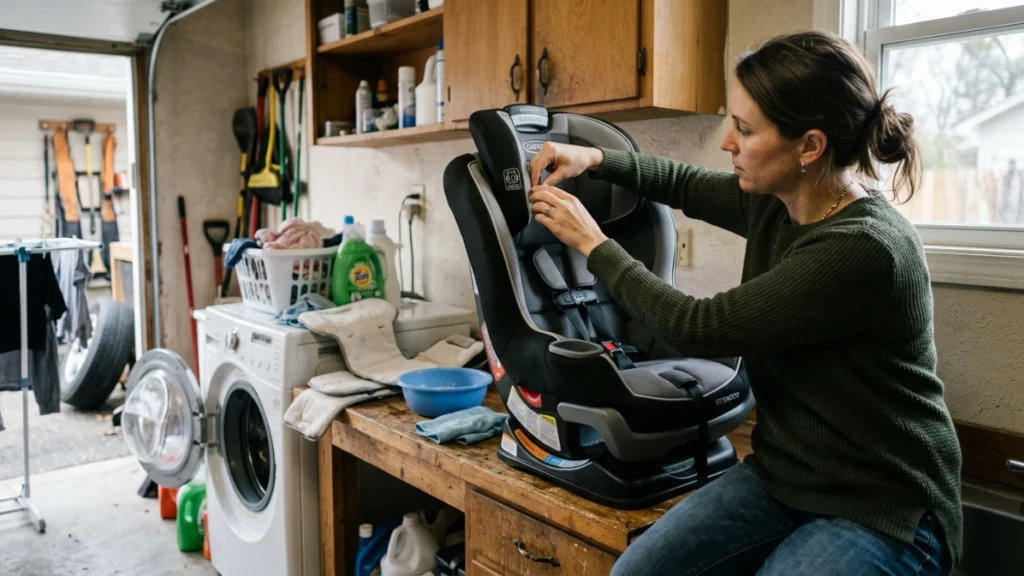
The seat includes a no-rethread-style headrest and harness adjustment system, so the harness height changes as you reposition the headrest.
Always check the harness position again after adjusting it.
Harness and buckle checks
- Rear-facing: Keep the harness at or below shoulder level.
- Forward-facing: Keep it at or above shoulder level.
- Buckle: Use the permitted position closest to the child without placing the buckle underneath the child.
- Harness tension: Remove slack before performing the pinch test.
- Chest clip: Finish with the clip at armpit level.
Cleaning the seat pads
The referenced manual permits several removable pads to be machine washed in cold water on a delicate cycle and drip-dried.
It specifically warns against bleach.
- Check the fabric’s care label before washing.
- Use mild soap and cool water for spot cleaning.
- Follow the manual carefully when removing and reinstalling pads.
- Do not alter the harness webbing with unapproved cleaners or chemicals.
- Use only mild soap and water on the Extend2Fit extension panel.
- Use only mild soap and water on the anti-rebound bar.
Remember the useful-life date
Graco states that this product family should stop being used 10 years after its date of manufacture.
The manufacture date is more useful than the purchase date when you’re checking that deadline.
Registering the restraint also helps the manufacturer contact you if a safety recall affects your model.
Section Takeaway: Keep the identification label readable. It connects your seat to the correct instructions, manufacture date, replacement parts, and recall information.
Frequently Asked Questions
Where is the Graco 4Ever Extend2Fit DLX manual stored on the car seat?
The referenced DLX seat includes an instruction-manual storage location on the restraint itself. If the original manual is missing, use the model number and manufacture date from the white product label to locate the correct replacement instructions through Graco support.
What is the rear-facing weight limit?
The DLX manual reviewed and Graco’s current product information both list rear-facing use from 4–50 lb. Height and head-position requirements also apply, so weight alone does not determine whether a child still fits rear-facing.
When can I turn the Graco 4Ever Extend2Fit forward-facing?
Keep your child rear-facing until they reach the rear-facing height or weight limit of their exact seat whenever possible. Check your seat label carefully because the minimum forward-facing weight differs between the older DLX manual and current Graco product information.
Can I use LATCH and the vehicle seat belt together?
Not for the five-point-harness installations described in the referenced DLX manual. Choose the approved lower-anchor method or the vehicle-seat-belt method, then follow the manual’s tether instructions for forward-facing use.
How tight should the car seat be?
After installation, hold the restraint at the belt path and move it side-to-side and front-to-back. It should move less than 1 inch in either direction at that location.
Can the anti-rebound bar stay attached forward-facing?
No. The referenced DLX manual states that its anti-rebound bar is for rear-facing use only and must not be used in forward-facing or booster configurations.
What should I do if I’m still unsure about the installation?
Don’t improvise. Use NHTSA’s car-seat resources to locate a trained Child Passenger Safety Technician who can inspect the installation and show you how to use the restraint correctly.
Final Takeaway
The Graco 4Ever Extend2Fit DLX can cover several stages of a child’s growth, but every mode has its own belt path, fit rules, and installation limits. Before making a change, match your model number to the correct manual, read your vehicle owner’s manual, and recheck the installation from the beginning.
