
The Complete Guide: How Long Can a 8 Month Old Be in Car Seat Safely?

Traveling with an infant requires extra planning, patience, and a deep understanding of automotive safety. Whether you are running a quick errand across town or packing up the family vehicle for a cross-country road trip, your baby’s well-being is always the top priority. Many parents and caregivers find themselves asking how long can a 8 month old be in car seat without risking their health or comfort.
Because infants are still developing physically, sitting in a semi-reclined position for extended periods comes with hidden risks. In this comprehensive guide, we will explain the medical and automotive safety guidelines regarding infant car seat limits. You will learn the hidden dangers of extended travel, how to plan your road trips effectively, and how to ensure your vehicle is mechanically ready to keep your baby safe and comfortable.
Quick Answer
If you are wondering how long can a 8 month old be in car seat, the standard safety guideline is no more than two hours within a 24-hour period. This “Two-Hour Rule” prevents dangerous breathing issues and spine strain. For longer road trips, you must plan frequent breaks to take your baby out of the seat, allowing them to stretch and breathe naturally.
Understanding the Two-Hour Rule for Infants
Child safety experts universally recommend limiting the time an infant spends in a car seat. For an 8-month-old, the absolute maximum time spent in a car seat should be two hours at a time.
This rule is not just about keeping a baby from getting fussy. It is rooted in how a baby’s body develops and functions. When placed in a car seat, an infant is positioned in a semi-upright, C-shaped curve. While this angle is highly effective at absorbing crash forces, it is not an ideal posture for prolonged periods.
The Risk of Positional Asphyxiation
An 8-month-old baby has a heavy head relative to their body size, and their neck muscles are still developing strength. If left in a car seat for too long, their head can slowly slump forward, pressing their chin into their chest.
This posture can slowly restrict their airway, leading to a dangerous condition called positional asphyxiation. Because this happens silently, parents in the front seat may not even realize the baby is struggling to breathe.
Spine and Hip Development
An infant’s spine and hips are actively developing during their first year. Spending excessive hours strapped into a rigid, curved plastic shell restricts their natural movement. Continuous pressure on the spine and hips can interfere with healthy physical development. Taking your baby out of the seat allows them to stretch, kick, and relieve pressure on their growing joints.
To ensure you are following the latest federal safety standards regarding child passenger equipment, you can review the NHTSA guidelines on child passenger safety, which offer deep insights into proper seat selection and installation.
Managing Long Road Trips with an 8-Month-Old
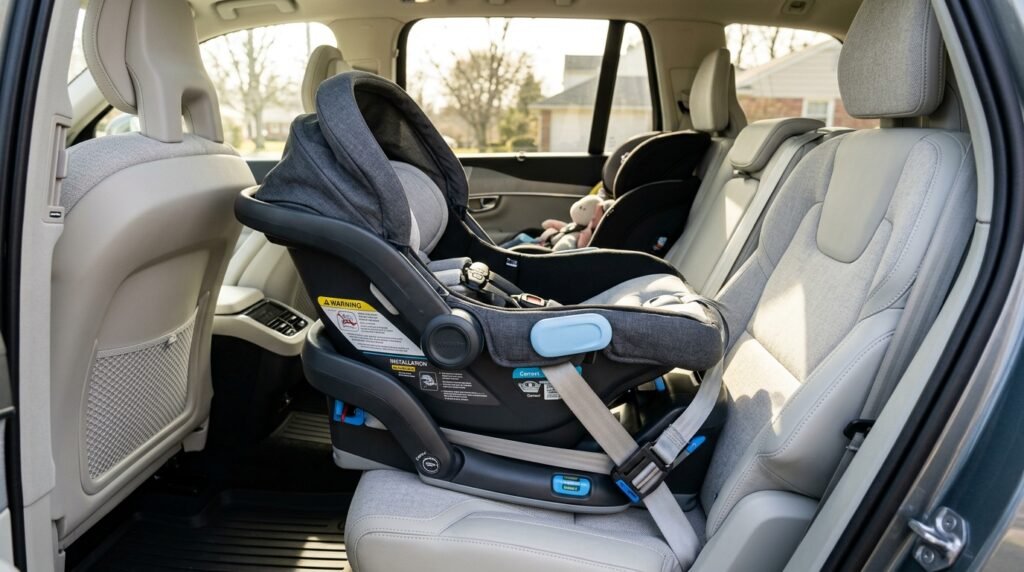
Family road trips are still possible with an 8-month-old, but they require strict time management and route planning. You cannot simply power through a six-hour drive like you did before having a baby.
Plan Your Stops in Advance
When mapping out your journey, identify safe, clean rest stops, parks, or family-friendly restaurants along your route. You must plan to pull over entirely every two hours. During these stops, take the baby out of the car seat completely. Lay out a blanket on the grass or floor so they can practice tummy time, roll around, and stretch their limbs.
Sit in the Back Seat
Whenever possible, have one adult sit in the back seat next to the baby. This allows you to monitor their breathing, check their head position, and ensure they are not overheating. If their head begins to slump forward while sleeping, you can gently reposition it.
Monitor Vehicle Climate Control
Car seats are made of dense foam and heavy fire-retardant fabrics that trap body heat. Even if the front of the vehicle feels cool, the rear-facing baby might be sweating. Use sunshades on the rear windows to block direct sunlight. Point the rear air conditioning vents toward the ceiling above the baby, allowing cool air to fall gently over them rather than blasting them directly.
Travel Systems and Everyday Errands
The two-hour limit includes all time spent in the car seat, not just time spent driving. This is a common trap for parents who use travel systems, where the infant car seat clicks directly out of the vehicle and into a stroller frame.
If you drive 30 minutes to the mall, push the baby in the car seat stroller for an hour, and drive 30 minutes home, your baby has reached the two-hour maximum.
Important Warning: Never let your baby use the car seat as a crib or regular sleep space outside of the vehicle. According to Consumer Product Safety Commission (CPSC) safe sleep standards, infants should always sleep on a firm, flat surface to prevent sudden infant death syndrome (SIDS) and accidental suffocation.
Vehicle Prep for Infant Safety
As an automotive owner, you are responsible for more than just the plastic car seat. The vehicle itself must be in excellent condition to safely transport your child.
Checking Your Seatbelts (ALR Mode)
If you are installing your car seat using the vehicle’s seatbelt instead of LATCH anchors, the belt must be locked. Most modern vehicles feature an Automatic Locking Retractor (ALR). Pull the seatbelt all the way out until it stops, then let it retract. You should hear a clicking sound, meaning the belt is locked and will hold the car seat tightly in a crash.
Inspecting LATCH Anchors
Lower Anchors and Tethers for Children (LATCH) are standard in modern cars. Before installing a car seat, inspect the metal anchors hidden in your seat bight (the crease where the backrest meets the bottom cushion). Ensure there is no severe rust, sticky residue, or debris blocking the anchor point.
When to Call a Professional Mechanic
While parents usually focus on the baby gear, your car’s mechanical health directly impacts your infant’s safety. You should take your vehicle to a professional mechanic or auto shop if you notice any of the following issues:
- Failing Air Conditioning: A broken AC system can quickly lead to infant heatstroke in a hot car. If your AC blows warm air or struggles to reach the back seat, have a mechanic recharge the refrigerant and check the compressor.
- Faulty Seatbelts: If your seatbelts do not lock when pulled sharply, or if the ALR mode is broken, a mechanic must replace the seatbelt assembly immediately.
- Suspension Problems: If your car bounces excessively over bumps or shakes at highway speeds, worn struts or shocks can violently jostle your baby. A smooth ride is essential to keeping their head safely positioned.
- Exhaust Leaks: A ticking noise from the engine or a smell of exhaust inside the cabin means dangerous carbon monoxide could be reaching your baby. Have a shop inspect the exhaust manifold and tailpipe.
Expert Tip:
Always remove your baby’s bulky winter coat before buckling them into their car seat. Thick coats compress during a crash, leaving the harness dangerously loose. Instead, buckle the baby in thin, snug layers, and drape a blanket over the harness to keep them warm.
Car Seat Time Limits vs. Break Requirements
Use this simple table to plan your travel and rest stops based on automotive safety best practices.
| Travel Duration | Max Continuous Time in Seat | Minimum Break Required | Recommended Break Activity |
| Quick Errands (Under 1 hour) | Up to 1 hour | N/A (Take baby out upon arrival) | Normal play or transition to flat bassinet |
| Medium Trips (2-3 hours) | 2 hours | 30 minutes | Tummy time on a blanket, feeding, diaper change |
| Long Road Trips (4+ hours) | 2 hours | 30 to 45 minutes | Full stretch, crawling practice, extended feeding |
| Multi-Day Driving | 2 hours at a time | Overnight stop (minimum 10 hours) | Sleep on a firm, flat surface (crib or pack-and-play) |
Common Mistakes Car Owners Should Avoid
Even well-meaning parents make errors when combining baby gear with their vehicles. Keep your 8-month-old safe by avoiding these common automotive mistakes:
- Leaving a sleeping baby in the seat after parking: It is tempting to bring a sleeping baby inside and leave them in the car seat on the living room floor. You must move them to a flat crib immediately.
- Using aftermarket car seat accessories: Do not attach mirrors, hanging toys, or custom seat covers that did not come in the box with your car seat. These items are not crash-tested and can become dangerous projectiles in an accident.
- Ignoring the vehicle owner’s manual: Your vehicle manual has a specific section on child restraints. It tells you exactly which seating positions are safe and where the LATCH anchors are located.
- Placing a rear-facing seat in front of an active airbag: Never put an infant seat in the front passenger seat. An deploying airbag will strike the back of the car seat with fatal force.
FAQs
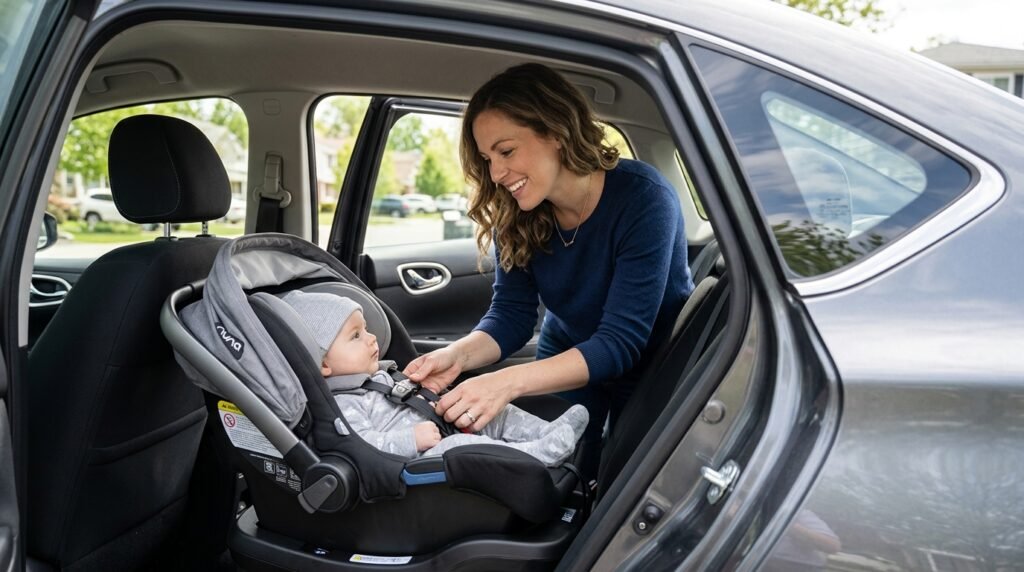
Can my 8-month-old sleep in their car seat on a road trip?
Yes, it is perfectly normal and safe for your baby to fall asleep while you are driving. However, you must still enforce the two-hour rule. If they have been sleeping in the seat for two hours, you must pull over, wake them up, and take them out for a break to protect their airway and spine.
What happens if I drive longer than two hours?
Pushing past the two-hour mark increases the risk of oxygen desaturation. Because infants cannot easily support their heavy heads, their chin may drop to their chest, quietly cutting off their air supply. It also places unhealthy stress on their developing spine.
Do travel system strollers count toward the two hours?
Yes. The two-hour limit applies to the total time spent in the curved car seat shell, regardless of whether the seat is clicked into a car base, a stroller, or sitting on the floor.
How can I keep my 8-month-old entertained safely?
Have a passenger sit in the back to read soft books, sing, or talk to the baby. Only provide soft, plush toys that do not have hard plastic parts. In a sudden stop, heavy toys can cause severe facial injuries.
Is it safe to feed my baby in the car seat while driving?
No. Feeding a baby a bottle or snacks while the vehicle is in motion is a major choking hazard. If the baby chokes, you cannot safely reach them or perform first aid while driving. Always pull over to feed your child.
Should my 8-month-old still be rear-facing?
Absolutely. All 8-month-old infants must be rear-facing. Automotive safety experts recommend keeping children rear-facing for as long as possible, ideally until they reach the maximum height or weight limit of their specific rear-facing seat.
Conclusion
Understanding how long can a 8 month old be in car seat is one of the most vital pieces of safety knowledge for parents hitting the road. By strictly enforcing the two-hour rule, you protect your baby from severe respiratory risks and ensure their spine develops naturally.
Taking road trips with an infant requires planning, frequent rest stops, and a vehicle that is in top mechanical condition. Make sure your car’s climate control, suspension, and seatbelts are working flawlessly before you buckle your baby in. Take the time to read both your vehicle’s owner manual and your car seat instructions carefully. Before your next big drive, double-check your seat installation, lock your seatbelts, and map out your rest stops to ensure a safe, comfortable ride for your whole family.
